
Bassaricyon
Bassaricyon, commonly known as olingos, are small arboreal mammals belonging to the procyonid family, native to the rainforests of Central and South America. They are nocturnal and share some morphological similarities with kinkajous, though they possess distinct features such as less specialized tails and different scent glands. Their evolutionary history is closely linked to coatis, with considerable diversification occurring in northwestern South America.
Key Facts
- ›Olingos are small, arboreal mammals found in the rainforests of Central and South America.
- ›They are nocturnal, meaning they are primarily active at night.
- ›Their closest relatives are coatis, with whom they diverged approximately 10.2 million years ago.
- ›There is ongoing debate among taxonomists regarding the exact number of olingo species, with proposals ranging from one to five.
- ›Olingos are often misidentified as kinkajous due to superficial similarities in appearance and habits.
- ›The genus Bassaricyon diversified starting around 3.5 million years ago, with early evolution occurring in northwestern South America.
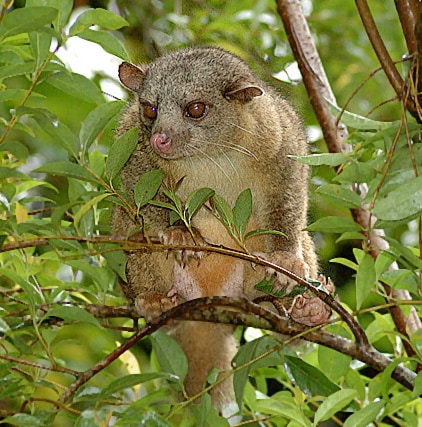
Olingo, Olingos
Central America, South America
Rainforest, Arboreal
Arboreal, Nocturnal
About Bassaricyon
Bassaricyon, commonly known as olingos, comprise a genus of small arboreal mammals native to the rainforests of Central and South America. These relatives of raccoons inhabit diverse elevations, from sea level up to 2,750 meters, and are primarily active during the night. While they bear a resemblance to kinkajous in their morphology and habits, olingos possess distinct characteristics, including the absence of prehensile tails and extrudable tongues, more elongated muzzles, and the presence of anal scent glands.
Taxonomy and Evolution
There is ongoing debate among taxonomists regarding the precise number of species within the Bassaricyon genus, with proposals ranging from a single species to as many as five. The recognition of new species, such as Bassaricyon neblina (the olinguito) discovered in 2013, has contributed to this discussion. Genetic studies have revealed that the closest living relatives of olingos are the coatis, with their lineages diverging approximately 10.2 million years ago. The diversification of the genus itself is estimated to have begun about 3.5 million years ago, with its early evolution likely occurring in northwestern South America following their migration from Central America during the Great American Interchange.
Distinguishing Features and Distribution
Olingos are distributed across the Neotropical region, with their range extending from Nicaragua southward to Peru. They are well-adapted to an arboreal lifestyle, spending most of their lives in trees. Despite their superficial similarities to kinkajous, the lack of a prehensile tail and specialized tongue are key distinguishing features. Olingos are notably rare in zoological collections and are often misidentified as kinkajous, highlighting the subtle but significant differences between these closely related procyonids.
Source: Wikipedia ↗
Frequently Asked Questions
What are olingos and where do they live?
Olingos (Bassaricyon) are small, arboreal mammals belonging to the procyonid family, closely related to raccoons. They are native to the rainforests of Central and South America, with their range extending from Nicaragua to Peru.
What makes olingos distinct from similar animals like kinkajous?
While olingos share some similarities with kinkajous, they lack prehensile tails and extrudable tongues. They also have more extended muzzles and possess anal scent glands, which distinguish them from kinkajous.
How many species of olingos are there?
The exact number of species within the genus Bassaricyon is a subject of taxonomic debate. Some classifications recognize as many as five species, while others suggest as few as one, with the recognition of B. neblina in 2013 adding to the complexity.
What is the evolutionary history of olingos?
Genetic studies indicate that olingos' closest relatives are coatis, with their lineage diverging around 10.2 million years ago. The diversification of the genus is thought to have begun in northwestern South America, shortly after their ancestors migrated from Central America.
Are olingos commonly found in zoos?
Olingos are described as quite rare in zoos. They are also frequently misidentified, often being mistaken for kinkajous by both the public and sometimes by zoo staff.
When did the olingo genus begin to diversify?
The diversification of the genus Bassaricyon appears to have started approximately 3.5 million years ago. The species B. neblina was the first to branch off, followed by the divergence of B. gabbii, and then the lowland species B. alleni and B. medius.
Related Mustelids, Otters & Raccoons
Bassariscus
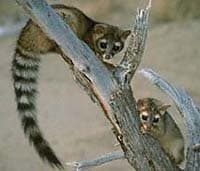
Bassariscus is a genus of two extant species, the ringtail and the cacomistle, belonging to the family Procyonidae. These animals are closely related to raccoons, diverging approximately 10 million years ago. Known for their semi-arid to tropical forest habitats, they are distinguished by a more digitigrade stance compared to other procyonids.
Conepatus
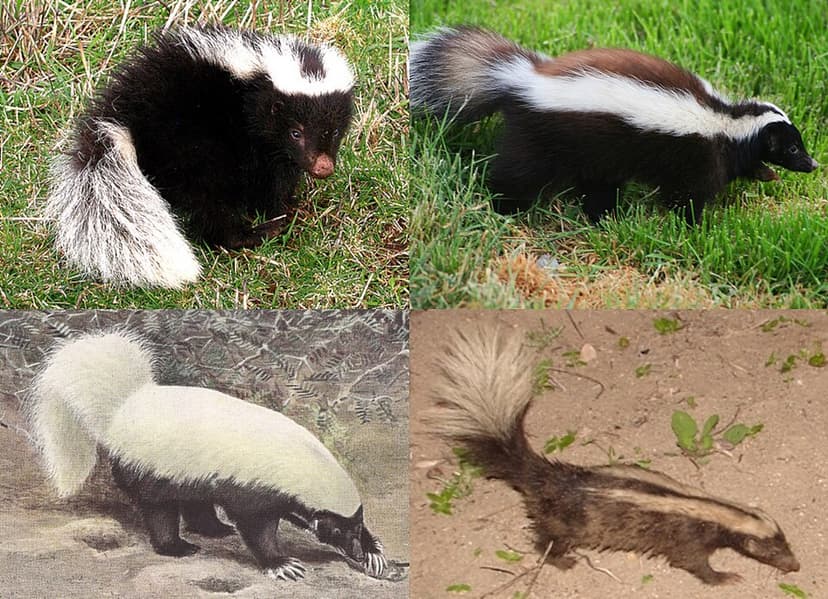
Conepatus, commonly known as hog-nosed skunks, are a genus of skunks native to the Americas. They are distinctive for their white backs and tails, black underparts, and a pig-like snout used for rooting in the earth. These nocturnal animals are primarily insectivorous and possess strong digging capabilities.