
Aphyllorchis
Aphyllorchis
Aphyllorchis is a genus of approximately twenty species of terrestrial, leafless orchids belonging to the Orchidaceae family. These orchids are characterized by fleshy, upright stems and resupinate flowers with narrow sepals and petals. They are native to a broad region stretching from India eastward to China and Japan, and southward to Indonesia, New Guinea, and Queensland, Australia.
Key Facts
- ›Aphyllorchis are leafless, terrestrial orchids.
- ›They are mycotrophic herbs, meaning they derive nutrients from fungi.
- ›Flowers are resupinate, typically cup-shaped with narrow sepals and petals.
- ›The genus name "Aphyllorchis" translates to "without leaves" and "orchid".
- ›Species are found in wet forests, often near streams, at low altitudes.
- ›The genus is distributed across a wide range from India to Australia.

Pauper Orchids, 無葉蘭屬, 无叶兰属
Terrestrial, Mycotrophic
About Aphyllorchis
Aphyllorchis, commonly known as pauper orchids or by its Chinese name 無葉蘭屬/无叶兰属 (wu ye lan shu), represents a genus of approximately twenty species within the Orchidaceae family. These orchids are distinct in that they are terrestrial and lack leaves, a characteristic reflected in their scientific name, which derives from the Ancient Greek words for "without leaves" and "orchid."
Description and Habitat
The plants in the Aphyllorchis genus are leafless, terrestrial herbs that are mycotrophic, meaning they obtain nutrients from symbiotic fungi in the soil. They feature fleshy, upright stems that can bear a few to many flowers. The flowers themselves are resupinate, typically presenting a cup-shaped form with narrow sepals and petals. A notable feature is the labellum, which is larger than the other floral segments and divided into an upper "epichile" and a lower "hypochile." These orchids are predominantly found in wet forests at low altitudes, frequently growing near streams.
Distribution
The geographical distribution of Aphyllorchis is extensive, spanning from India eastward to China and Japan, and southward to Indonesia, New Guinea, and Queensland, Australia. While the genus is widespread, certain species exhibit more localized ranges, with two species being endemic to tropical Queensland and one to China.
Source: Wikipedia ↗
Frequently Asked Questions
What are "pauper orchids"?
"Pauper orchids" is a common name for orchids in the genus Aphyllorchis. This name likely reflects their leafless nature and terrestrial growth habit, suggesting a simpler or less showy appearance compared to many other orchids.
What does the name "Aphyllorchis" mean?
The scientific name Aphyllorchis is derived from Ancient Greek words. "Aphyllos" means "without leaves," and "orchis" means "testicle" or "orchid."
Where are Aphyllorchis orchids found?
Aphyllorchis orchids are native to a wide geographical area that includes India, Sri Lanka, China, Japan, Taiwan, Thailand, Myanmar, Malaysia, the Philippines, Indonesia, New Guinea, and Australia (specifically Queensland).
What is the typical habitat of Aphyllorchis species?
Most Aphyllorchis species grow at low altitudes in wet forests. They are often found in close proximity to streams.
Are there any Aphyllorchis species endemic to specific regions?
Yes, the article notes that two species of Aphyllorchis are endemic to tropical Queensland in Australia, and one species is endemic to China.
Related Orchid species

Galeola
Galeola is a genus of myco-heterotrophic orchids found across Southeast Asia, Madagascar, and the Comoros. These orchids are of particular biological interest due to their parasitic nature, relying entirely on fungi for sustenance, and their exceptionally large, winged seeds, which are the biggest among all orchid seeds.
Cryptostylis
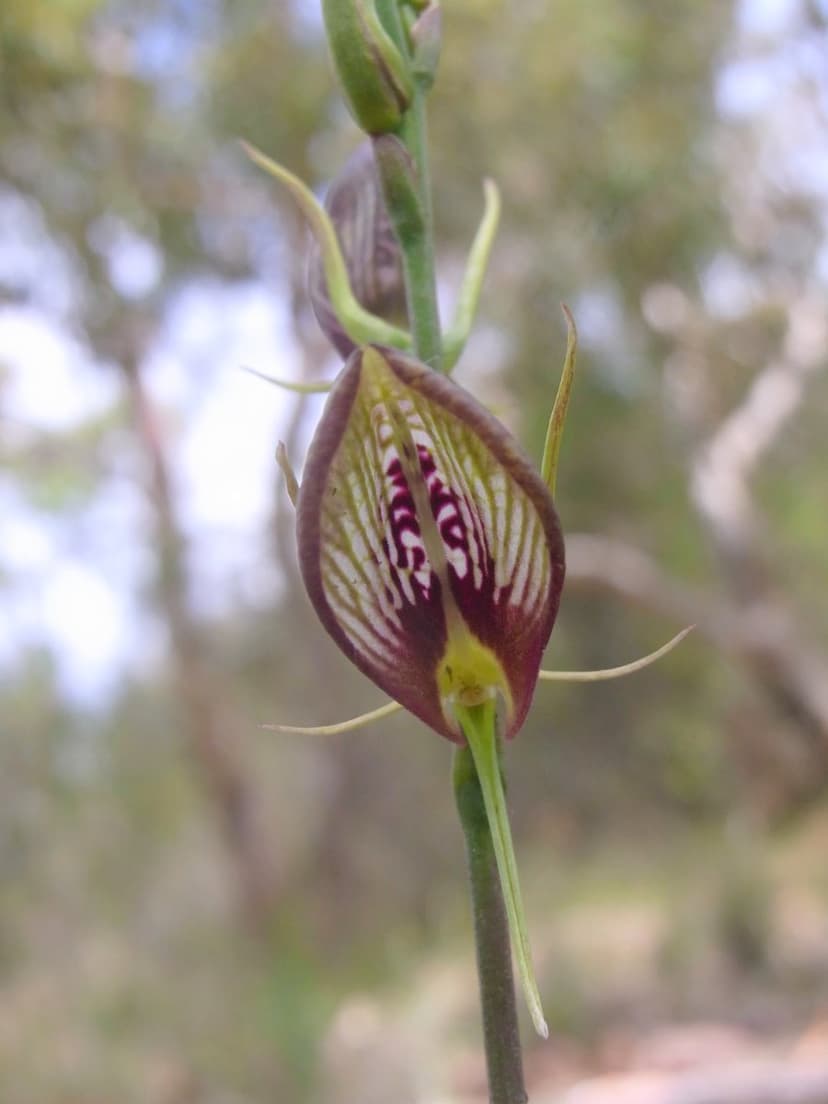
Cryptostylis, commonly known as tongue orchids, is a genus of terrestrial orchids found in South Asia, Southeast Asia, and the South Pacific. These orchids are distinguished by their prominent labellum, which is the most conspicuous part of the flower, and their unique pollination strategy involving wasps attempting to mate with the flowers. At least some species are pollinated through a process called pseudocopulation, where male wasps mistake the flower for a female wasp.

Arundina
Arundina graminifolia, commonly known as the bamboo orchid, is a terrestrial orchid species native to tropical Asia. It is distinguished by its reedy stems, grass-like leaves, and showy, lilac and white flowers with a purple lip. This species has also naturalized in various regions worldwide and holds medicinal value in traditional Chinese medicine.