
Caladenia
Caladenia
Caladenia, commonly known as spider orchids, is a diverse genus of terrestrial orchids with approximately 350 species, primarily found in Australia. These plants are characterized by a single hairy leaf and stem, with a distinctive labellum often fringed or toothed and adorned with calli, which are adaptations to attract specific insect pollinators. The genus is broadly categorized into spider orchids, zebra orchids, and cowslip orchids, with a significant concentration of species in Western Australia.
Key Facts
- ›Caladenia is a genus of terrestrial orchids comprising around 350 species.
- ›Most species are native to Australia, with 136 species found in Western Australia.
- ›The genus is divided into three informal groups: spider orchids, zebra orchids, and cowslip orchids.
- ›Flowers feature a labellum with calli, designed to attract specific insect pollinators, often mimicking female insects.
- ›Cultivation can be challenging, requiring the symbiotic fungus necessary for the orchid's survival and careful fertilization.
- ›The tubers of some Caladenia species are recorded as edible.
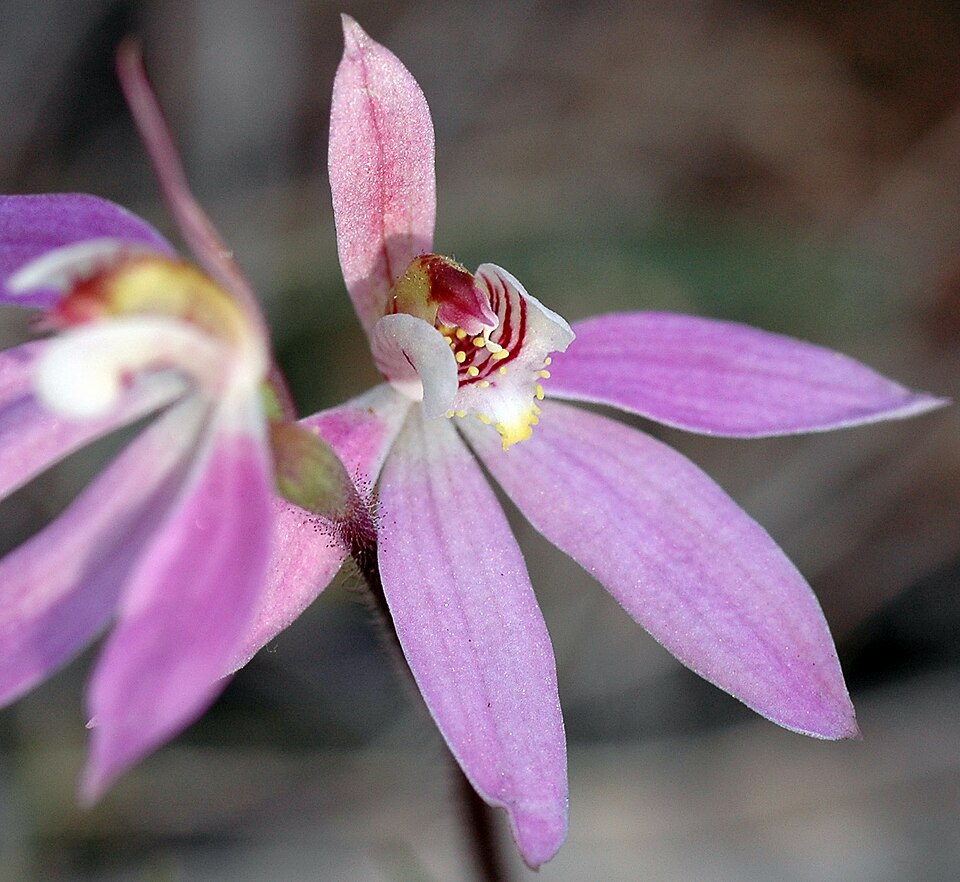
Spider Orchids, Zebra Orchids, Cowslip Orchids
Terrestrial
Early Spring
Insects, Bees, Wasps
About Caladenia
Caladenia, commonly known as spider orchids, is a significant genus within the Orchidaceae family, encompassing approximately 350 species. These terrestrial herbs are predominantly found in Australia, with a remarkable concentration of 136 species in Western Australia, making it the most species-rich orchid genus in that state.
Description and Characteristics
Plants in the genus Caladenia are perennial, deciduous, and sympodial herbs that grow from a tuber. They possess a single, hairy, convolute leaf at the base of the plant, with most species exhibiting an enlarged cell at the base of each hair. The leaves are simple, typically medium to large, and can be fleshy or leathery with a lance-shaped to oblong form.
The inflorescence is a raceme bearing one to eight resupinate flowers. The sepals and petals are free and similar in size and shape. A key feature is the highly modified central petal, the labellum, which is usually divided into three parts with fringed or dentate margins. This labellum often bears stalked or button-like calli, frequently arranged in rows, which play a crucial role in pollination.
Taxonomy and Naming
The genus was first formally described by Robert Brown in 1810. The name Caladenia originates from the Ancient Greek words 'kalos' (beautiful) and 'aden' (a gland), a reference to the orchid's attractive labellum. Taxonomic interpretations have varied over time, with recent molecular phylogenetic studies influencing the inclusion of species previously classified under genera like Glossodia, Elythranthera, and Cyanicula.
Caladenia species are often informally grouped based on their flower morphology: those with long, narrow sepals and petals (e.g., white spider orchid); those with short sepals and petals that hang near the stem (e.g., zebra orchid); and a third group with short, spreading sepals and petals (e.g., cowslip orchid).
Distribution and Habitat
While most Caladenia are endemic to Australia, eleven species are found in New Zealand, with one also occurring in Australia. Caladenia catenata and C. carnea are found in New Caledonia, and C. carnea also extends to Indonesia. In Western Australia, the genus is distributed across the southwestern region, from north of Kalbarri to the Nuytsland Nature Reserve. Their habitats are diverse, ranging from cool, moist karri forests to coastal swamplands and arid mallee woodlands.
Ecology and Pollination
Caladenia orchids are primarily pollinated by insects, with bees and wasps being common visitors. Some species have evolved remarkable mimicry strategies, attracting male wasps by resembling flightless female wasps in scent, shape, and coloration. For instance, C. lobata attracts male Thynnoides bidens wasps. The weight of the insect landing on the labellum causes it to tip, guiding the wasp into contact with the column to facilitate pollination. Other species may attract pollinators by mimicking food sources, as seen with C. patersonii, which has a fermented odor and attracts various insect species.
Horticulture
Cultivating Caladenia orchids presents significant challenges. Enthusiasts have reported limited success by carefully managing the symbiotic fungus required by the orchid and employing precise fertilization techniques to maintain the delicate balance between the fungus and the plant. Historical records, such as the 1889 book 'The Useful Native Plants of Australia,' note that the tubers of some Caladenia species are edible.
Source: Wikipedia ↗
Frequently Asked Questions
What are spider orchids?
Caladenia, commonly known as spider orchids, is a genus of terrestrial herbs in the orchid family. They are known for their single hairy leaf, hairy stem, and a labellum with fringed or toothed margins and small projections called calli.
Where are Caladenia orchids found?
The vast majority of Caladenia species are endemic to Australia, particularly in the southwestern region of Western Australia. Some species also occur in New Zealand, New Caledonia, and Indonesia.
How do Caladenia orchids attract pollinators?
Caladenia flowers have adaptations to attract specific insects, often bees or wasps, for pollination. Some species mimic the scent, shape, and color of flightless female wasps to attract male wasps.
Are Caladenia orchids easy to grow?
Caladenia orchids have generally proven difficult to cultivate. Success often requires the presence of their symbiotic fungus and careful management of fertilizer to maintain a balance between the fungus and the orchid.
What is the origin of the name Caladenia?
The genus name Caladenia is derived from the Ancient Greek words 'kalos' meaning 'beautiful' and 'aden' meaning 'a gland,' referring to the colorful labellum.
What are the different groups of Caladenia orchids?
Caladenia orchids are informally grouped based on their flower shape. These include spider orchids with long narrow sepals and petals, zebra orchids with short sepals and petals that hang near the stem, and cowslip orchids with short, spreading sepals and petals.
Related Orchid species

Corybas
Corybas, commonly known as helmet orchids, is a genus of about 120 species of small, perennial, terrestrial herbs in the orchid family. Native to a wide range including Australia, New Zealand, Southeast Asia, and the Himalayas, these orchids are distinctive for their single, fungus-like flower, dominated by a large dorsal sepal and labellum, often resembling a helmet.
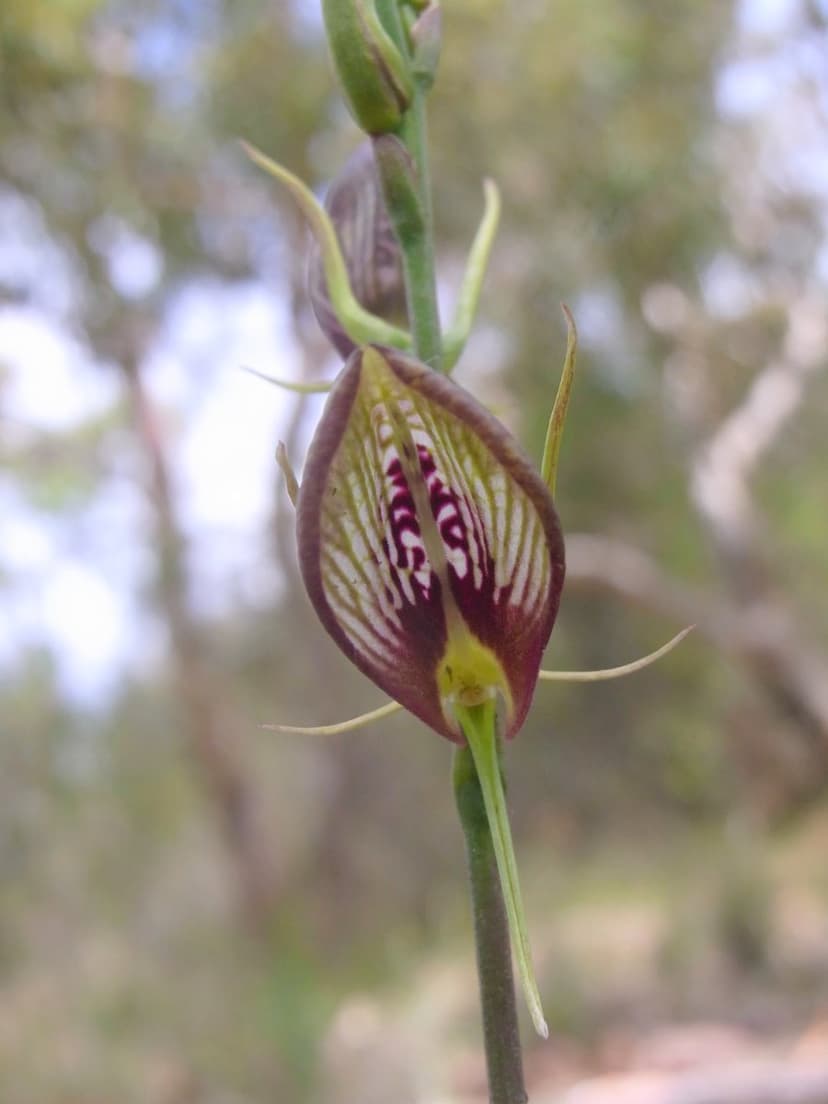
Cryptostylis
Cryptostylis, commonly known as tongue orchids, is a genus of terrestrial orchids found in South Asia, Southeast Asia, and the South Pacific. These orchids are distinguished by their prominent labellum, which is the most conspicuous part of the flower, and their unique pollination strategy involving wasps attempting to mate with the flowers. At least some species are pollinated through a process called pseudocopulation, where male wasps mistake the flower for a female wasp.

Calochilus
Calochilus, commonly known as beard orchids, is a genus of approximately 30 terrestrial orchid species belonging to the family Orchidaceae. These orchids are distinctive for their densely hairy labellum, which gives them their common name. Primarily found in Australia, with some species extending to New Zealand, New Guinea, and New Caledonia, they are terrestrial herbs that typically have a single leaf or are leafless, and reproduce through self-pollination if cross-pollination fails.