
Corymborkis
Corymborkis
Corymborkis is a genus of terrestrial orchids found across tropical regions worldwide. These evergreen plants are known for their leafy stems, pleated leaves, and widely-opening flowers, which are typically greenish-white and arranged in crowded clusters. The genus name itself reflects the characteristic bunched arrangement of their blooms.
Key Facts
- ›Corymborkis species are terrestrial orchids, meaning they grow in soil.
- ›They are evergreen plants that often grow in clumps.
- ›Their flowers are typically greenish-white with thin, spreading sepals and petals.
- ›The genus is widely distributed throughout the tropics of Africa, Asia, Australia, and the Americas.
- ›They commonly inhabit moist, shady environments within rainforests.
- ›The name Corymborkis derives from Greek words meaning 'bunch of flowers' and 'orchid'.

Cinnamon Orchids, 管花兰属
Terrestrial
About Corymborkis
Corymborkis is a genus of terrestrial orchids recognized for their evergreen nature and distinctive growth habits. These plants are found across a wide range of tropical environments, thriving in moist, shady conditions typical of rainforests. The genus name, derived from Greek, aptly describes the characteristic clustered arrangement of their flowers.
Description and Characteristics
Orchids in the Corymborkis genus are evergreen herbs that typically grow in clumps. They possess short rhizomes and thin, wiry stems, from which one or more unbranched stems emerge. These stems bear numerous papery, pleated leaves, often egg-shaped to elliptic, concentrated in the upper half of the plant. A branching flowering stem develops from the upper leaf axils, bearing crowded, widely-opening flowers. The flowers themselves are generally greenish-white, featuring thin, spreading sepals and petals that are quite similar in appearance, with the petals being slightly wider. The labellum is approximately the same length as the sepals, closely encircling the column, and is characterized by a tube-like base and two longitudinal ridges.
Taxonomy and Naming
The genus Corymborkis was first formally described in 1809 by Louis-Marie Aubert du Petit-Thouars. The name "Corymborkis" is a combination of two Ancient Greek words: "korymbos," meaning "bunch of flowers or fruit," and "orchis," which translates to "testicle" or "orchid." This etymology directly refers to the distinctive bunched arrangement of the flowers found in this genus.
Distribution and Habitat
Corymborkis orchids are widely distributed throughout the tropical world. Their natural range includes tropical Africa, India, Sri Lanka, Thailand, Malaysia, the Philippines, Indonesia, New Guinea, and Australia, with occurrences noted on Christmas Island. They are commonly found growing in moist, shady locations within rainforest habitats, where they often form dense clumps.
Source: Wikipedia ↗
Frequently Asked Questions
What are the common names for the Corymborkis genus?
The Corymborkis genus is commonly known as cinnamon orchids. In Chinese, it is referred to as 'guan hua lan shu'.
Where are Corymborkis orchids found naturally?
These orchids have a wide distribution throughout the tropics. They can be found in regions of tropical Africa, India, Sri Lanka, Southeast Asia, New Guinea, Australia, and the Americas.
What kind of habitat do Corymborkis orchids prefer?
Corymborkis orchids typically grow in moist, shady locations within rainforest environments. They are terrestrial plants, often found growing in clumps.
What do Corymborkis flowers look like?
The flowers of Corymborkis are usually greenish-white and feature thin, spreading sepals and petals that are similar in appearance. The labellum is about as long as the sepals and encircles the column, possessing a tube-like base and two longitudinal ridges.
What is the origin of the name Corymborkis?
The scientific name Corymborkis originates from Ancient Greek. 'Korymbos' means 'bunch of flowers or fruit,' and 'orchis' means 'testicle' or 'orchid,' referring to the characteristic clustered arrangement of the flowers.
Related Orchid species

Didymoplexis
Didymoplexis, commonly known as crystal orchids, is a genus of about twenty described species of leafless, terrestrial orchids. These orchids are characterized by their swollen, fleshy rhizomes and delicate, upright flowering stems bearing resupinate, bell-shaped flowers that are typically white or pale yellowish-brown and short-lived. They are found across a wide geographic range, including Africa, Madagascar, Southeast Asia, Australia, and various Pacific islands.

Brassavola
Brassavola is a genus of 21 orchid species, named in honor of Antonio Musa Brassavola, an Italian nobleman and physician. These orchids are widespread across Mexico, Central America, the West Indies, and South America, distinguished by their succulent leaves and fragrant, nocturnal blooms. They are primarily epiphytic, with a few also growing as lithophytes.
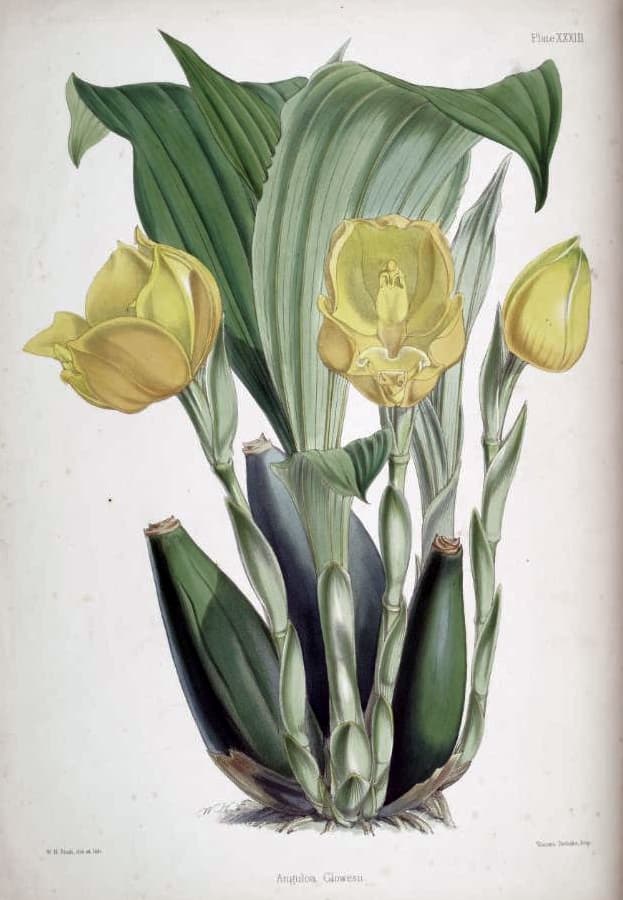
Anguloa
Anguloa, commonly known as tulip orchids, is a genus of about 13 species closely related to Lycaste. Native to the forest floor at high elevations in South America, these terrestrial orchids are distinctive for their large, waxy flowers resembling tulips and their unique pollination mechanism involving a rocking lip. They are also known for their strong cinnamon fragrance.