
Didymoplexis
Didymoplexis
Didymoplexis, commonly known as crystal orchids, is a genus of about twenty described species of leafless, terrestrial orchids. These orchids are characterized by their swollen, fleshy rhizomes and delicate, upright flowering stems bearing resupinate, bell-shaped flowers that are typically white or pale yellowish-brown and short-lived. They are found across a wide geographic range, including Africa, Madagascar, Southeast Asia, Australia, and various Pacific islands.
Key Facts
- ›Terrestrial, leafless orchids with swollen, fleshy rhizomes.
- ›Flowering stems are thin, upright, and fleshy, bearing few scale-like bracts.
- ›Flowers are resupinate, bell-shaped, and typically white or pale yellowish-brown.
- ›Bloom duration is often less than a day.
- ›Found in diverse habitats from grassy forests to rainforests.
- ›Native to Africa, Madagascar, Southeast Asia, Australia, and Pacific islands.

Crystal Orchids, Crystal Bells
Africa, Madagascar, Southeast Asia, Australia, Pacific Islands, India, China, Indochina, Japan, Philippines, Malay Archipelago, New Guinea, Christmas Island, South West Africa
Terrestrial, Mycotrophic
White, Pale Yellowish Brown
About Didymoplexis
What is Didymoplexis?
Didymoplexis, commonly referred to as crystal orchids, constitutes a genus of approximately twenty described species of leafless, terrestrial orchids. These plants are recognized for their unique subterranean structures and ephemeral floral displays.
Description and Characteristics
Orchids within the genus Didymoplexis are characterized by their terrestrial, mycotrophic nature, meaning they lack leaves and derive nutrients from fungi in the soil. They possess swollen, fleshy rhizomes from which thin, pale, upright, and fleshy flowering stems emerge. These stems bear a few scale-like bracts and one to a few flowers. The flowers themselves are resupinate, meaning they twist during development to present a downward-facing orientation. They are typically white or pale yellowish-brown and have a distinct bell shape, formed by the sepals and petals joining at the base, with widely spreading tips. A notable feature is the labellum, which is relatively broad and features a band of calli along its midline. The flowers are ephemeral, often lasting for less than a day.
Taxonomy and Naming
The genus Didymoplexis was formally described in 1843 by William Griffith. The scientific name, Didymoplexis, is derived from the Ancient Greek words 'didymos', meaning "double" or "twin," and 'plexis', meaning "twine," "twist," or "weave." This nomenclature likely refers to the interlocking calli observed on the orchid's labellum.
Distribution and Habitat
Crystal orchids exhibit a broad geographic distribution. They are found in various regions including India, southern China, Indochina, extending to southern Japan and the Philippines. Their range continues throughout the Malay Archipelago to New Guinea, Christmas Island, tropical Australia, and the southwest Pacific islands. Additionally, some species occur in South West Africa and Madagascar. These orchids typically inhabit grassy forests, bamboo thickets, and rainforest environments.
Source: Wikipedia ↗
Frequently Asked Questions
What are crystal orchids?
Crystal orchids belong to the genus Didymoplexis, which are leafless, terrestrial orchids. They are known for their distinctive swollen, fleshy rhizomes and delicate, short-lived flowers.
What do Didymoplexis flowers look like?
The flowers of Didymoplexis are resupinate and bell-shaped, with sepals and petals joined at the base. They are typically white or pale yellowish-brown and often last for less than a day.
Where are crystal orchids found?
Crystal orchids are distributed across a wide range, including India, southern China, Indochina, southern Japan, the Philippines, the Malay Archipelago, New Guinea, Christmas Island, tropical Australia, the southwest Pacific islands, South West Africa, and Madagascar.
What is the habitat of Didymoplexis?
Didymoplexis orchids grow in various habitats such as grassy forests, bamboo thickets, and rainforests.
What does the name Didymoplexis mean?
The genus name Didymoplexis is derived from Ancient Greek words: 'didymos' meaning 'double' or 'twin', and 'plexis' meaning 'twine', 'twist', or 'weave'. This refers to the interlocking calli found on the labellum of the flowers.
Related Orchid species

Corymborkis
Corymborkis is a genus of terrestrial orchids found across tropical regions worldwide. These evergreen plants are known for their leafy stems, pleated leaves, and widely-opening flowers, which are typically greenish-white and arranged in crowded clusters. The genus name itself reflects the characteristic bunched arrangement of their blooms.
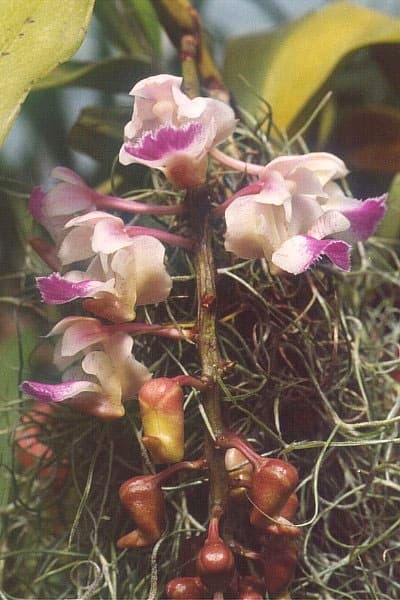
Aerides
Aerides, commonly known as cat's-tail orchids and fox brush orchids, is a genus of tropical epiphytic orchids native to Asia. These orchids are highly valued in horticulture for their showy, fragrant, and long-lasting flowers, which typically appear in racemes and are often white with colorful edges.
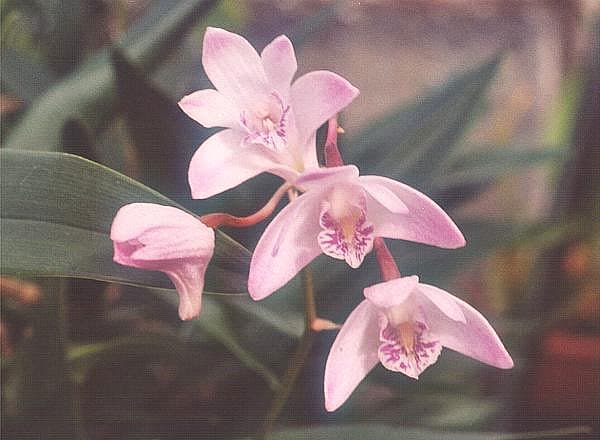
Dendrobium
Dendrobium is a vast genus of orchids, predominantly epiphytic or lithophytic, found across Asia and the Pacific. These orchids are characterized by their creeping roots and unique flower arrangements, often featuring contrasting labellums and a central callus. Many species are cultivated for their horticultural value and some are recognized for their air-purifying qualities and medicinal properties.