
Danhatchia
Danhatchia
Danhatchia is a genus of mycoheterotrophic terrestrial orchids, meaning they lack chlorophyll and obtain nutrients from fungi in the soil. Three species are currently known, with Danhatchia australis found in New Zealand and Australia, while Danhatchia copelandii and Danhatchia novaehollandiae are endemic to New South Wales, Australia.
Key Facts
- ›A genus of terrestrial orchids that are mycoheterotrophic.
- ›They lack chlorophyll and rely on symbiotic fungi in the soil for nutrition.
- ›Three species are recognized within the genus: Danhatchia australis, Danhatchia copelandii, and Danhatchia novaehollandiae.
- ›Danhatchia australis is found in New Zealand and New South Wales, Australia.
- ›Danhatchia copelandii and Danhatchia novaehollandiae are native to New South Wales, Australia.

Terrestrial
About Danhatchia
Danhatchia is a genus of terrestrial orchids distinguished by their mycoheterotrophic nature. Unlike most plants, these orchids lack chlorophyll and are therefore unable to photosynthesize. Instead, they obtain all their essential nutrients by forming symbiotic relationships with fungi present in the soil.
Species and Distribution
Three species are currently recognized within the Danhatchia genus. Danhatchia australis has a broader distribution, being found in both the North and South Islands of New Zealand, as well as in New South Wales, Australia. The remaining two species, Danhatchia copelandii and Danhatchia novaehollandiae, are endemic to New South Wales in Australia.
Mycoheterotrophy
The defining characteristic of Danhatchia orchids is their reliance on mycoheterotrophy. This specialized mode of nutrition involves a parasitic or symbiotic association with fungi. The fungi, in turn, often connect to the roots of photosynthetic trees or shrubs, effectively allowing the orchid to indirectly benefit from the photosynthetic activity of other plants.
Source: Wikipedia ↗
Frequently Asked Questions
What is a Danhatchia orchid?
Danhatchia is a genus of terrestrial orchids that are mycoheterotrophic. This means they do not produce their own food through photosynthesis as they lack chlorophyll, instead obtaining nutrients from fungi in the soil.
Where are Danhatchia orchids found?
The genus Danhatchia has a distribution across New Zealand and Australia. Specifically, Danhatchia australis is found in both the North and South Islands of New Zealand, as well as in New South Wales, Australia. The other two species, Danhatchia copelandii and Danhatchia novaehollandiae, are native exclusively to New South Wales.
How do Danhatchia orchids get their nutrients?
Danhatchia orchids are mycoheterotrophic, a unique adaptation where they lack chlorophyll and are unable to photosynthesize. Instead, they form symbiotic relationships with specific fungi in the soil, deriving all their necessary nutrients from these fungal partners.
How many species are in the Danhatchia genus?
Currently, three species are recognized within the Danhatchia genus. These are Danhatchia australis, Danhatchia copelandii, and Danhatchia novaehollandiae.
Related Orchid species

Calochilus
Calochilus, commonly known as beard orchids, is a genus of approximately 30 terrestrial orchid species belonging to the family Orchidaceae. These orchids are distinctive for their densely hairy labellum, which gives them their common name. Primarily found in Australia, with some species extending to New Zealand, New Guinea, and New Caledonia, they are terrestrial herbs that typically have a single leaf or are leafless, and reproduce through self-pollination if cross-pollination fails.

Corybas
Corybas, commonly known as helmet orchids, is a genus of about 120 species of small, perennial, terrestrial herbs in the orchid family. Native to a wide range including Australia, New Zealand, Southeast Asia, and the Himalayas, these orchids are distinctive for their single, fungus-like flower, dominated by a large dorsal sepal and labellum, often resembling a helmet.
Cryptostylis
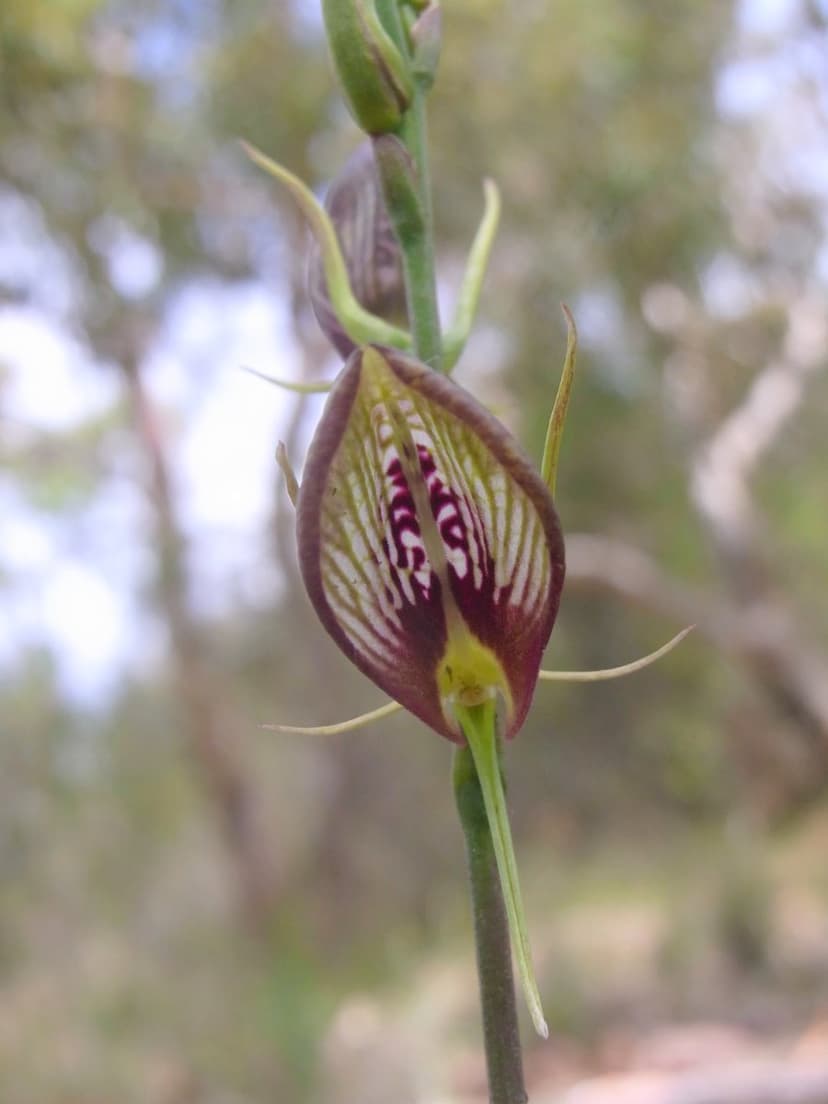
Cryptostylis, commonly known as tongue orchids, is a genus of terrestrial orchids found in South Asia, Southeast Asia, and the South Pacific. These orchids are distinguished by their prominent labellum, which is the most conspicuous part of the flower, and their unique pollination strategy involving wasps attempting to mate with the flowers. At least some species are pollinated through a process called pseudocopulation, where male wasps mistake the flower for a female wasp.