
Eulophia
Eulophia
Eulophia, commonly known as corduroy orchids, is a genus of approximately two hundred flowering plant species within the orchid family, Orchidaceae. Primarily found in Africa and Asia, these orchids typically inhabit shady forest floors, open scrub, or woodlands, often adapting to dry seasons with underground storage organs. While most species are terrestrial, a few have evolved to thrive in arid environments.
Key Facts
- ›Eulophia is a genus of about 200 species in the Orchidaceae family.
- ›Most species are terrestrial, with some adapted to arid conditions.
- ›They are widely distributed, with the majority found in Africa and Asia.
- ›Flowers typically have sepals larger than petals and a three-lobed labellum with a spur.
- ›Many species can survive dry periods due to underground rhizomes or pseudobulbs.
- ›The genus name 'Eulophia' derives from Greek words meaning 'good crest' or 'good ridge'.

Corduroy Orchids
Terrestrial, Epiphytic
Cactus/Succulent Potting Mix, Pure White Sand
About Eulophia
Eulophia, commonly referred to as corduroy orchids, represents a diverse genus comprising approximately two hundred species within the Orchidaceae family. These plants are primarily found in the tropical and subtropical regions of Africa and Asia, though their distribution extends to the Americas, India, and Queensland. Most Eulophia species are terrestrial in nature, often inhabiting shady forest floors, open scrublands, or woodlands.
Description and Habitat
Species within the Eulophia genus are typically terrestrial herbs characterized by either underground rhizomes or pseudobulbs that sit on the surface. Leaves, when present, are generally long and narrow, sometimes exhibiting a pleated appearance. The flowers are borne on a slender flowering spike, which may appear before the leaves in some species. The flowers themselves often feature sepals that are larger than the petals, and a distinctive three-lobed labellum equipped with a spur or pouch at its base. While the majority of Eulophia are terrestrial, two species found on Madagascar are epiphytic, growing on other plants.
Adaptation and Distribution
Many Eulophia orchids possess a remarkable ability to survive dry seasons, owing to their substantial, bulbous underground structures like corms or rhizomes that store water and nutrients. This adaptation allows some species to colonize challenging environments. Notably, certain species, such as Eulophia petersii, have evolved to inhabit extremely arid conditions, making them among the few orchids that can truly live in desert landscapes.
Horticultural Use
In frost-free, semi-arid regions like Southern California, several Eulophia species, including E. macra, E. petersii, E. plantaginea, and E. speciosa, can be cultivated outdoors year-round. They thrive in well-drained pots using a cactus or succulent potting mix, though E. speciosa specifically prefers pure white sand. These plants require ample light during winter and a dry resting period. Warmer-growing varieties, such as E. pulchra and potentially the rare E. cucullata, may also be grown outdoors in warmer parts of Florida and Hawaii. The generally large, fleshy underground rhizome indicates a sympodial growth habit, which facilitates division and propagation with careful handling.
Source: Wikipedia ↗
Frequently Asked Questions
What are Eulophia orchids commonly called?
Eulophia orchids are commonly known as corduroy orchids. This name likely refers to the appearance of their leaves or perhaps the texture of their floral parts.
Where are Eulophia orchids found naturally?
The genus Eulophia is widely distributed across tropical and subtropical regions. While species are found in the Americas, India, Asia, and Queensland, the greatest concentration of Eulophia species occurs in Africa.
What are the typical habitats for Eulophia orchids?
Eulophia orchids generally grow in shady locations within forests, often found amongst grass or shrubs. They can also be found in open scrub or woodland environments.
How do Eulophia orchids survive dry seasons?
Many Eulophia species have adapted to survive dry periods by utilizing large, bulbous underground structures such as rhizomes or pseudobulbs, which store water and nutrients.
Are there any Eulophia species that live in deserts?
Yes, some Eulophia species, like Eulophia petersii, have evolved to thrive in very arid environments, making them among the few orchids capable of true desert living.
What is the meaning of the name 'Eulophia'?
The name 'Eulophia' is derived from Ancient Greek words: 'eu' meaning 'good,' 'well,' or 'true,' and 'lophos' meaning 'mane,' 'crest,' 'comb,' 'tuft,' or 'ridge.' This name may allude to the callus on the labellum of some species.
Related Orchid species

Liparis
Liparis, commonly known as widelip orchids or sphinx orchids, is a widespread genus of over 350 orchid species found on every continent except Antarctica. These plants exhibit diverse growth habits, being terrestrial, lithophytic, or epiphytic, and are characterized by their small to medium-sized, often dull-colored flowers with a distinctive, usually larger labellum.
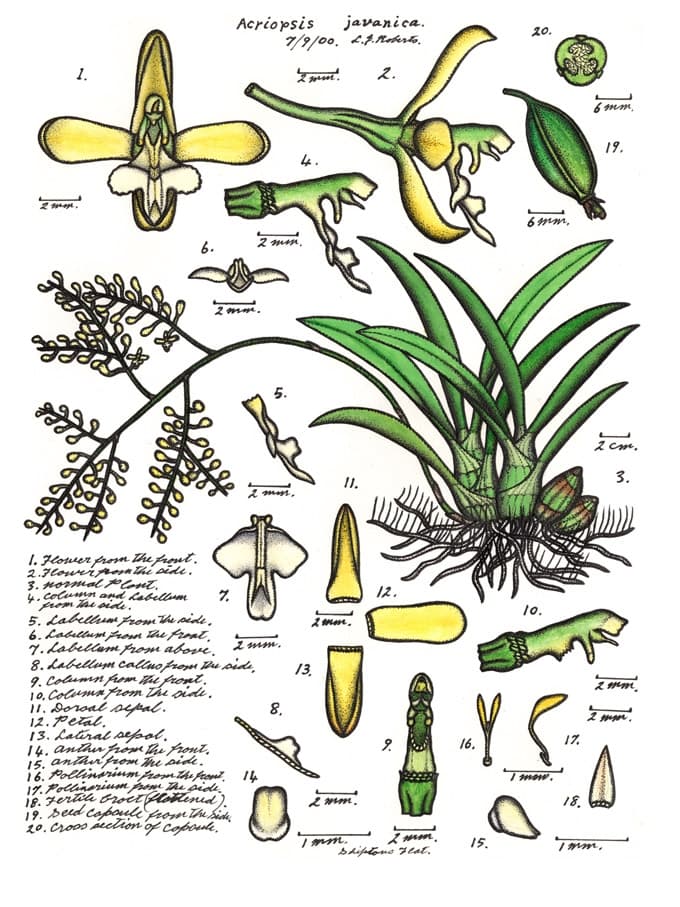
Acriopsis
Acriopsis, commonly known as chandelier orchids or 合萼兰属 (he e lan shu), is a genus of epiphytic herbs in the Orchidaceae family. Native to regions spanning India, Southeast Asia, New Guinea, and Australia, these orchids are distinguished by their many small, non-resupinate flowers with unique column projections and a grasshopper-like appearance.

Geodorum
Geodorum is a genus of eight deciduous, terrestrial orchid species found across southern Japan, tropical Asia, Australia, and the southwest Pacific islands. These orchids are distinguished by their underground pseudobulbs, broad pleated leaves, and small to medium-sized, bell-shaped or tube-shaped flowers that hang downwards on a drooping flowering stem.