
Barred owl
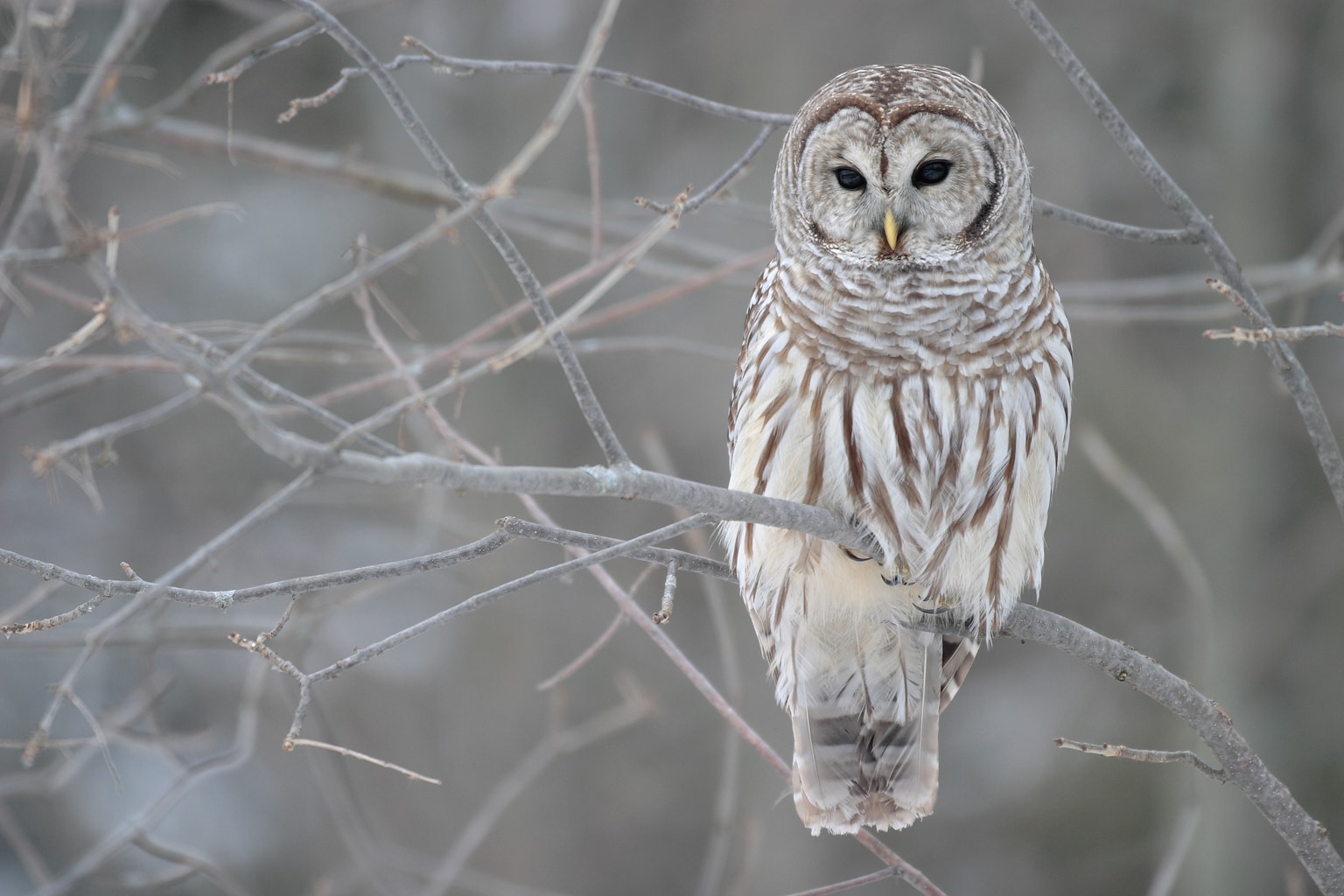
The barred owl (Strix varia) is a large North American owl known for its distinctive "Who cooks for you, who cooks for you all" call. Primarily found in mature forests and woodlands in eastern North America, it has expanded its range westward, where it is considered an invasive species. This owl is characterized by its brown to gray plumage with dark striping on its underside and its large, rounded head without ear tufts.
Key Facts
- ›Native to eastern North America, with a significant westward range expansion.
- ›Prefers mature forests and woodlands, often near water sources.
- ›Diet primarily consists of small mammals, but is an opportunistic predator of other small vertebrates and invertebrates.
- ›Easily identified by its distinctive "who cooks for you, who cooks for you all" vocalization.
- ›Females are larger than males, a trait known as reverse sexual dimorphism.
- ›Considered an invasive species on the west coast, impacting native spotted owls.
Northern Barred Owl, Striped Owl, Hoot Owl, Eight-Hooter Owl, Old Eight-Hooter
Mature Forests, Old Deciduous Forests, Mixed Forests, Coniferous Forests, Open Woodlands, Bottomland Hardwood Forests, Oak Savanna, Cabbage-Palm Areas, Riparian Areas, Swampy Ground, Wooded Areas In Mountainous Regions, Mixed Swamps
North America, Eastern United States, Southern Canada, Mexico
Small Mammals, Birds, Reptiles, Amphibians, Invertebrates
Avian Predators
About Barred owl
The barred owl (Strix varia), also known as the northern barred owl or striped owl, is a large species of owl native to North America. It belongs to the true owl family, Strigidae, and is part of the genus Strix. These owls are predominantly found in mature forests and woodlands, particularly in eastern North America, though they have expanded their range westward and are now considered an invasive species along the west coast.
Description and Characteristics
Barred owls are characterized by their brown to gray plumage, with distinctive dark striping on their underside. They possess a large, rounded head without ear tufts and dark brown eyes. Their distinctive call, often described as "Who cooks for you, who cooks for you all," is a key identifying feature and can carry long distances. The barred owl is an opportunistic predator, with its diet mainly comprising small mammals, but also including other small vertebrates and invertebrates. Females are typically larger than males, exhibiting reverse sexual dimorphism.
Habitat and Range
The preferred habitat of the barred owl includes old deciduous, mixed, and sometimes coniferous forests. They are often found in bottomland hardwood forests, riparian areas, and swampy grounds. Their native range is primarily the eastern United States and southern Canada. However, due to increased forestation in areas like the Great Plains, they have successfully expanded their territory westward, reaching as far as California, British Columbia, and southeastern Alaska.
Conservation and Impact
The westward expansion of the barred owl has led to significant ecological concern, particularly regarding its impact on the related and threatened spotted owl. Evidence suggests that the presence of the invasive barred owl poses substantial threats to spotted owl populations, leading biologists to recommend management strategies such as culling operations to mitigate these negative effects.
Vocalizations
The barred owl is known for its loud and varied vocalizations. The most recognized call is a series of eight hoots, often mimicked as "Who cooks for you, who cooks for you all." They also produce an "ascending type" call and a "mumble." When agitated, they may hiss, click their beaks, or emit "cat-like screams" and "prolonged outbursts of cackling." Peak vocalization periods typically occur between late January and early April, with the most frequent calls heard between dusk and dawn.
Source: Wikipedia ↗
Frequently Asked Questions
What does a barred owl sound like?
The barred owl is a powerful vocalist, famous for its "Who cooks for you, who cooks for you all" call, which consists of eight accented hoots with a downward pitch at the end. They also have other calls, including an "ascending type" or "legato" call and a "mumble" call. When agitated, they can produce a buzzy hiss and beak clicks.
Where do barred owls live?
Barred owls are primarily found in eastern North America, inhabiting mature deciduous and mixed forests, as well as open woodlands. They have also expanded their range westward into areas like British Columbia, Washington, Oregon, and California, where they are considered invasive.
What do barred owls eat?
Their diet mainly consists of small mammals. However, barred owls are opportunistic predators and will also prey on other small vertebrates like birds, reptiles, and amphibians, as well as a variety of invertebrates.
What is the difference between a barred owl and a spotted owl?
The barred owl and the spotted owl are related and have been hypothesized to be within a superspecies. However, genetic testing shows they diverged very early. Barred owls are expanding into the range of the threatened spotted owl, posing a threat to its population.
Are barred owls active at night?
Barred owls are primarily nocturnal, with their peak vocalization times occurring between 6:00 pm and 6:00 am. While they do call during the day, especially when provoked, their most active hunting and calling periods are after dusk and before dawn.
Related Owl species

African scops owl
The African scops owl (Otus senegalensis) is a small owl native to sub-Saharan Africa, characterized by its cryptic greyish-brown plumage and bright yellow eyes. It is a strictly nocturnal hunter, often overlooked during the day due to its remarkable camouflage. Its distinctive call is a monotonous "prrrp" sound.

Eastern screech owl
The eastern screech owl is a stocky, short-tailed owl native to Eastern North America, found from Mexico to Canada. It is a midsized screech owl, adaptable to various woodland habitats and even urban environments, though its strictly nocturnal habits often make it elusive. Distinctive features include prominent ear tufts, yellow eyes, and a unique tremolo call.

Eurasian scops owl
The Eurasian scops owl (Otus scops) is a small owl native to southern Europe and extending eastwards into Siberia and the Himalayas. This migratory species is distinctive for its small size, ear tufts, and a call resembling that of midwife toads. It primarily inhabits open woodlands and can be found wintering in sub-Saharan Africa.