
Eastern screech owl
The eastern screech owl is a stocky, short-tailed owl native to Eastern North America, found from Mexico to Canada. It is a midsized screech owl, adaptable to various woodland habitats and even urban environments, though its strictly nocturnal habits often make it elusive. Distinctive features include prominent ear tufts, yellow eyes, and a unique tremolo call.
Key Facts
- ›Found in Eastern North America, from Mexico to Canada.
- ›Inhabits diverse woodland types, including urban and suburban areas.
- ›Exhibits plumage polymorphism with gray and rufous (red) color morphs.
- ›Strictly nocturnal, hunting from dusk to dawn.
- ›Vocalizations include a tremolo with a descending, whinny-like quality and a monotone purring trill.
- ›Nests in tree cavities, often those excavated by woodpeckers, or in manmade nest boxes.

Eastern Screech-Owl
Open Mixed Woodlands, Deciduous Forests, Parklands, Wooded Suburban Areas, Riparian Woods Along Streams and Wetlands, Mature Orchards
North America, Mexico, Canada
Insects, Invertebrates, Small Mammals, Small Birds
Great Horned Owls
About Eastern screech owl
The eastern screech owl (Megascops asio) is a common, midsized owl found throughout Eastern North America, ranging from Mexico up to Canada. It is known for its adaptability, inhabiting a wide variety of woodland types, including forests, parklands, and even wooded suburban areas, often living in close proximity to humans. Despite its commonality, the eastern screech owl frequently avoids detection due to its strictly nocturnal habits.
Description and Appearance
Adult eastern screech owls typically measure between 16 to 25 cm in length with a wingspan of 46 to 61 cm. They possess a stocky build, short tail, and broad wings. A distinctive feature is their large, round head adorned with prominent ear tufts, complemented by bright yellow eyes and a yellowish beak. Their plumage exhibits intricate patterns in either rusty or dark gray, with streaking on the underparts. A unique characteristic is their plumage polymorphism, with individuals existing as either rufous (red) morphs or gray morphs. Rufous morphs are more prevalent in the southern parts of their range, while northern populations tend to be predominantly gray. A rare brown morph has also been documented, particularly in Florida.
Distribution and Habitat
The eastern screech owl occupies a broad geographic range across Eastern North America. Its preferred habitats include open mixed woodlands, deciduous forests, parklands, and wooded suburban environments. They are also found in riparian woods along streams and wetlands, and in mature orchards. These owls actively avoid areas with high activity from larger owl species, such as the great horned owl. Their ability to thrive in developed areas is notable, outranking even some larger owl species in their tolerance for urbanization.
Behavior and Vocalizations
These owls are strictly nocturnal, roosting during the day in tree cavities or next to tree trunks, and becoming active from dusk to dawn. Their vocalizations are distinctive and do not include a true screech. Instead, they produce a characteristic tremolo call with a descending, whinny-like quality, often described as resembling a miniature horse. A monotone purring trill is also part of their vocal repertoire.
Diet and Hunting
Eastern screech owls are opportunistic hunters, often referred to as "feathered wildcats" due to their hunting prowess. Their diet is varied and includes large insects and invertebrates during the breeding season, and small mammals, such as mice and shrews, which become a primary food source in winter. They also prey on small birds. Hunting is typically done from perches, with the owl dropping onto its unsuspecting prey. Their acute hearing, aided by asymmetrical ear placement, and silent flight, facilitated by specialized wing feathers, are crucial for locating and capturing prey, even under heavy vegetation or snow.
Reproduction and Nesting
During the breeding season, eastern screech owls typically nest in tree cavities, often those excavated by woodpeckers, or in manmade nest boxes. They do not construct their own nests, but rather lay eggs directly on the floor of the chosen cavity. Breeding pairs often return to the same site year after year. Eggs are laid at two-day intervals, with incubation lasting about 26 days. The young reach fledging stage at approximately 31 days old. The female generally incubates and broods, while the male provides most of the food. The female is also responsible for defending the nest aggressively, even against humans.
Taxonomy and Subspecies
The eastern screech owl was formally described by Carl Linnaeus in 1758. It is now classified within the genus Megascops. Five subspecies are typically recognized, though the taxonomy is considered complex and much of the variation is clinal, with size decreasing from north to south and color adapting to local habitats.
Source: Wikipedia ↗
Frequently Asked Questions
What is the scientific name of the eastern screech owl?
The scientific name of the eastern screech owl is Megascops asio. It was first formally described by Carl Linnaeus in 1758, who initially placed it in the genus Strix before it was later moved to the genus Megascops.
What are the different color variations of the eastern screech owl?
Eastern screech owls are known for their plumage polymorphism, with two primary color variations: gray morphs and rufous (red) morphs. A rarer brown morph has also been recorded, particularly in Florida, and paler gray variations exist in western Canada and the north-central United States.
Where do eastern screech owls typically live?
These owls inhabit a wide range of woodland habitats, including open mixed woodlands, deciduous forests, parklands, and wooded suburban areas. They are also found in riparian woods along streams and wetlands, and even in mature orchards. They tend to avoid areas with high activity from larger owls like the great horned owl.
What does an eastern screech owl sound like?
Despite their name, eastern screech owls do not make a screeching sound. Their primary call is a tremolo with a descending, whinny-like quality, often described as similar to a miniature horse. They also produce a monotone purring trill.
What do eastern screech owls eat?
Eastern screech owls are opportunistic hunters with a varied diet. During the breeding season, large insects and invertebrates are favored. In winter, small mammals become a primary food source. They also consume small birds, amphibians, reptiles, and other invertebrates.
How do eastern screech owls hunt?
These owls are strictly nocturnal hunters, typically perching and then dropping down onto their prey. They utilize their acute hearing and vision to locate food, and their flight feathers are serrated to muffle noise for stealthy approaches. They can locate prey under vegetation or snow.
Related Owl species

African scops owl
The African scops owl (Otus senegalensis) is a small owl native to sub-Saharan Africa, characterized by its cryptic greyish-brown plumage and bright yellow eyes. It is a strictly nocturnal hunter, often overlooked during the day due to its remarkable camouflage. Its distinctive call is a monotonous "prrrp" sound.
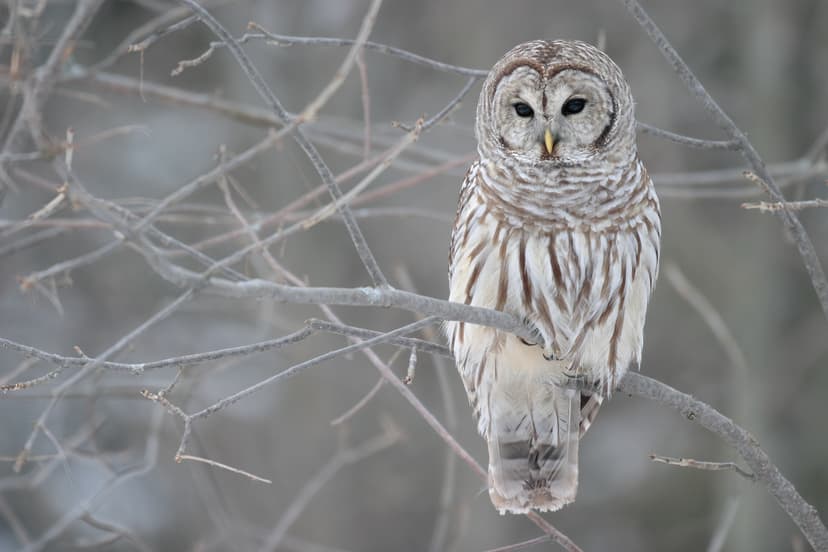
Barred owl
The barred owl (Strix varia) is a large North American owl known for its distinctive "Who cooks for you, who cooks for you all" call. Primarily found in mature forests and woodlands in eastern North America, it has expanded its range westward, where it is considered an invasive species. This owl is characterized by its brown to gray plumage with dark striping on its underside and its large, rounded head without ear tufts.

Eurasian scops owl
The Eurasian scops owl (Otus scops) is a small owl native to southern Europe and extending eastwards into Siberia and the Himalayas. This migratory species is distinctive for its small size, ear tufts, and a call resembling that of midwife toads. It primarily inhabits open woodlands and can be found wintering in sub-Saharan Africa.