
Eurasian scops owl
The Eurasian scops owl (Otus scops) is a small owl native to southern Europe and extending eastwards into Siberia and the Himalayas. This migratory species is distinctive for its small size, ear tufts, and a call resembling that of midwife toads. It primarily inhabits open woodlands and can be found wintering in sub-Saharan Africa.
Key Facts
- ›Breeds in southern Europe, Siberia, and the Himalayas.
- ›Migratory, wintering in sub-Saharan Africa.
- ›Possesses small ear tufts and a predominantly grey-brown plumage.
- ›Its call is a deep whistle, similar to that of midwife toads.
- ›Nests in tree holes, walls, or old nests of other species.
- ›Feeds mainly on insects and other invertebrates.

European Scops Owl, Common Scops Owl, Scops Owl
Open Woodland, Parks, Gardens
Europe, Asia, Africa
Insects, Invertebrates
About Eurasian scops owl
The Eurasian scops owl (Otus scops) is a small owl species belonging to the typical owl family Strigidae. Its breeding grounds span from southern Europe eastward across southern Siberia and into the western Himalayas. This migratory bird spends its winters in Africa, south of the Sahara, though some populations in Mediterranean Europe remain resident year-round.
Description and Characteristics
This owl is characterized by its compact size, measuring approximately 19–21 cm in length with a wingspan ranging from 47–54 cm, making it somewhat smaller than the little owl. It possesses small ear-tufts and typically perches in an upright posture. The plumage is predominantly a grey-brown hue, accented by a paler face, underparts, and a noticeable shoulder line. Its flight is direct and strong, utilizing long, narrow wings, which is consistent with its migratory lifestyle.
The call of the Eurasian scops owl is a distinctive deep whistle, audible from both sexes, and is noted for its similarity to the vocalizations of midwife toads. This nocturnal species is largely active after dark, preying on small creatures such as insects and other invertebrates.
Distribution and Habitat
The Eurasian scops owl favors open woodland, parks, and gardens for its habitat. Its breeding range is extensive, covering much of southern Europe and extending into western and central Asia. While it migrates to sub-Saharan Africa for the winter, rare sightings have been recorded further north, sometimes as a spring overshoot. It is typically not found outside its breeding range during the non-calling season.
Breeding Behavior
During the breeding season, Eurasian scops owls select nests typically located in tree cavities or within walls; old nests of other birds, such as crows, are also utilized. The female incubates a clutch of usually 4 or 5 white eggs for 24–25 days. After hatching, both parents contribute to feeding and caring for the young. The owlets fledge at around 21–29 days of age and achieve independence from their parents within 30–40 days.
Source: Wikipedia ↗
Frequently Asked Questions
What is the Eurasian scops owl?
The Eurasian scops owl is a small owl belonging to the typical owl family Strigidae. It is known for its compact size, distinctive ear tufts, and a unique whistling call.
Where does the Eurasian scops owl live?
This owl species breeds across southern Europe, extending eastward into southern Siberia and the western Himalayas. It undertakes migration, spending its winters in Africa south of the Sahara.
What does the Eurasian scops owl look like?
It is a small owl, typically 19–21 cm in length with a wingspan of 47–54 cm. Its plumage is largely grey-brown with a paler face, underparts, and a noticeable shoulder line, and it has small ear tufts.
What does the Eurasian scops owl eat?
The diet of the Eurasian scops owl consists mainly of small prey, such as insects and other invertebrates. It is a largely nocturnal hunter.
How does the Eurasian scops owl breed?
Eurasian scops owls typically nest in holes in trees or walls, or sometimes use old nests of other birds. They usually lay a clutch of 4 or 5 white eggs, which are incubated solely by the female.
What is the call of the Eurasian scops owl?
The call of the Eurasian scops owl is a deep whistle, which is produced by both males and females. This sound is noted to be similar to the calls made by midwife toads.
Related Owl species

African scops owl
The African scops owl (Otus senegalensis) is a small owl native to sub-Saharan Africa, characterized by its cryptic greyish-brown plumage and bright yellow eyes. It is a strictly nocturnal hunter, often overlooked during the day due to its remarkable camouflage. Its distinctive call is a monotonous "prrrp" sound.
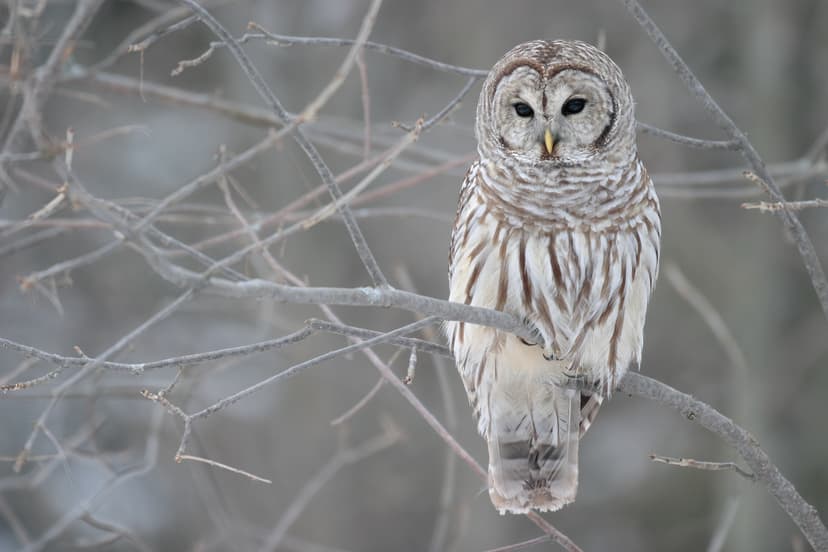
Barred owl
The barred owl (Strix varia) is a large North American owl known for its distinctive "Who cooks for you, who cooks for you all" call. Primarily found in mature forests and woodlands in eastern North America, it has expanded its range westward, where it is considered an invasive species. This owl is characterized by its brown to gray plumage with dark striping on its underside and its large, rounded head without ear tufts.

Eastern screech owl
The eastern screech owl is a stocky, short-tailed owl native to Eastern North America, found from Mexico to Canada. It is a midsized screech owl, adaptable to various woodland habitats and even urban environments, though its strictly nocturnal habits often make it elusive. Distinctive features include prominent ear tufts, yellow eyes, and a unique tremolo call.