
Amazonian pygmy owl
The Amazonian pygmy owl (Glaucidium hardyi), also known as Hardy's pygmy owl, is a small owl species native to the Amazon Basin and northern South America. It is characterized by its large, round head with false eyespots, diurnal habits, and a diet likely consisting of arthropods and small vertebrates. Its conservation status is listed as Least Concern by the IUCN, despite evidence of a decreasing population.
Key Facts
- ›It is a very small owl, belonging to the genus Glaucidium, meaning 'little owl'.
- ›Adults have a gray-brown crown spotted with small white dots and white underparts with brown streaks.
- ›They are diurnal, meaning they are active during the day, and often perch quietly for extended periods.
- ›Their primary call is a series of repeated, short, high-pitched tweets.
- ›The species inhabits the canopy and subcanopy of humid, tropical evergreen forests.
- ›Its conservation status is 'Least Concern' by the IUCN due to its extensive range, though its population is noted as decreasing.
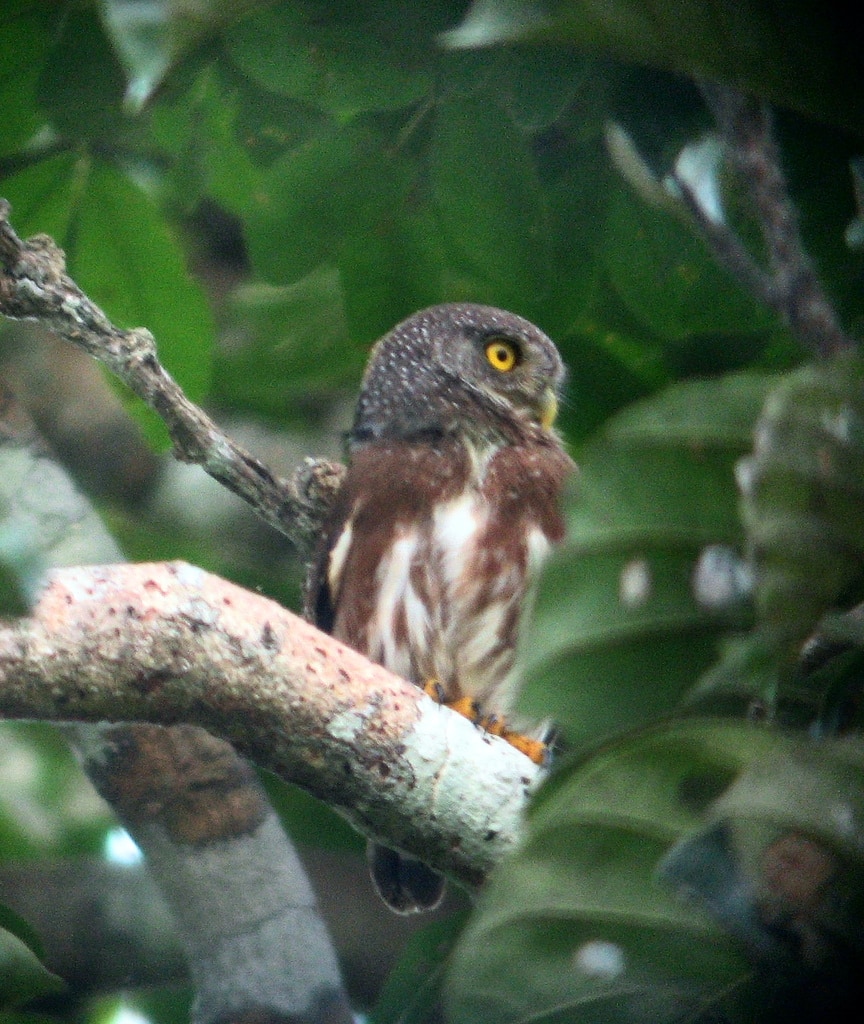
Hardy's Pygmy Owl
- Canopy of Tall, Humid, Tropical Evergreen Forests
- Subcanopy of Tall, Humid, Tropical Evergreen Forests
Northern South America, Amazon Basin, Bolivia, Peru, Venezuela, Guyana, Suriname, French Guiana
Large Arthropods, Small Vertebrates
About Amazonian pygmy owl
The Amazonian pygmy owl, scientifically known as Glaucidium hardyi and sometimes referred to as Hardy's pygmy owl, is a diminutive avian species inhabiting the vast Amazon Basin and extending into northern South America. As a member of the Strigidae family, it is classified among the true owls. Its name, derived from the genus Glaucidium, directly signifies its small stature, translating to 'little owl'.
Physical Characteristics and Behavior
Adult Amazonian pygmy owls are distinguished by their striking physical features, including a large, round head adorned with markings that mimic eyes, likely serving as a deterrent against predators. Their crown is a soft gray-brown, speckled with minute white dots, while their body plumage features white underparts streaked with broad brown or rufous brown bands. They possess bright golden yellow irises, a greenish-yellow bill, and a pale yellow cere. Unlike many owl species, the Amazonian pygmy owl is diurnal, meaning it is active during daylight hours. Individuals often perch motionlessly for extended periods, making them challenging to spot even when active. Observations suggest they form socially monogamous pairs.
Habitat and Diet
The natural habitat of the Amazonian pygmy owl is the upper layers, or canopy and subcanopy, of tall, humid, tropical evergreen forests. They have been recorded at elevations ranging from sea level to over 1100 meters. While specific dietary information is scarce, the species is presumed to feed on large arthropods and small vertebrates. During hot periods, adults have been observed panting with partially open beaks and have been noted to deliver food such as cicadas and small birds to their young.
Distribution and Conservation
This owl's geographic range is extensive, covering the central and southwestern parts of the Amazonia region, with confirmed presence in northern Bolivia, various parts of Peru, and extending eastwards across Venezuela, Guyana, Suriname, and French Guiana. The Amazonian pygmy owl is categorized as 'Least Concern' by the International Union for Conservation of Nature (IUCN) due to its wide distribution. However, the IUCN also notes a decreasing population trend. Research indicates that canopy loss and fragmentation in the Amazon basin, largely due to selective logging, are likely impacting this canopy-dwelling species.
Source: Wikipedia ↗
Frequently Asked Questions
What is the scientific name of the Amazonian pygmy owl?
The scientific name of the Amazonian pygmy owl is Glaucidium hardyi. This binomial nomenclature classifies it within the genus Glaucidium, which comprises pygmy owls.
What does the Amazonian pygmy owl look like?
The Amazonian pygmy owl is very small with a large, round head that has false eyespots. Its crown is gray-brown with small white spots, and its underparts are white with broad brown streaks. It has bright golden yellow irises and a greenish-yellow bill.
Where can the Amazonian pygmy owl be found?
This owl is found in the central and southwestern areas of the Amazonia region. Its range extends across northern Bolivia, Peru, eastern Venezuela, Guyana, Suriname, and French Guiana.
What is the habitat of the Amazonian pygmy owl?
The Amazonian pygmy owl primarily inhabits the canopy and subcanopy of tall, humid, tropical evergreen forests. They can be found from lowlands up to elevations exceeding 1100 meters.
What does the Amazonian pygmy owl eat?
Very little specific information is available regarding the diet of the Amazonian pygmy owl. However, it is presumed to prey on large arthropods and small vertebrates.
What is the conservation status of the Amazonian pygmy owl?
The Amazonian pygmy owl is listed as 'Least Concern' by the IUCN. Despite this, the IUCN also notes that its population is decreasing, though the exact population size has not been quantified.
Related Owl species

Central American pygmy owl
The Central American pygmy owl (Glaucidium griseiceps) is a small owl species native to the humid tropical forests and secondary growth areas of Central America and northwestern Colombia. It is distinguished by its small size, spotted crown, and the presence of dark "false eyes" on its nape, which are thought to deter predators. This owl is known to hunt both during the day and at night.
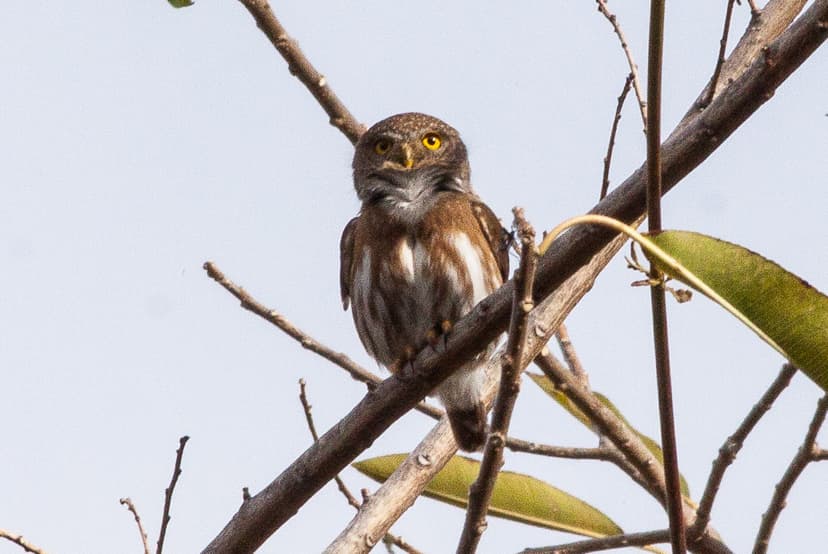
Colima pygmy owl
The Colima pygmy owl is a small owl species endemic to western Mexico, found in various forest types and coffee plantations. It is characterized by its brown plumage with white spots, distinctive "eyebrows," and a unique hooting song. While primarily nocturnal, it also exhibits daytime activity.

Collared owlet
The collared owlet (Taenioptynx brodiei) is the smallest owl species in Asia, found in submontane and montane forests across oriental Asia. It is distinguished by its small size, distinctive facial markings including white eyebrows and a simulated "occipital face" on the nape, and a unique ventriloquial vocalization.