
Central American pygmy owl
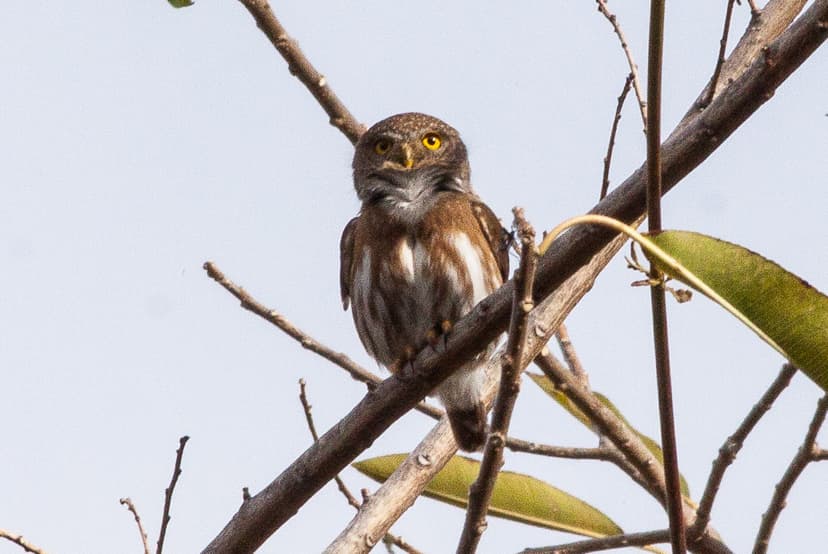
The Central American pygmy owl (Glaucidium griseiceps) is a small owl species native to the humid tropical forests and secondary growth areas of Central America and northwestern Colombia. It is distinguished by its small size, spotted crown, and the presence of dark "false eyes" on its nape, which are thought to deter predators. This owl is known to hunt both during the day and at night.
Key Facts
- ›Found from southern Mexico through Central America to northwestern Colombia, with a disjunct population in Ecuador.
- ›Inhabits humid tropical evergreen forests, secondary forests, and mature cacao plantations.
- ›Adults have a grayish-brown crown with buff to whitish spots and a tail with pale bars.
- ›Juveniles have a gray, unspotted crown and sooty false eyes on the nape.
- ›Diet is thought to include large insects, invertebrates, and small vertebrates.
- ›Breeding season occurs in April and may, with clutches of two to four eggs laid in tree cavities.

- Lowland and Foothill Humid Tropical Evergreen Forest
- Secondary Forest
- Semi-Open Areas
- Mature Cacao Plantations
Belize, Colombia, Costa Rica, Ecuador, Guatemala, Honduras, Mexico, Nicaragua, Panama
Large Insects, Other Invertebrates, Small Lizards, Small Birds, Small Mammals
About Central American pygmy owl
The Central American pygmy owl, scientifically known as Glaucidium griseiceps, is a diminutive owl species native to the humid tropical forests and associated secondary growth and agricultural landscapes of Central America and northwestern Colombia. Its natural range extends from southern Mexico, through Guatemala, Belize, Honduras, Costa Rica, and Panama, with a notable disjunct population in northwestern Ecuador. This small owl is adapted to life in lowland and foothill environments, often found in evergreen forests, but also tolerating secondary forests, semi-open areas, and even mature cacao plantations.
Physical Characteristics and Behavior
Adult Central American pygmy owls typically measure between 13 to 18 cm in length. They are characterized by a grayish-brown crown and nape, with the crown adorned with buff to whitish spots. A distinctive feature is the presence of dark "false eyes" on the nape, which are thought to serve as a defensive mechanism against predators by mimicking larger eyes. Their upperparts and tail are a rich brown, marked with pale bars across the tail, while their underparts are whitish with reddish-brown streaks. Juveniles exhibit a gray crown without spots and sooty false eyes.
This species is known for its flexible hunting patterns, often being active during both nocturnal and diurnal periods. While detailed dietary studies are limited, it is believed to prey on large insects, other invertebrates, and small vertebrates such as lizards, birds, and mammals. The breeding phenology of the Central American pygmy owl is not extensively documented, but nesting has been reported to occur in April and May. They utilize natural tree cavities or abandoned woodpecker holes for their nests, typically laying clutches of two to four eggs.
Source: Wikipedia ↗
Frequently Asked Questions
What is the scientific name of the Central American pygmy owl?
The scientific name of the Central American pygmy owl is Glaucidium griseiceps. This binomial nomenclature identifies it as a distinct species within the Glaucidium genus.
Where is the Central American pygmy owl found?
This owl species is distributed from southern Mexico (Veracruz, Oaxaca, Chiapas) through Guatemala, Belize, Honduras, Costa Rica, and Panama, extending into northwestern Colombia. A separate population exists in far northwestern Ecuador.
What kind of habitat does the Central American pygmy owl prefer?
The Central American pygmy owl inhabits lowland and foothill humid tropical evergreen forests. It can also be found in secondary forests, semi-open areas, and mature cacao plantations.
What does the Central American pygmy owl eat?
While its diet is not extensively documented, it is believed to consist of large insects, other invertebrates, and small vertebrates such as lizards, birds, and mammals.
When does the Central American pygmy owl breed?
The breeding period for this species is reported to be in April and May. During this time, they are known to lay clutches of two to four eggs.
What is the conservation status of the Central American pygmy owl?
The International Union for Conservation of Nature (IUCN) has assessed the Central American pygmy owl as Least Concern. Its population size is not precisely known but is believed to be stable.
Related Owl species
Colima pygmy owl
The Colima pygmy owl is a small owl species endemic to western Mexico, found in various forest types and coffee plantations. It is characterized by its brown plumage with white spots, distinctive "eyebrows," and a unique hooting song. While primarily nocturnal, it also exhibits daytime activity.

Cuban pygmy owl
The Cuban pygmy owl (Glaucidium siju) is a small owl species endemic to Cuba, recognized for its two color morphs: gray-brown and rufous. It inhabits various forest types and open areas across the island, from sea level to high elevations. This owl is notable for its active hunting during both day and night, feeding on a varied diet of insects, reptiles, small mammals, birds, and frogs.

Little owl
The little owl (Athene noctua) is a small bird found across temperate and warmer regions of Europe, Asia, and North Africa. Distinctive for its flat-topped head, yellow eyes, and a stern expression, it inhabits a variety of open landscapes and is known for its association with wisdom in ancient Greek and Roman culture.