
Colima pygmy owl
The Colima pygmy owl is a small owl species endemic to western Mexico, found in various forest types and coffee plantations. It is characterized by its brown plumage with white spots, distinctive "eyebrows," and a unique hooting song. While primarily nocturnal, it also exhibits daytime activity.
Key Facts
- ›Found in western Mexico from central Sonora south to Oaxaca.
- ›Inhabits thorn forests, tropical deciduous forests, and coffee plantations.
- ›Measures 13 to 15 cm in length.
- ›Features brown plumage with small dull white spots on the head and wings.
- ›Has a distinctive hooting song that can include up to 24 notes.
- ›Assessed as Least Concern by the IUCN due to its common status and stable population.
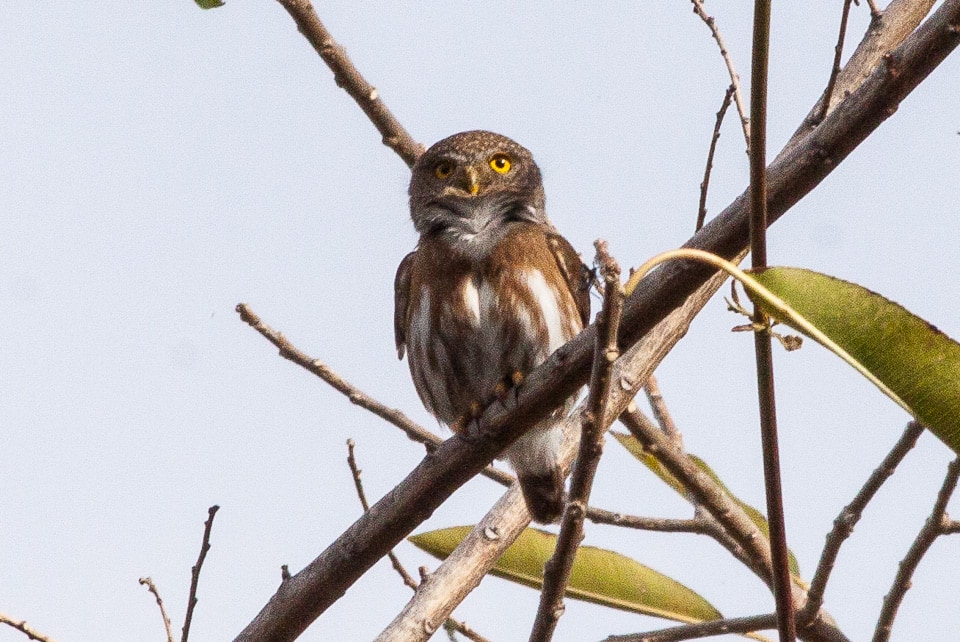
Colima Owl
Thorn Forests, Tropical Deciduous Forests, Lowland Tropical Evergreen Forests, Lower Parts of Humid Montane Forests, Coffee Plantations
Mexico
Large Arthropods, Small Vertebrates
About Colima pygmy owl
The Colima pygmy owl (Glaucidium palmarum) is a small owl species found exclusively in the western regions of Mexico. It is a member of the Strigidae family and is endemic to this specific geographic area.
Distribution and Habitat
This owl's range extends from central Sonora southward to Oaxaca, inhabiting elevations from sea level up to 1,500 meters (4,900 ft). The Colima pygmy owl thrives in a variety of forest ecosystems, including thorn forests, tropical deciduous forests, lowland tropical evergreen forests, and the lower reaches of humid montane forests. It has also adapted to human-modified landscapes, being found in coffee plantations.
Physical Description
Adult Colima pygmy owls measure between 13 to 15 cm (5.1 to 5.9 in) in length. Males typically weigh between 43 to 48 g (1.5 to 1.7 oz), with females noted as being heavier. The upperparts are primarily brown, complemented by grayish-brown wings and a deeper grayish-brown tail. The head is adorned with small, dull white spots, and similar white markings appear along the closed wing. The tail displays oval white spots that form distinct bands. Notable facial features include dull white "eyebrows" and a pair of dark "eye spots" on the nape. The owl's underparts are a buffy white color, characterized by wide cinnamon stripes.
Behavior and Diet
The Colima pygmy owl exhibits primarily nocturnal activity but is also known to be active during daylight hours. It forages in the mid-levels of its forest habitat. While detailed dietary studies are scarce, it is believed to prey on large arthropods and small vertebrates.
Vocalization
The characteristic vocalization of the Colima pygmy owl is a "hollow hooting" call. This song can feature a variable number of notes, often increasing in pitch or intensity, with recorded series containing up to 24 notes or potentially more.
Reproduction
Much of the breeding biology of the Colima pygmy owl remains unknown. Current understanding suggests they are socially monogamous and are presumed to utilize tree cavities for nesting.
Conservation Status
The International Union for Conservation of Nature (IUCN) has assessed the Colima pygmy owl as a species of Least Concern. Despite the lack of precise population enumeration, the species is described as being fairly common to very common throughout its extensive range, and its population trend appears to be stable, indicating a healthy status for now.
Source: Wikipedia ↗
Frequently Asked Questions
What is the scientific name of the Colima pygmy owl?
The scientific name of the Colima pygmy owl is Glaucidium palmarum.
Where can the Colima pygmy owl be found?
This owl species is endemic to western Mexico, with a range extending from central Sonora south to Oaxaca. It inhabits a variety of forest types, including thorn forests, tropical deciduous forests, and coffee plantations.
What does the Colima pygmy owl look like?
The Colima pygmy owl is a small bird, measuring 13 to 15 cm in length. It has brown upperparts, grayish-brown wings and tail, and buffy white underparts with cinnamon stripes. Distinctive features include small dull white spots on its head and wings, and dull white "eyebrows."
What is the conservation status of the Colima pygmy owl?
The Colima pygmy owl is classified as Least Concern by the IUCN. The species is considered fairly common to very common across its range, and its population appears to be stable.
What does the Colima pygmy owl eat?
Little is precisely known about the diet of the Colima pygmy owl. However, it is presumed to feed on large arthropods and small vertebrates.
What are the nesting habits of the Colima pygmy owl?
Information regarding the breeding phenology of the Colima pygmy owl is largely unknown. It is presumed to nest in tree cavities and is thought to be socially monogamous.
Related Owl species

Central American pygmy owl
The Central American pygmy owl (Glaucidium griseiceps) is a small owl species native to the humid tropical forests and secondary growth areas of Central America and northwestern Colombia. It is distinguished by its small size, spotted crown, and the presence of dark "false eyes" on its nape, which are thought to deter predators. This owl is known to hunt both during the day and at night.

Cuban pygmy owl
The Cuban pygmy owl (Glaucidium siju) is a small owl species endemic to Cuba, recognized for its two color morphs: gray-brown and rufous. It inhabits various forest types and open areas across the island, from sea level to high elevations. This owl is notable for its active hunting during both day and night, feeding on a varied diet of insects, reptiles, small mammals, birds, and frogs.

Little owl
The little owl (Athene noctua) is a small bird found across temperate and warmer regions of Europe, Asia, and North Africa. Distinctive for its flat-topped head, yellow eyes, and a stern expression, it inhabits a variety of open landscapes and is known for its association with wisdom in ancient Greek and Roman culture.