
Collared owlet
The collared owlet (Taenioptynx brodiei) is the smallest owl species in Asia, found in submontane and montane forests across oriental Asia. It is distinguished by its small size, distinctive facial markings including white eyebrows and a simulated "occipital face" on the nape, and a unique ventriloquial vocalization.
Key Facts
- ›Asia's smallest owl species, measuring around 15 cm in length.
- ›Found in submontane and montane forests with open spaces throughout oriental Asia.
- ›Possesses prominent white eyebrows, lemon-yellow eyes, and a white throat patch.
- ›Features a pale collar and two black spots on the nape that MIMIC eyes, creating an "occipital face".
- ›Primarily diurnal, active during the day, though can be seen hunting at night.
- ›Diet includes small birds, insects, lizards, invertebrates, and small mammals.

Collared Pygmy Owl
Submontane Forests, Montane Forests, Evergreen Forests, Forest Edges, Mixed Deciduous-Evergreen Forests, Open Woodlands With Scrub, Cultivated Lands
Oriental Asia, Himalayas, South China, Indochina, Malay Peninsula, Taiwan
Small Birds, Insects, Lizards, Invertebrates, Small Mammals
About Collared owlet
The collared owlet (Taenioptynx brodiei), also known as the collared pygmy owl, is a remarkable species of owl renowned for being the smallest in Asia. It inhabits submontane and montane forests across a broad swathe of oriental Asia, typically found in areas with open spaces.
Physical Characteristics and Identification
This diminutive owl measures between 15 and 17 centimeters in length, with females generally being larger than males. Its plumage is predominantly grey-brown, marked with barring on the back and flanks and spotting on the head. Distinctive features include prominent white eyebrows, striking lemon-yellow eyes, and a white throat patch. A particularly unique characteristic is the "occipital face" on the nape, formed by a pale collar and two black spots that mimic eyes, giving the impression of the owl staring backward. It lacks ear-tufts and possesses a relatively long tail for its size, with rapid wingbeats noticeable in flight. The collared owlet also exhibits age-dependent colour morphs, transitioning through fledgling, rufous, and grey stages as it matures.
Distribution and Habitat
The collared owlet boasts a wide geographic range, extending from the Himalayas through to eastern China and Taiwan, and southwards into Malaysia. It can be found in countries such as Bhutan, China, India, Laos, Malaysia, Nepal, Pakistan, Thailand, and Vietnam. Its preferred habitats are varied, encompassing evergreen forests, forest edges, mixed deciduous-evergreen forests, and open woodlands with scrub. They are typically found at altitudes between 1,350 and 2,750 meters but have been observed at lower elevations near cultivated lands.
Behavior and Ecology
Contrary to the stereotype of owls being exclusively nocturnal, the collared owlet is primarily diurnal, meaning it is most active during daylight hours. It can be observed perching, hunting, and vocalizing throughout the day, though it may also hunt at night. Despite its small stature, the collared owlet is a fierce predator, with a diet that is presumed to include small birds, insects, lizards, invertebrates, and small mammals, capable of taking prey as large as itself.
Vocalizations
This owl possesses highly distinctive vocalizations. Males emit a characteristic 4-note call, often described as "wüp-wüwü-wüp," which is repeated at intervals. The calls begin mellowly and can become shriller, and the bird's tendency to turn its head in various directions creates a ventriloquial effect that makes it challenging to pinpoint its exact location.
Breeding and Nesting
While detailed information on breeding is limited, the mating season is believed to occur between March and April. Collared owlets are secondary cavity-nesters; they do not excavate their own nests but utilize natural tree hollows or abandoned cavities made by woodpeckers and barbets. These nesting sites are often found in old, rotten trees situated in clearings or open forest areas. Clutch sizes typically range from 3 to 5 round, white eggs, with young fledging between mid-June and early August.
Conservation Status
On the IUCN Red List, the collared owlet is classified as Least Concern. However, habitat loss remains its primary threat. Studies have indicated that the species is sensitive to habitat fragmentation, with individuals rarely found in forest fragments smaller than 100 hectares, highlighting the impact of anthropogenic pressures such as deforestation.
Source: Wikipedia ↗
Frequently Asked Questions
What is the collared owlet's scientific name?
The scientific name for the collared owlet is Taenioptynx brodiei. It was first described in 1836 by Edward Burton as Noctua brodiei and later moved to the genus Glaucidium before being placed in its current genus, Taenioptynx.
Where is the collared owlet found?
The collared owlet has a wide distribution across oriental Asia, ranging from the Himalayas in northern Pakistan to eastern China and Taiwan, extending south through Malaysia. It inhabits countries like Bhutan, China, India, Laos, Malaysia, Nepal, Pakistan, Thailand, and Vietnam.
What are the distinctive physical features of the collared owlet?
This small owl is characterized by its grey-brown plumage with barred back and flanks, spotted head, prominent white eyebrows, vibrant lemon-yellow eyes, and a white throat patch. A notable feature is the "occipital face" on its nape, formed by a pale collar and black spots that resemble eyes.
What does the collared owlet eat?
The diet of the collared owlet is believed to be similar to that of related species, consisting mainly of small birds, insects, lizards, invertebrates, and small mammals. Despite its small size, it is known to be a fierce hunter capable of capturing prey as large as itself.
What are the vocalizations of the collared owlet like?
The collared owlet has distinctive vocalizations, with males producing a repetitive 4-note phrase, often described as "wüp-wüwü-wüp." Their calls can start mellow and become shriller, and the bird's head movements create a ventriloquial effect, making it difficult to pinpoint their location.
What is the conservation status of the collared owlet?
The collared owlet is listed as Least Concern on the IUCN Red List. However, habitat loss due to anthropogenic pressures like deforestation poses a significant threat, with studies indicating they are absent from forest fragments smaller than 100 hectares.
Related Owl species
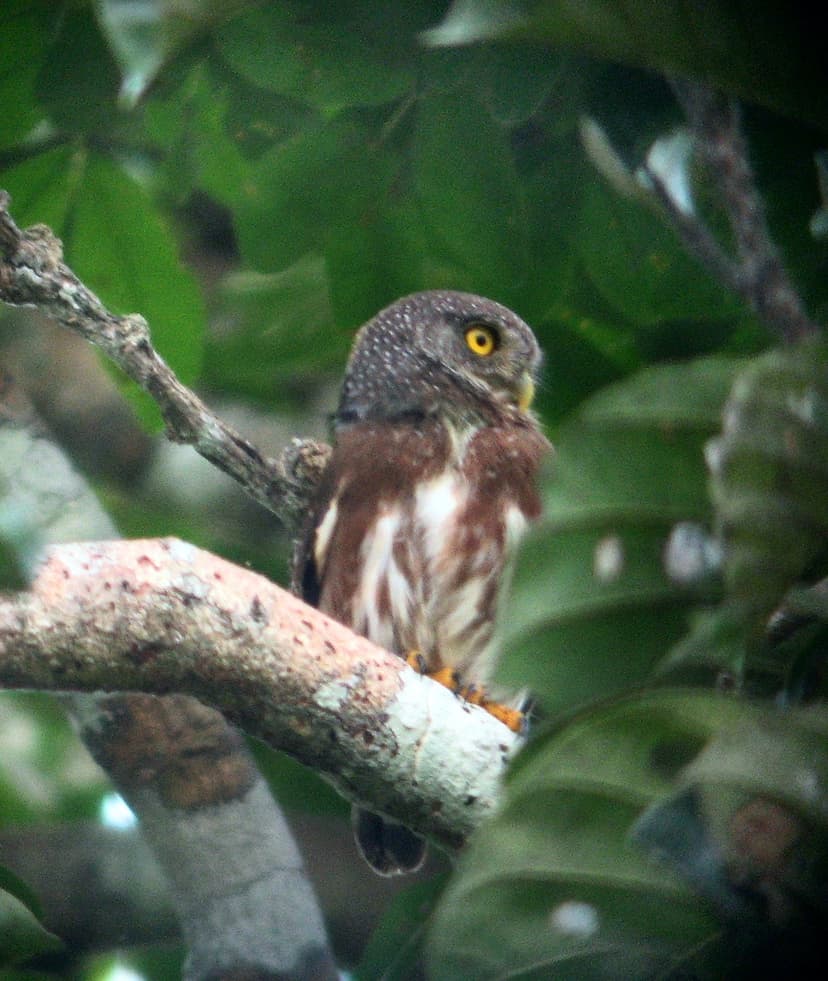
Amazonian pygmy owl
The Amazonian pygmy owl (Glaucidium hardyi), also known as Hardy's pygmy owl, is a small owl species native to the Amazon Basin and northern South America. It is characterized by its large, round head with false eyespots, diurnal habits, and a diet likely consisting of arthropods and small vertebrates. Its conservation status is listed as Least Concern by the IUCN, despite evidence of a decreasing population.

Central American pygmy owl
The Central American pygmy owl (Glaucidium griseiceps) is a small owl species native to the humid tropical forests and secondary growth areas of Central America and northwestern Colombia. It is distinguished by its small size, spotted crown, and the presence of dark "false eyes" on its nape, which are thought to deter predators. This owl is known to hunt both during the day and at night.
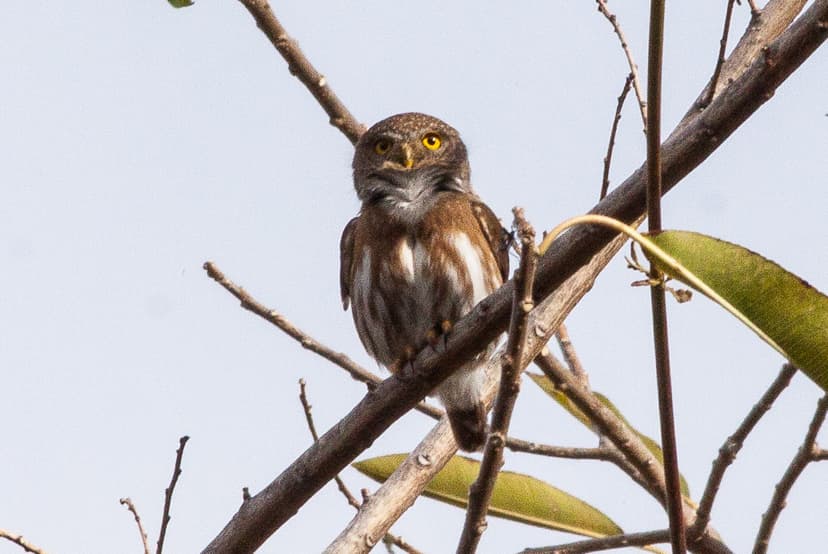
Colima pygmy owl
The Colima pygmy owl is a small owl species endemic to western Mexico, found in various forest types and coffee plantations. It is characterized by its brown plumage with white spots, distinctive "eyebrows," and a unique hooting song. While primarily nocturnal, it also exhibits daytime activity.