
Austral pygmy owl
The austral pygmy owl is a small owl species found in central and southern Chile and parts of southern Argentina. It is distinctive for its gray-brown and red color morphs and its ability to hunt both during the day and at night. This owl is known for its varied vocalizations, including contact whistles, territorial trills, and courtship calls.
Key Facts
- ›Found in central and southern Chile and southern Argentina.
- ›Exists in gray-brown and red color morphs.
- ›Hunts insects, birds, mammals, and reptiles, sometimes taking prey larger than itself.
- ›Nests in tree cavities or holes in earthen banks.
- ›Lays a clutch of three to five eggs between September and November.
- ›Has distinct vocalizations including whistles and trills.

Austral Pygmy Owl
City Parks, Farmland With Scattered Trees, Deciduous Forests, Thickets, Evergreen Shrublands, Temperate Forests, Southern Beech Forests, Patagonian Scrub/Steppe
Chile, Argentina
Insects, Birds, Mammals, Reptiles
About Austral pygmy owl
The austral pygmy owl (Glaucidium nana) is a small owl species native to central and southern Chile and parts of southern Argentina. Often considered the most abundant owl in Chile, it inhabits a diverse range of environments, from urban parks to dense forests and open scrublands. This species is known for its ability to hunt effectively during both daylight hours and at night, a characteristic that distinguishes it from many other owl species.
Description and Morphology
Measuring between 17 and 21 cm in length, the austral pygmy owl exhibits a striking dimorphism in coloration, appearing in either a gray-brown or a reddish morph, with intermediate forms also observed. Common features across both morphs include pale yellow eyes, prominent black markings on the nape that resemble 'false eyes,' and a pale face with dark speckling. The ventral plumage is typically off-white with dark streaking, while the dorsal side and tail display patterns of dark grayish-brown or reddish-brown with lighter dots or bars.
Distribution and Habitat
The geographic range of the austral pygmy owl extends from approximately Valparaíso Province in Chile and Neuquén Province in western Argentina southward to the tip of Tierra del Fuego. Within this extensive range, the species occupies a wide array of habitats. These include human-modified landscapes such as city parks and farmland with scattered trees, as well as natural ecosystems like deciduous and evergreen shrublands, temperate forests, southern beech forests, and the arid Patagonian scrub and steppe.
Behavior and Ecology
Primarily diurnal, the austral pygmy owl also displays nocturnal activity, making it a versatile hunter. It employs a hunting strategy of sallying from a perch to capture its prey, which consists of insects, birds, small mammals, and reptiles. Notably, it has been documented successfully preying on birds that are nearly twice its own size.
Reproduction
The breeding cycle of the austral pygmy owl typically occurs between September and November. Nests are usually established in pre-existing tree cavities, though the species has also been observed utilizing holes dug into earthen banks. Females lay clutches of three to five eggs, and they are solely responsible for incubation.
Vocalizations
This owl species possesses a repertoire of five distinct vocalizations. These include a contact call described as a rapid whistle, a sharp trill serving as a territorial call, soft chirps made by nestlings, a whistling courtship call, and an additional undefined call. These sounds play crucial roles in communication for pair bonding and territorial defense.
Conservation Status
The austral pygmy owl is classified as Least Concern by the International Union for Conservation of Nature (IUCN). Despite the lack of precise population figures, it is considered the most abundant owl species in Chile. However, in agricultural regions, its nocturnal vocalizations are sometimes misinterpreted as an ill omen, leading to persecution by humans.
Source: Wikipedia ↗
Frequently Asked Questions
What is the scientific name of the austral pygmy owl?
The scientific name of the austral pygmy owl is Glaucidium nana. It is recognized as a distinct species, separate from the ferruginous pygmy owl, based on DNA studies and other data.
Where does the austral pygmy owl live?
The austral pygmy owl is primarily found in central and southern Chile, extending into parts of southern Argentina. Its range covers areas from Valparaíso Province in Chile and Neuquén Province in Argentina down to Tierra del Fuego.
What does the austral pygmy owl look like?
This owl measures between 17 to 21 cm in length and comes in gray-brown and red color morphs. Both morphs have pale yellow eyes, black 'false eyes' on their nape, and distinctive streaking on their underparts.
What does the austral pygmy owl eat?
The austral pygmy owl is a solitary hunter that preys on insects, birds, mammals, and reptiles. It is known to capture prey that is nearly twice its own size.
When does the austral pygmy owl breed?
The breeding season for the austral pygmy owl occurs between September and November. They typically lay three to five eggs in a tree cavity or a hole in an earthen bank.
What are the sounds of the austral pygmy owl?
The austral pygmy owl has five main vocalizations. These include contact whistles, a territorial trill, chirps from nestlings, a courtship whistle, and an undefined call.
What is the conservation status of the austral pygmy owl?
The austral pygmy owl is listed as Least Concern by the IUCN. Despite population numbers not being precisely quantified, it is considered the most abundant owl in Chile.
Related Owl species
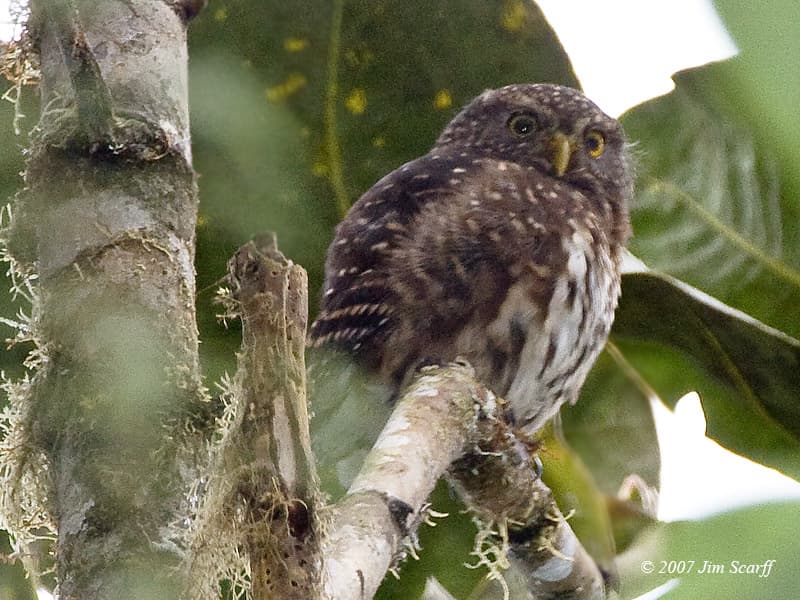
Andean pygmy owl
The Andean pygmy owl is a small owl species native to the Andes mountains of South America, found in countries like Colombia, Ecuador, Peru, and Venezuela. It is distinguished by its two color morphs, white facial markings including prominent "brows" and "moustaches," and a distinctive face-like pattern on its nape. This owl is an opportunistic predator, active both day and night, feeding on a variety of small invertebrates, birds, and mammals.
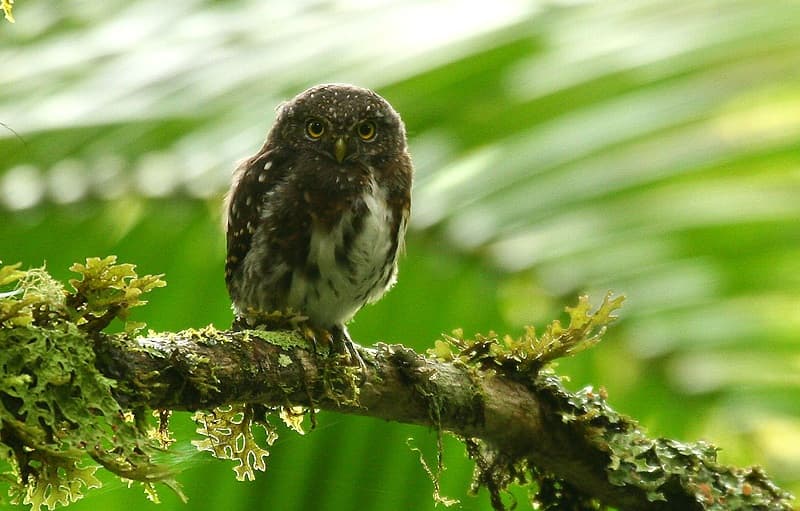
Costa Rican pygmy owl
The Costa Rican pygmy owl is a small owl species found in the montane forests of Costa Rica and Panama. It is known for its distinctive "eye spots" on the back of its head and its varied vocalizations. This species is a year-round resident and forages for prey both day and night.

Pacific pygmy owl
The Pacific pygmy owl, also known as the Peruvian pygmy owl, is a small owl species found on the western slopes of the Andes in Chile, Ecuador, and Peru. It is distinguished by its varied color morphs, including gray, brown, and rufous, and its distinctive vocalizations which help differentiate it from similar species.