
Costa Rican pygmy owl
The Costa Rican pygmy owl is a small owl species found in the montane forests of Costa Rica and Panama. It is known for its distinctive "eye spots" on the back of its head and its varied vocalizations. This species is a year-round resident and forages for prey both day and night.
Key Facts
- ›Found in the montane oak and evergreen forests of Costa Rica and western Panama.
- ›Has two color morphs: brown and rufous.
- ›Features a pair of blackish spots on its nape that resemble "eyes".
- ›Forages for prey both during the day and at night.
- ›Its song consists of a series of clear, unmodulated toots.
- ›Assessed by the IUCN as Least Concern.
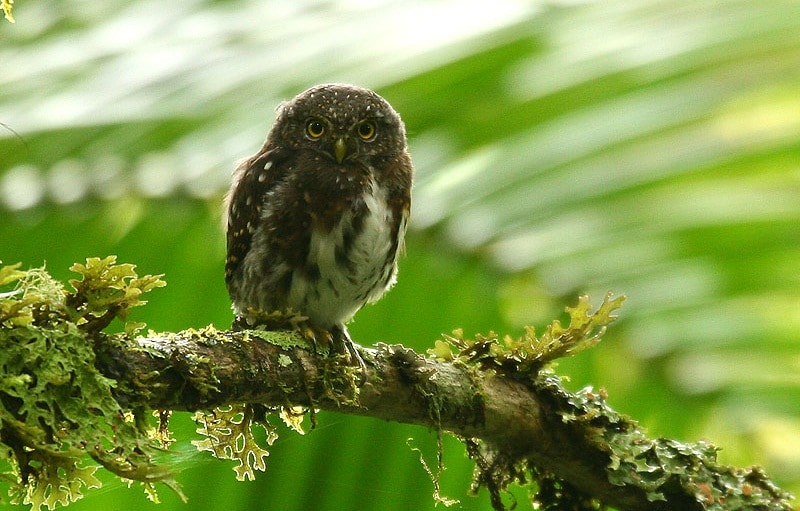
Costa Rican Pygmy-Owl
Humid Montane Oak Forests, Evergreen Forests, Forest Canopy, Forest Edges
Costa Rica, Panama
Birds, Small Mammals, Other Vertebrates, Large Arthropods
About Costa Rican pygmy owl
The Costa Rican pygmy owl (Glaucidium costaricanum) is a small "typical owl" belonging to the subfamily Surniinae. This species is native to the montane forests of Costa Rica and western Panama, inhabiting elevations typically between 900 and 3,000 meters above sea level.
Description and Identification
Measuring between 14.5 to 17 cm in length, the Costa Rican pygmy owl exhibits sexual dimorphism in size, with females being larger than males. Adults are found in two color morphs: one predominantly brown and the other rufous. Both morphs feature lighter, paler spots on their head and upper body parts. A distinctive characteristic is a pair of blackish spots with pale borders on the nape, which visually resemble "eyes" on the back of the head. The tail is similarly colored to the body, adorned with four white bands and a white tip. The breast and belly are white, with the flanks matching the base color. The facial disc is also of the basal color, marked with narrow buff and white lines. The eyes and feet are yellow, the upper beak (maxilla) is greenish yellow, and the lower beak (mandible) is light brown tipped with yellow.
Distribution and Habitat
The species is found year-round within its range, primarily in the Cordillera Central and Cordillera de Talamanca of Costa Rica, extending patchily into western Panama. Its preferred habitat includes the canopy and edges of humid montane oak and evergreen forests.
Behavior and Diet
The Costa Rican pygmy owl is active both during the day and at night. It hunts from a low perch, ambushing prey with a swift dash. If a hunt is unsuccessful, the owl typically returns to its perch rather than pursuing the prey. Its diet is known to include birds, small mammals, other vertebrates, and large arthropods. When agitated, like other pygmy owls, they exhibit a characteristic swishing of their tails from side to side.
Reproduction
Information regarding the breeding habits of the Costa Rican pygmy owl is not extensively documented. It is known to nest in natural tree cavities and holes, and may also utilize old nests of woodpeckers or other arboreal birds. While average clutch sizes are uncertain, a nest observed in March 2020 contained three eggs.
Vocalization
The vocalizations of the Costa Rican pygmy owl are distinctive. Its song is described as "a long series of clear, unmodulated toots in an irregular rhythm." These toots can be delivered in pairs, as a series of three pairs, or as a continuous stream of single notes. When exhibiting excitement, the owl produces a faster, higher-pitched sequence of five toots.
Conservation Status
The International Union for Conservation of Nature (IUCN) has assessed the Costa Rican pygmy owl as being of Least Concern. Although its total population size remains unknown, it is believed to be stable. No specific threats have been identified for the species. It is considered rare in Panama and ranges from rare to locally fairly common in Costa Rica. Human activity generally has minimal short-term direct impact, aside from localized habitat destruction.
Source: Wikipedia ↗
Frequently Asked Questions
What is the scientific name of the Costa Rican pygmy owl?
The scientific name of the Costa Rican pygmy owl is Glaucidium costaricanum. It was previously described as a subspecies of the Andean pygmy owl.
Where is the Costa Rican pygmy owl found?
This owl species is found in Costa Rica, specifically in the Cordillera Central and Cordillera de Talamanca, and patchily in western Panama. It inhabits the canopy and edges of humid montane oak and evergreen forests.
What does the Costa Rican pygmy owl look like?
Adults are typically brown or rufous and feature lighter spots on their head and upper body. A distinctive feature is a pair of blackish spots on the nape that resemble 'eyes'. They have yellow eyes and feet.
What does the Costa Rican pygmy owl eat?
While its diet is not detailed, it is known to consume birds, small mammals, other vertebrates, and large arthropods. It hunts from a low perch, making short dashes to capture prey.
What are the nesting habits of the Costa Rican pygmy owl?
The nesting phenology is not well understood. They are known to nest in natural tree crevices and holes and may use abandoned nests of woodpeckers or other tree-dwelling birds.
What is the conservation status of the Costa Rican pygmy owl?
The Costa Rican pygmy owl is assessed by the IUCN as Least Concern. Its population is believed to be stable, and no specific threats have been identified.
Related Owl species

Pacific pygmy owl
The Pacific pygmy owl, also known as the Peruvian pygmy owl, is a small owl species found on the western slopes of the Andes in Chile, Ecuador, and Peru. It is distinguished by its varied color morphs, including gray, brown, and rufous, and its distinctive vocalizations which help differentiate it from similar species.
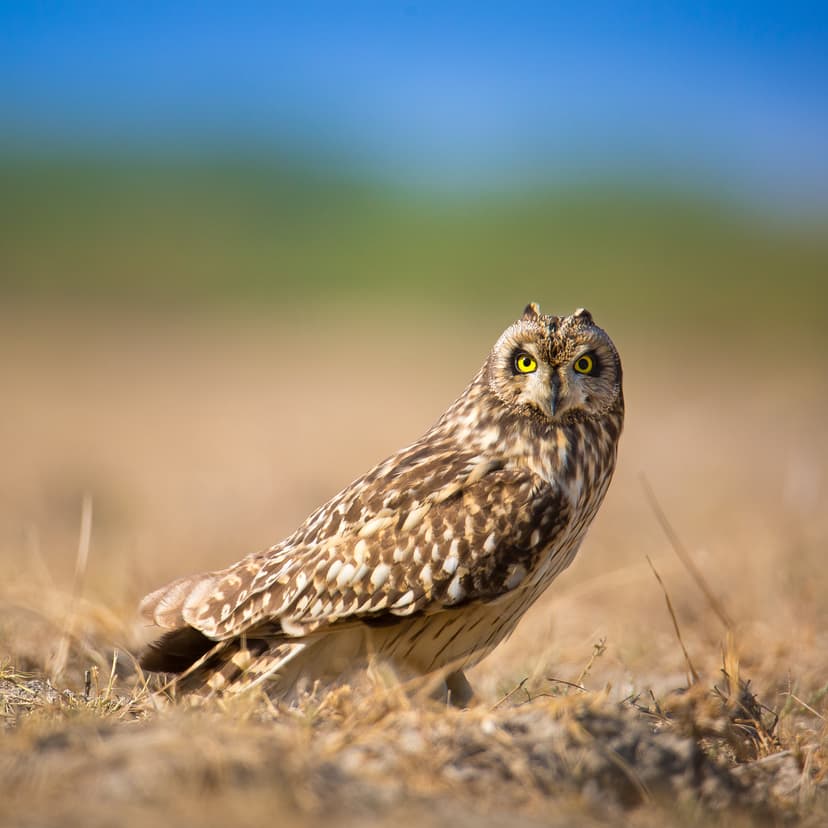
Short-eared owl
The short-eared owl (Asio flammeus) is a widely distributed grassland species known for its distinctive "ear" tufts, which are usually not visible but can be displayed when defensive. This medium-sized owl is found on open country and grasslands across most continents, feeding primarily on rodents like voles.

Yungas pygmy owl
The Yungas pygmy owl (Glaucidium bolivianum) is a small owl species native to the eastern Andes of South America, found in Argentina, Bolivia, and Peru. It is distinguished by its three color morphs (gray, brown, and rufous), pale dorsal spotting, and distinctive "false eyes" on its nape.