
Morepork
The morepork, also known by its Māori name ruru, is a small brown owl native to New Zealand and Norfolk Island, with a former presence on Lord Howe Island. It is distinguished by its dark-brown plumage with pale spots, golden-yellow eyes, and a distinctive "more-pork" call. This generally nocturnal owl hunts insects and small vertebrates by perching and pouncing, demonstrating excellent night vision and hearing.
Key Facts
- ›The morepork is named for its distinctive "more-pork" call, though it possesses multiple vocalizations.
- ›It has dark-brown plumage with pale spots and golden-yellow eyes.
- ›Primarily nocturnal, it may also be active during dawn and dusk (crepuscular).
- ›Its diet consists mainly of large insects and small vertebrates, hunted from tree perches.
- ›The morepork boasts supreme night vision and excellent hearing for locating prey.
- ›It is currently listed as a species of least concern by the IUCN due to its large range and stable population.

Ruru, Boobook, Mopoke
- Forests dominated by Podocarpus, Nothofagus, Metrosideros, and other hardwoods
- Forests of Norfolk Island Pine on Norfolk Island
New Zealand, Norfolk Island, Formerly Lord Howe Island
Large Invertebrates, Small Vertebrates, Small Birds
Swamp Harriers
About Morepork
The morepork, scientifically known as Ninox novaeseelandiae and by its Māori name ruru, is a small brown owl native to New Zealand and Norfolk Island, with a historical presence on Lord Howe Island. Its common names, including boobook and mopoke, are derived from its characteristic calls. The species exhibits dark-brown plumage adorned with pale spots and possesses striking golden-yellow eyes.
Description and Behavior
Moreporks typically measure between 26 to 29 cm in length, with females being slightly larger and heavier than males. They are predominantly nocturnal hunters, utilizing their exceptional night vision and acute hearing to locate prey, which includes large insects like beetles and moths, as well as small vertebrates such as mice and lizards. Their hunting technique often involves perching and then pouncing on unsuspecting prey. While primarily active at night, they may also be seen hunting during dawn and dusk hours.
Taxonomy and Distribution
First formally described in 1788, the morepork's taxonomic classification has been subject to revision, with it previously being grouped with the Australian boobook (Ninox boobook) and the Tasmanian boobook (Ninox leucopsis). Genetic studies in recent years have led to the reclassification of the Tasmanian boobook as a distinct species. Three subspecies have been recognized: N. n. novaeseelandiae found in New Zealand, N. n. undulata on Norfolk Island, and the extinct N. n. albaria from Lord Howe Island.
Habitat and Conservation
The morepork inhabits forests in New Zealand, favoring those dominated by native trees such as Podocarpus and Nothofagus, extending up to the alpine tree line. On Norfolk Island, it resides in forests of Norfolk Island pine. The species is generally found singly, in pairs, or in small family units. The International Union for Conservation of Nature (IUCN) has assessed the morepork as a species of least concern, owing to its extensive range and a stable population, indicating no significant current threats of decline.
Source: Wikipedia ↗
Frequently Asked Questions
What is the scientific name of the morepork?
The scientific name of the morepork is *Ninox novaeseelandiae*. It was first described by Johann Friedrich Gmelin in 1788.
Where does the morepork live?
The morepork is found in New Zealand, the Australian island of Norfolk Island, and formerly Lord Howe Island. Within New Zealand, it inhabits forests from the North Island to Stewart Island.
What does the morepork eat?
The morepork's diet primarily includes large invertebrates such as beetles, moths, caterpillars, spiders, and grasshoppers. It also preys on small vertebrates like lizards, rats, and mice.
What makes the morepork's call distinctive?
The morepork is named for its most frequent vocalization, a "more-pork" call. However, researchers have identified as many as 11 distinct calls, including a high-pitched yelping, a whistling call, and a lower pitched "quork-quork" rumbling call.
What is the conservation status of the morepork?
The morepork is listed as a species of least concern by the International Union for Conservation of Nature (IUCN). This is attributed to its large geographical range and apparently stable population, with no evidence of significant decline.
Related Owl species

Australian boobook
The Australian boobook (Ninox boobook) is the smallest owl species native to mainland Australia, also found in southern New Guinea, Timor, and the Sunda Islands. It is distinguished by its characteristic "boo-book" call and its predominantly dark-brown plumage marked with pale spots. This nocturnal hunter primarily preys on insects and small vertebrates, nesting in tree hollows and is considered of least concern by the IUCN.
Costa Rican pygmy owl
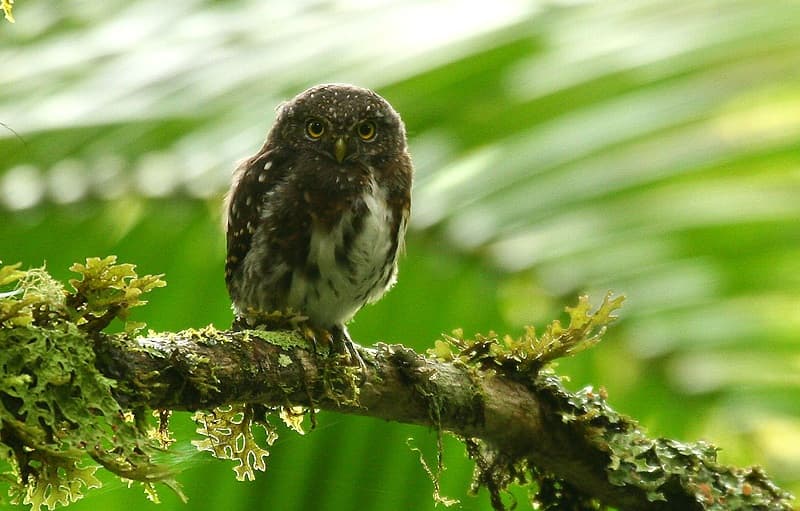
The Costa Rican pygmy owl is a small owl species found in the montane forests of Costa Rica and Panama. It is known for its distinctive "eye spots" on the back of its head and its varied vocalizations. This species is a year-round resident and forages for prey both day and night.

Pacific pygmy owl
The Pacific pygmy owl, also known as the Peruvian pygmy owl, is a small owl species found on the western slopes of the Andes in Chile, Ecuador, and Peru. It is distinguished by its varied color morphs, including gray, brown, and rufous, and its distinctive vocalizations which help differentiate it from similar species.