
Black-banded owl
The black-banded owl (Strix huhula) is a medium-sized, nocturnal owl native to South America. It is characterized by its striking black plumage with dense white horizontal bars and a distinctive black facial mask. This species inhabits various subtropical and tropical forests, and its elusive nature makes it one of the least understood owls in its range.
Key Facts
- ›Medium-sized owl, measuring 30-36 cm in length.
- ›Distinctive black and white barred plumage with a black facial mask.
- ›Found in subtropical and tropical forests of South America.
- ›Entirely nocturnal and does not migrate.
- ›Diet includes bats and moths.
- ›Typically lays a single egg in a nest among forked branches.

Black-Banded Owl
Subtropical Forests, Tropical Forests, Lowland Forests, Medium-Altitude Forests, Humid Forests, Atlantic Forests, Igapó Forests, Terra-Firme Forests, Araucaria Forests, Disturbed Habitats
South America, Argentina, Bolivia, Brazil, Colombia, Ecuador, French Guiana, Guyana, Paraguay, Peru, Suriname, Venezuela
Bats, Moths, Large Insects, Small Rodents
About Black-banded owl
The Black-Banded Owl
The black-banded owl (Strix huhula) is a medium-sized, nocturnal owl species belonging to the Strigidae family. It is a resident bird, meaning it does not migrate and remains within its native South American range year-round. The species is characterized by its striking appearance: a predominantly blackish plumage densely striated with horizontal, wavy white bars, a distinct black facial mask, and a yellow-orange bill and feet. Its rounded head lacks ear tufts, distinguishing it from some other owl species.
Habitat and Distribution
This elusive owl inhabits a variety of subtropical and tropical forests, ranging from lowlands to medium altitudes. Its presence has been recorded across numerous South American countries, including Argentina, Bolivia, Brazil, Colombia, Ecuador, French Guiana, Guyana, Paraguay, Peru, Suriname, and Venezuela. They are often found below 500 meters, though occasional sightings occur up to 1,400 meters. Habitats include humid forests, Atlantic forests, igapó, terra-firme forests, Araucaria forests, and even disturbed areas like clearings and agricultural land.
Behavior and Diet
The black-banded owl is entirely nocturnal. Its vocalizations are distinctive, with males producing a song of changing hoots, typically a sequence of deep guttural notes followed by shorter, louder hoots. Females emit a slightly higher-pitched version. During the nesting period, a variety of screeches and calls are heard between mates. Information on their diet is limited, but known prey includes bats and moths. Their closest relative, the black-and-white owl, also preys on large insects and bats, and other related species consume small rodents.
Reproduction
Details on the reproduction of the black-banded owl are scarce, with the first description of nesting reported in 2013. They typically lay a single egg, which is incubated among forked branches rather than in a cavity. The incubation period occurs from September to November. It is assumed that the female undertakes most of the incubation and brooding. Both parents actively defend their nest site. While pairs may reuse a tree fork for nesting in subsequent years, they do not necessarily breed consecutively.
Source: Wikipedia ↗
Frequently Asked Questions
What is the scientific name of the black-banded owl?
The scientific name of the black-banded owl is Strix huhula. There is some taxonomic debate, with some authors placing it in the genus Ciccaba along with other medium-sized South American wood owls.
Where do black-banded owls live?
Black-banded owls are found in subtropical and tropical forests across South America. Their range extends from southern Colombia to southeastern Argentina and Brazil, inhabiting areas from lowlands up to medium altitudes.
What does a black-banded owl look like?
These owls are medium-sized, with blackish plumage densely striated with wavy white bars. They have a black face mask around their eyes, a rounded head without ear tufts, and a yellow-orange bill and feet. The tail is sooty-brown with narrow white bars.
What do black-banded owls eat?
While information on their diet is limited, black-banded owls are known to eat bats, and they have been observed eating and feeding moths to their nestlings. Their closest relative, the black-and-white owl, also consumes large insects and bats.
How do black-banded owls reproduce?
Reproduction details are scarce, but the black-banded owl typically has a clutch size of one nestling. Their nests are found among forked branches, not in cavities, and both parents defend the nest. The incubation period is from September to November.
Are black-banded owls easy to find?
No, black-banded owls are difficult to detect and are considered one of the least known Strigidae in South America. Few sightings have been recorded, and their population size has not been assessed, though they are described as relatively common but patchily distributed.
Related Owl species
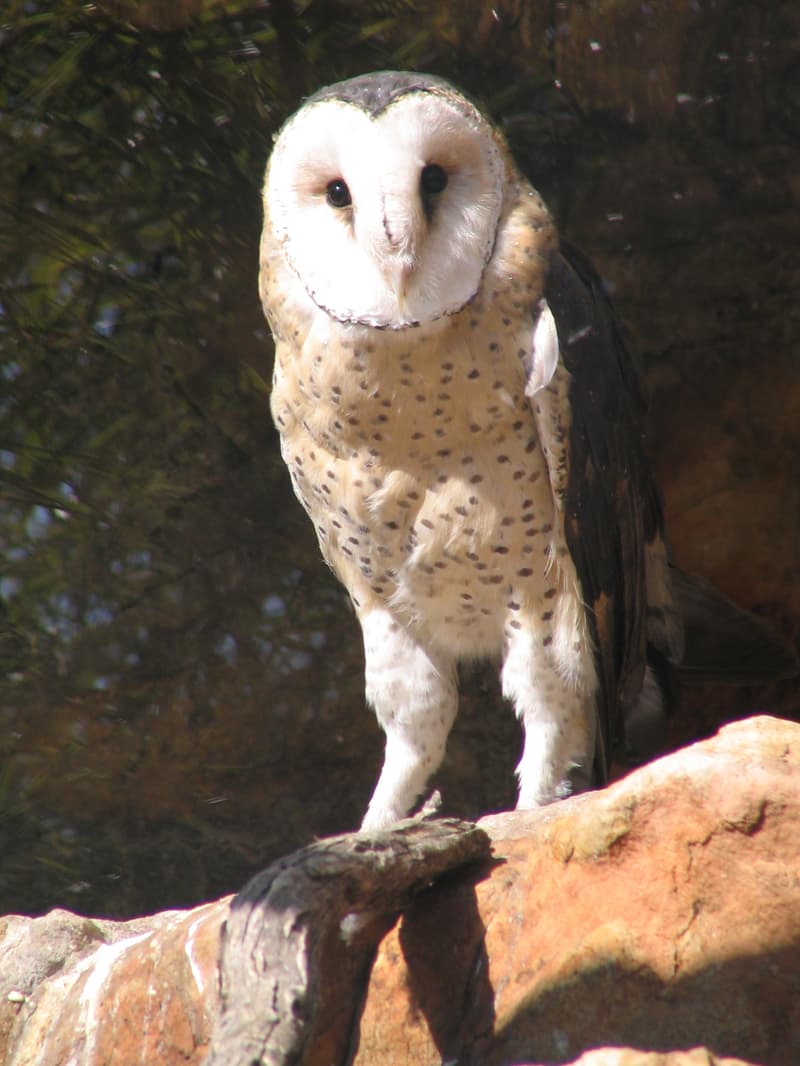
African grass owl
The African grass owl (Tyto capensis) is a medium-sized owl found in sub-Saharan Africa, known for its uniform sooty blackish-brown upperparts and heart-shaped facial disc. It primarily inhabits moist grasslands and savannas, where it hunts rodents and other small mammals at night.

African scops owl
The African scops owl (Otus senegalensis) is a small owl native to sub-Saharan Africa, characterized by its cryptic greyish-brown plumage and bright yellow eyes. It is a strictly nocturnal hunter, often overlooked during the day due to its remarkable camouflage. Its distinctive call is a monotonous "prrrp" sound.

African wood owl
The African wood owl (Strix woodfordii), also known as Woodford's owl, is a common forest owl species native to sub-Saharan Africa. It is distinguished by its rounded head, large dark eyes with white eyebrows, and a distinctive hooting call that can be heard over long distances. This owl is strictly nocturnal and primarily inhabits indigenous forests and woodlands.