
Camiguin boobook
The Camiguin boobook (Ninox leventisi), also known by its native name kugkug, is an owl species endemic to Camiguin island in the Philippines. It is distinguished by its unique greenish-yellow or grayish eyes, a trait not found in its closely related species. This species was reclassified from a subspecies of the Philippine hawk-owl in 2012 based on vocal and other evidence indicating its distinctiveness.
Key Facts
- ›Found exclusively on Camiguin island in the Philippines.
- ›Possesses distinctive greenish-yellow or grayish eyes, unlike the yellow or reddish-brown eyes of related species.
- ›Is one of the largest owls within the Philippine hawk-owl species complex.
- ›Inhabits tropical moist lowland primary and secondary forests.
- ›Classified as Vulnerable by the IUCN, with an estimated 250-999 mature individuals.
- ›Threatened primarily by habitat loss due to logging, mining, and agricultural conversion.
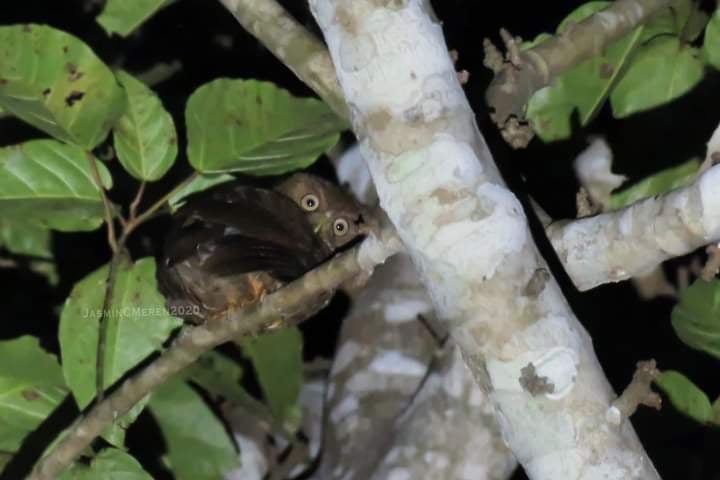
Camiguin Hawk-Owl, Kugkug
Tropical Moist Lowland Primary Forests, Tropical Moist Lowland Secondary Forests, Forest Edge, Clearings, Plantations
Philippines
Insects, Small Mammals, Reptiles, Amphibians, Birds
About Camiguin boobook
The Camiguin boobook, scientifically known as Ninox leventisi and locally called kugkug, is a distinctive owl species endemic to the island of Camiguin in the Philippines. It stands out within its species complex due to its striking greenish-yellow or grayish eyes, a rare characteristic compared to the typical yellow or reddish-brown eyes of its relatives. Previously considered a subspecies of the Philippine hawk-owl, it was elevated to its own species status in 2012 following research that highlighted differences in its voice and other evidence.
Description and Size
Physically, the Camiguin boobook is notably one of the larger members of the Philippine hawk-owl complex. It reaches a height of approximately 25 cm, making it significantly larger than some of its congeners such as the Luzon boobook, Mindanao boobook, Mindoro boobook, and Sulu boobook, which typically measure between 15 to 20 cm tall. Its most unique physical attribute is its eye color, which is a vivid greenish-yellow, setting it apart from the standard eye coloration of closely related species.
Habitat and Ecology
The preferred habitat of the Camiguin boobook consists of tropical moist lowland forests, encompassing both primary and secondary growth. These owls can be found up to an elevation of 700 meters above sea level. While their presence is most concentrated in these forest environments, they are also occasionally observed in areas bordering forests, such as forest edges, clearings, and agricultural plantations.
Diet and Behavior
Detailed studies on the ecology and behavior of the Camiguin boobook are limited. However, based on the habits of other boobook owls, it is presumed that their diet consists of a variety of food sources. This likely includes insects, small mammals, reptiles, amphibians, and possibly even other birds. Information regarding their breeding habits is scarce, though it is generally assumed that, like other boobook owls, they nest within tree cavities.
Conservation Status and Threats
The Camiguin boobook is currently classified as Vulnerable by the International Union for Conservation of Nature (IUCN). Population estimates suggest a mature individual count ranging between 250 and 999, underscoring the species' precarious status. The most significant threat to this owl is habitat loss, driven by extensive deforestation for logging, mining operations, and the conversion of forest land into farmlands through slash-and-burn agriculture and urbanization. The influx of tourism has also contributed to habitat degradation.
Conservation Efforts
At present, there are no species-specific conservation programs actively underway for the Camiguin boobook. Proposed conservation actions include conducting more comprehensive surveys to gain a better understanding of the species' habitat requirements and population dynamics. Additionally, there is a call to initiate education and awareness campaigns to elevate the species' profile among local communities and foster a sense of pride in its protection. Lobbying for the preservation of remaining forest habitats is also a key proposed measure.
Source: Wikipedia ↗
Frequently Asked Questions
What makes the Camiguin boobook distinctive?
The Camiguin boobook is most notably distinguished by its unique greenish-yellow or grayish eyes, which differ from the yellow or reddish-brown eyes found in its closely related owl species. This feature, along with vocal evidence, led to its reclassification as a distinct species.
What is the habitat of the Camiguin boobook?
This owl species resides in tropical moist lowland forests, both primary and secondary, and can be found up to 700 meters above sea level. They are also occasionally observed at forest edges, in clearings, and within plantations.
What is the conservation status of the Camiguin boobook?
The Camiguin boobook is currently classified as Vulnerable on the IUCN Red List. Population estimates suggest there are between 250 and 999 mature individuals remaining, highlighting the need for conservation efforts.
What are the main threats facing the Camiguin boobook?
The primary threat to the Camiguin boobook is habitat loss. This is driven by extensive forest clearance for logging, mining, and conversion to farmlands through slash-and-burn practices and urbanization, often exacerbated by tourism development.
What does the Camiguin boobook eat?
While its diet has not been extensively studied, it is presumed to feed on a typical boobook diet. This likely includes insects, small mammals, reptiles, amphibians, and potentially even other birds.
Related Owl species
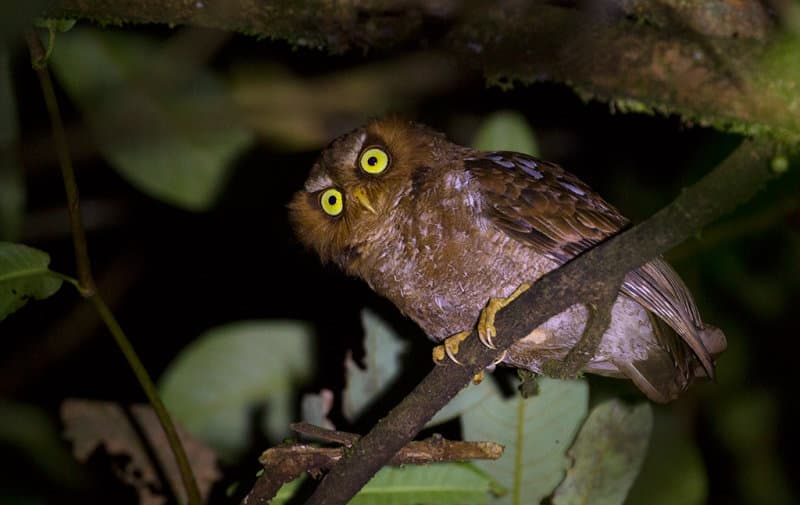
Flores scops owl
The Flores scops owl (Otus alfredi) is a small owl species found exclusively on the island of Flores in Indonesia. It is distinguished by its short, rounded ear-tufts, white forehead vermiculation, and orange-yellow beak with long, reddish rictal bristles. This vulnerable species is threatened by significant habitat loss.

Golden masked owl
The golden masked owl (Tyto aurantia) is a barn owl species native to New Britain, Papua New Guinea. It is characterized by its distinctive heart-shaped, white facial disc and is a poorly studied, largely solitary, and nocturnal predator of small mammals and insects. Habitat loss due to deforestation poses a significant threat to its vulnerable conservation status.

New Britain boobook
The New Britain boobook (Ninox odiosa) is a small owl endemic to the island of New Britain in Papua New Guinea. It is distinguished by its finely spotted chocolate-brown plumage, golden eyes, and distinctive vocalization of rapidly repeated, rising "whoo"s.