
Flores scops owl
The Flores scops owl (Otus alfredi) is a small owl species found exclusively on the island of Flores in Indonesia. It is distinguished by its short, rounded ear-tufts, white forehead vermiculation, and orange-yellow beak with long, reddish rictal bristles. This vulnerable species is threatened by significant habitat loss.
Key Facts
- ›Endemic to the island of Flores, Indonesia.
- ›Small and compact with short, rounded ear-tufts and white forehead marking.
- ›Possesses an orange-yellow beak and reddish rictal bristles.
- ›Inhabits montane forests, including moist semi-evergreen and dry monsoon forests.
- ›Listed as Vulnerable by the IUCN due to a declining population.
- ›Threatened primarily by habitat loss from various human activities.
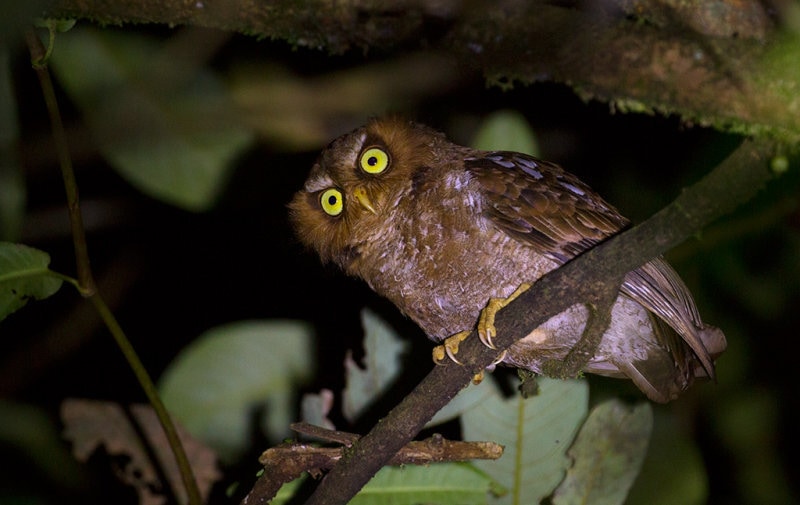
Flores Scops Owl
Montane Forests, Moist Semi-Evergreen Forests, Dry Monsoon Forests
Indonesia
About Flores scops owl
The Flores scops owl (Otus alfredi) is a small owl species endemic to the island of Flores in Indonesia. It is characterized by its compact size, short and rounded ear-tufts, and distinctive white markings on its forehead. The owl possesses an orange-yellow beak, accented by long, reddish rictal bristles, and its plumage features red-brown facial outlines and dark rufous neck feathers with white bases.
Habitat and Distribution
This species exclusively inhabits the island of Flores, residing in montane forests at elevations between 1,000 and 1,400 meters. While initially believed to thrive in moist semi-evergreen forests, recent observations suggest they also occupy dry monsoon forests found at lower altitudes.
Conservation Status
The Flores scops owl is recognized as a Vulnerable species by the IUCN, with its population estimated to be between 2,500 and 9,999 mature individuals in the wild. The population is experiencing a decline. Significant threats to its survival include habitat loss stemming from agriculture, logging, road construction, and fires.
Observations and Vocalizations
Early observations of the Flores scops owl were scarce, with only six records from Alfred Everett in 1896. More recent sightings have been made by various researchers since 2005, including at Danau Ranamese and near Poco Mandasawu. The calls of the Flores scops owl consist of sharp single notes and a more prominent territorial call, described as a rapid series of staccato notes.
Conservation Efforts
Conservation initiatives are in progress, notably at the Ruteng Nature Recreation Park, to preserve critical montane forest remnants. Proposals for further conservation include extensive nocturnal surveys in the Ruteng mountains and the Mata Wae Ndeo ridge forests.
Source: Wikipedia ↗
Frequently Asked Questions
What is the scientific name of the Flores scops owl?
The scientific name of the Flores scops owl is Otus alfredi. The genus name 'Otus' originates from the Greek word 'otos,' meaning eared owl.
Where is the Flores scops owl found?
The Flores scops owl is found exclusively on the island of Flores in Indonesia. It inhabits montane forests at altitudes ranging from 1,000 to 1,400 meters.
What does the Flores scops owl look like?
It is a small and compact owl with short, rounded ear-tufts and a white vermiculated forehead. It has an orange-yellow beak and reddish rictal bristles, along with red-brown facial markings and dark rufous neck feathers.
What are the conservation concerns for the Flores scops owl?
The Flores scops owl is listed as Vulnerable by the IUCN. Its population is declining due to threats such as habitat loss caused by logging, agriculture, and infrastructure development.
What are the vocalizations of the Flores scops owl?
Single calls are quick, sharp 'UH!' sounds lasting 1.5-2.5 seconds. Territorial calls are a 'short burst of loud, rapid staccato notes' translated as 'UH-UH-UH-UH...', which can continue for up to fifteen minutes.
Related Owl species
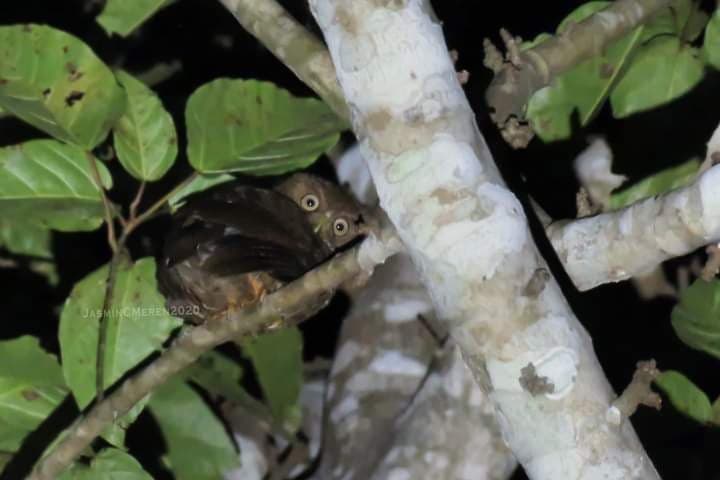
Camiguin boobook
The Camiguin boobook (Ninox leventisi), also known by its native name kugkug, is an owl species endemic to Camiguin island in the Philippines. It is distinguished by its unique greenish-yellow or grayish eyes, a trait not found in its closely related species. This species was reclassified from a subspecies of the Philippine hawk-owl in 2012 based on vocal and other evidence indicating its distinctiveness.

Golden masked owl
The golden masked owl (Tyto aurantia) is a barn owl species native to New Britain, Papua New Guinea. It is characterized by its distinctive heart-shaped, white facial disc and is a poorly studied, largely solitary, and nocturnal predator of small mammals and insects. Habitat loss due to deforestation poses a significant threat to its vulnerable conservation status.

New Britain boobook
The New Britain boobook (Ninox odiosa) is a small owl endemic to the island of New Britain in Papua New Guinea. It is distinguished by its finely spotted chocolate-brown plumage, golden eyes, and distinctive vocalization of rapidly repeated, rising "whoo"s.