
Little owl
The little owl (Athene noctua) is a small bird found across temperate and warmer regions of Europe, Asia, and North Africa. Distinctive for its flat-topped head, yellow eyes, and a stern expression, it inhabits a variety of open landscapes and is known for its association with wisdom in ancient Greek and Roman culture.
Key Facts
- ›Inhabits temperate and warmer parts of Europe, the Palearctic east to Korea, and North Africa.
- ›Small owl, approximately 22 cm in length with a wingspan of 56 cm.
- ›Feeds on insects, earthworms, invertebrates, and small vertebrates such as amphibians, reptiles, birds, and mammals.
- ›A cavity nester, typically laying a clutch of three to five eggs in spring.
- ›Symbol of wisdom and knowledge in ancient Greek and Roman mythology.
- ›Assessed as 'least concern' by the IUCN due to its wide range and stable population.

Owl of Athena, Owl of Minerva
- Farmland
- Woodland Fringes
- Steppes
- Semi-Deserts
- Agricultural Land With Hedgerows and Trees
- Orchards
- Woodland Verges
- Parks and Gardens
- Stony Semi-Deserts
- Dunes
- Vicinity of Ruins, Quarries and Rocky Outcrops
- Villages and Suburbs
Europe, Palearctic, North Africa, Korea
Insects, Earthworms, Invertebrates, Small Vertebrates, Amphibians, Reptiles, Birds, Mammals
About Little owl
Little Owl (Athene noctua)
The little owl, scientifically known as Athene noctua, is a small bird of prey recognized for its association with wisdom in classical mythology, often referred to as the owl of Athena or Minerva. It is native to much of temperate and warmer Europe, parts of Asia extending to Korea, and North Africa. The species has also been introduced to Britain and New Zealand.
Description and Habitat
This owl is characterized by its compact body, flat-topped head, and short tail, measuring approximately 22 cm in length with a wingspan of about 56 cm. Its plumage is a cryptic greyish-brown, marked with white spotting and barring, and it possesses prominent yellow eyes that contribute to its stern expression. The little owl thrives in a variety of open habitats, including farmland, woodland edges, steppes, and semi-deserts, often utilizing cavities in trees, cliffs, or old buildings for nesting.
Behavior and Diet
Primarily a nocturnal hunter, the little owl is also partly diurnal, often perching openly during the day. Its diet is varied, consisting mainly of insects, earthworms, and other invertebrates, supplemented by small vertebrates such as amphibians, reptiles, birds, and mammals. Males are territorial and defend their areas, while pairs often form strong, long-lasting bonds. The breeding season occurs in late spring, with females incubating a clutch of three to five eggs, and both parents contributing to feeding the young.
Conservation and Cultural Significance
With an extensive range and a large, stable population, the little owl is classified as 'Least Concern' by the IUCN. Historically, it has held significant cultural importance, symbolizing wisdom and knowledge due to its association with the Greek goddess Athena and the Roman goddess Minerva. Representations of the little owl appear on ancient Greek coinage and in artworks, and its call was even thought to have heralded historical events.
Source: Wikipedia ↗
Frequently Asked Questions
What is the scientific name of the little owl?
The scientific name of the little owl is Athene noctua. It was formally described in 1769 by Giovanni Antonio Scopoli under the binomial name Strix noctua before being placed in the genus Athene.
Where is the little owl found?
The little owl is widespread across Europe, Asia, and North Africa. Its range extends from the Iberian Peninsula and Denmark eastwards to China, and southwards to the Himalayas. In Africa, it is found from Mauritania to Egypt.
What does the little owl eat?
The little owl has a varied diet consisting of insects, earthworms, and other invertebrates. It also preys on small vertebrates, including amphibians, reptiles, birds, and mammals such as mice and voles.
What is the conservation status of the little owl?
The little owl is assessed as 'least concern' by the International Union for Conservation of Nature. This is due to its extremely large range, an estimated global population between 5 million and 15 million birds, and a believed stable population trend.
What are the distinctive physical characteristics of the little owl?
The little owl is a small owl with a flat-topped head, a plump body, and a short tail. It has a greyish-brown plumage spotted and streaked with white, pale underparts, and yellow eyes. Its facial disc gives it a stern, frowning expression.
How does the little owl breed?
The little owl breeds in spring, laying a clutch of three to five eggs in cavities such as tree holes, cliffs, or old buildings. The female incubates the eggs while the male provides food, and both parents care for the young until they leave the nest at around seven weeks old.
Related Owl species

Central American pygmy owl
The Central American pygmy owl (Glaucidium griseiceps) is a small owl species native to the humid tropical forests and secondary growth areas of Central America and northwestern Colombia. It is distinguished by its small size, spotted crown, and the presence of dark "false eyes" on its nape, which are thought to deter predators. This owl is known to hunt both during the day and at night.
Colima pygmy owl
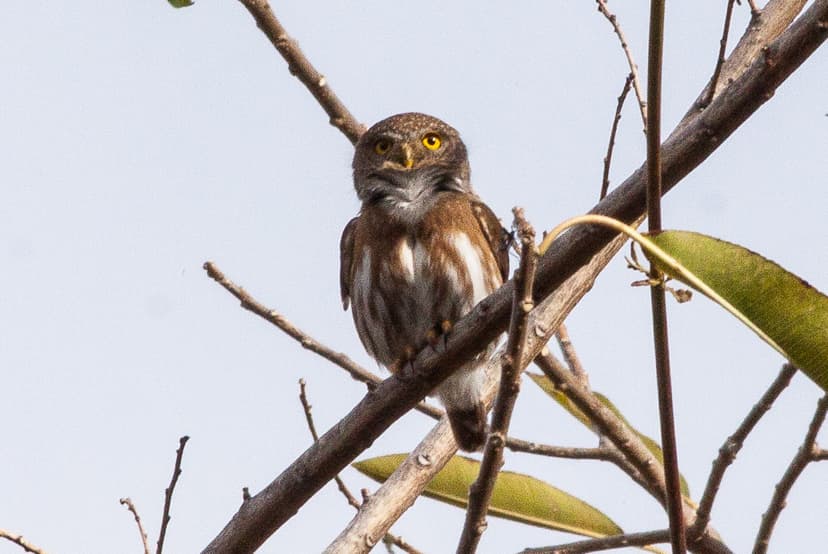
The Colima pygmy owl is a small owl species endemic to western Mexico, found in various forest types and coffee plantations. It is characterized by its brown plumage with white spots, distinctive "eyebrows," and a unique hooting song. While primarily nocturnal, it also exhibits daytime activity.

Cuban pygmy owl
The Cuban pygmy owl (Glaucidium siju) is a small owl species endemic to Cuba, recognized for its two color morphs: gray-brown and rufous. It inhabits various forest types and open areas across the island, from sea level to high elevations. This owl is notable for its active hunting during both day and night, feeding on a varied diet of insects, reptiles, small mammals, birds, and frogs.