
Cinereous owl
Strigiformes·Not assessed by IUCN
The cinereous owl (Strix sartorii), also known as the Mexican barred owl, is a species of owl endemic to Mexico. Historically considered a subspecies of the barred owl, recent vocal and genetic studies support its classification as a distinct species. It is characterized by its brownish-gray upperparts with whitish bars and pale, streaked underparts.
Key Facts
- ›Endemic to Mexico, found in three disjunct areas along the Sierra Madre Oriental, from Durango to Michoacán, and in Guerrero.
- ›Possesses brownish-gray upperparts with whitish to buff bars and pale buff to white underparts with dark streaks.
- ›Its diet and foraging strategy are presumed to be similar to the barred owl, including small mammals, birds, reptiles, and invertebrates.
- ›Limited information exists on its breeding phenology, with only one observation of a fledgling in early June.
- ›Its vocalizations, recorded since 2015, include a variety of hoots and other calls.
- ›The IUCN has not yet assessed its conservation status, and its biology requires further research.

Mexican Barred Owl
Forests
Mexico
Small Mammals, Lagomorphs, Small Birds, Reptiles, Invertebrates
About Cinereous owl
The cinereous owl (Strix sartorii), also known as the Mexican barred owl, is a species of owl found exclusively in Mexico. Historically, it was often classified as a subspecies of the barred owl (Strix varia), but since 2010, vocal and genetic evidence has led many ornithological bodies, including the International Ornithological Committee (IOC) and Clements taxonomy, to recognize it as a distinct species. However, some sources, like BirdLife International, still list it as a subspecies.
Description and Distribution
This large owl is characterized by its round head. Its upperparts are a brownish-gray, marked with whitish to buff bars, while its underparts are pale buff to white, featuring dark streaks. The facial disks are grayish-white to brownish-gray, framed by darker brown and buffy bars. Measurements from the few available specimens indicate a length ranging from 43.0 to 50.5 cm. Male weights have been recorded between 469 and 812 g, and female weights between 610 and 1,051 g.
The cinereous owl's distribution in Mexico is divided into three separate regions. The largest of these is along the Sierra Madre Oriental, extending from San Luis Potosí in the north to Veracruz in the south. A second significant area is a band running from Durango southward to Michoacán. A smaller, distinct area is found in Guerrero. Historical records suggest it may have once inhabited Oaxaca.
Behavior and Ecology
Information regarding the cinereous owl's foraging habits and diet is scarce. However, it is presumed to be similar to that of the barred owl, which is a semi-nocturnal to nocturnal predator. Its diet likely includes small mammals, lagomorphs, small birds, reptiles, and invertebrates.
Details about the cinereous owl's breeding are also limited. The only available information comes from the observation of a fledgling in Nayarit during early June. This young owl had well-developed flight feathers but retained downy body plumage. Vocalizations, first recorded in 2015, consist of a variety of hoots and other calls.
Conservation Status
The conservation status of the cinereous owl has not been assessed by the IUCN. Researchers emphasize that nearly every aspect of this owl's biology requires significantly more study and research.
Source: Wikipedia ↗
Frequently Asked Questions
What is the cinereous owl?
The cinereous owl (Strix sartorii) is a species of owl native to Mexico. It is also known as the Mexican barred owl.
Where does the cinereous owl live?
This owl is found in Mexico, with populations in the Sierra Madre Oriental, a band from Durango to Michoacán, and a smaller area in Guerrero. It may have formerly occurred in Oaxaca.
How is the cinereous owl described?
It is a large, round-headed owl with brownish-gray upperparts marked by whitish to buff bars. Its facial disks are grayish-white to brownish-gray, and its underparts are pale buff to white with dark streaks.
What is known about the cinereous owl's diet?
Little is directly known about its diet, but it is assumed to be similar to the barred owl, which preys opportunistically on small mammals, birds, reptiles, and invertebrates.
What is the conservation status of the cinereous owl?
The International Union for Conservation of Nature (IUCN) has not yet assessed the conservation status of the cinereous owl. Much of its biology remains poorly understood.
Related Owl species
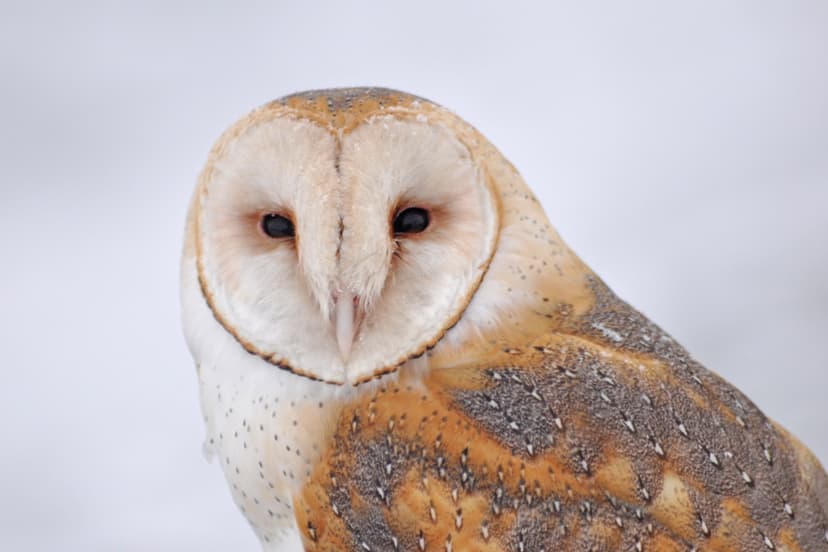
American barn owl
The American barn owl, scientifically known as Tyto furcata, is a widespread owl species native to North and South America. It is distinguished by its pale, heart-shaped facial disc, long wings, and undulating flight pattern, and plays a crucial role in rodent control due to its specialized diet.

Australian boobook
The Australian boobook (Ninox boobook) is the smallest owl species native to mainland Australia, also found in southern New Guinea, Timor, and the Sunda Islands. It is distinguished by its characteristic "boo-book" call and its predominantly dark-brown plumage marked with pale spots. This nocturnal hunter primarily preys on insects and small vertebrates, nesting in tree hollows and is considered of least concern by the IUCN.

Chaco owl
The Chaco owl is a species of owl native to southern South America, inhabiting the Gran Chaco region of Argentina, Bolivia, and Paraguay. It is distinguished by its lack of ear tufts, pale facial disk with dark lines, and barred plumage. Primarily nocturnal hunters, they are vocally active during twilight hours.