
Short-eared owl
The short-eared owl (Asio flammeus) is a widely distributed grassland species known for its distinctive "ear" tufts, which are usually not visible but can be displayed when defensive. This medium-sized owl is found on open country and grasslands across most continents, feeding primarily on rodents like voles.
Key Facts
- ›Widespread grassland species found on all continents except Antarctica and Australia.
- ›Distinguished by very short "ear" tufts that are usually not visible.
- ›Measures 34–43 cm in length with a wingspan of 85–110 cm.
- ›Plumage is mottled tawny to brown with streaked upper breast and barred tail and wings.
- ›Primarily feeds on rodents, especially voles, but also takes small mammals and occasionally birds.
- ›Nests on the ground in open habitats like prairie, tundra, and meadows.
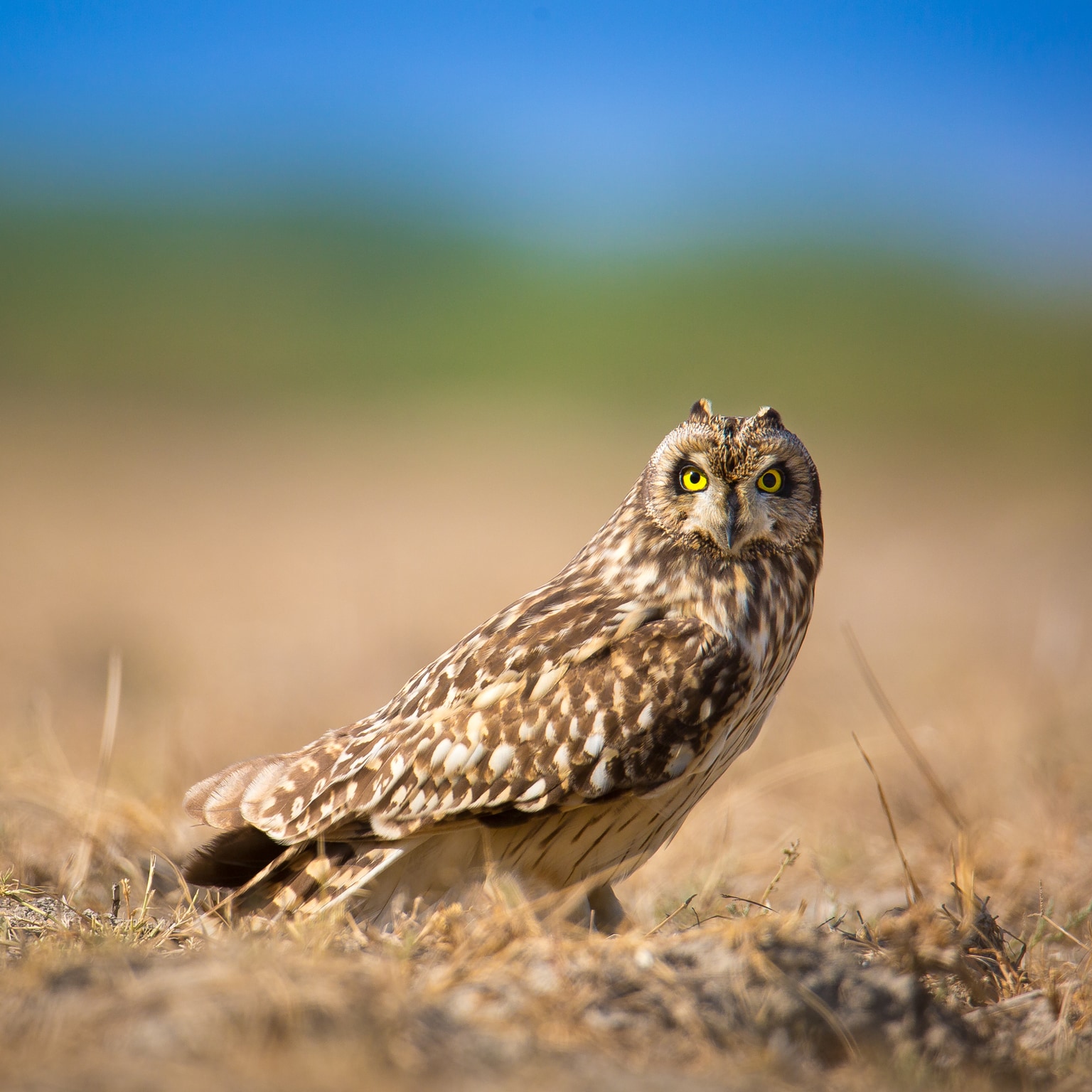
Pueo
Open Country, Grasslands, Prairie, Tundra, Savanna, Meadows
North America, South America, Europe, Asia, Africa, Caribbean, Hawaii, GaláPagos Islands
Rodents, Voles, Small Mammals, Small Birds, Insects
About Short-eared owl
The short-eared owl (Asio flammeus) is a widely distributed species belonging to the Strigidae family, characterized by its presence in open country and grasslands across a vast geographical range. While members of the genus Asio are known as "eared owls" due to feather tufts resembling ears, the short-eared owl's very short tufts are typically not visible, only being displayed in defensive situations.
Taxonomy and Distribution
Formally described in 1763, the short-eared owl's specific epithet, flammeus, derives from the Latin for "flame-colored." This species is now classified within the genus Asio. It boasts one of the most extensive distributions of any bird, found on all continents except Antarctica and Australia. It breeds in North America, South America, Europe, Asia, Africa, the Caribbean, Hawaii, and the Galápagos Islands. The short-eared owl is partially migratory, moving south from its northern breeding grounds in winter, and may also wander nomadically in search of food sources, particularly in years with low vole populations.
Physical Description
A medium-sized owl, the short-eared owl measures between 34–43 cm in length with a wingspan ranging from 85–110 cm. Its plumage is a mottled tawny to brown, featuring a barred tail and wings, with significantly streaked upper breast. Distinctive features include large, yellow-orange eyes encircled by prominent black rings, creating a mask-like appearance. Females are generally larger than males. Its flight is often described as floppy and bat-like due to its irregular wingbeats.
Behavior and Diet
Short-eared owls are active hunters, primarily at night, but are also known to hunt during diurnal and crepuscular periods, often coinciding with high vole activity. They typically fly low over open fields and grasslands before swooping down on their prey. Their diet predominantly consists of rodents, especially voles, supplemented by other small mammals and occasionally birds. Insects also form part of their diet. During the breeding season, which occurs from March to June in the Northern Hemisphere, males perform elaborate flight displays. They nest on the ground in concealed locations within their habitat, laying clutches of 4 to 7 eggs, though this number can increase significantly in years with abundant prey. The incubation period lasts 21–37 days, and young owls fledge in just over four weeks. A notable defensive behavior is the owl's ability to feign a crippled wing to lure predators away from its nest.
Vocalization
Their calls are described as scratchy and bark-like, with common vocalizations including raspy "waowk, waowk, waowk" or "toot-toot-toot-toot-toot" sounds. A loud "eeee-yerp" is also heard on the breeding grounds, though they are typically silent during the winter months.
Conservation Status
With an estimated global population of 1,200,000 to 2,100,000 individuals and a very wide range, the short-eared owl is classified as a species of Least Concern by the IUCN. However, declining populations have been noted in the southern United States, and it is listed as endangered in New Mexico. Efforts are underway in some regions, such as Long Island, New York, to assess the environmental impact of development on short-eared owl habitats.
Source: Wikipedia ↗
Frequently Asked Questions
How can I distinguish a short-eared owl from a long-eared owl?
Short-eared owls have very short ear tufts that are usually not visible, unlike the more prominent tufts of the long-eared owl. Additionally, short-eared owls have yellow irises with black rings around their eyes, while long-eared owls often have orange irises and black markings that are vertical rather than horizontal around the eyes.
What do short-eared owls eat?
Their diet consists mainly of rodents, with voles being a preferred prey. They will also consume other small mammals like mice, shrews, rats, bats, and muskrats. Occasionally, they will prey on smaller birds, particularly near coastal areas.
Where do short-eared owls live?
Short-eared owls inhabit open country and grasslands worldwide, excluding Antarctica and Australia. They breed in areas such as Europe, Asia, North and South America, the Caribbean, Hawaii, and the Galápagos Islands.
What are the distinctive physical features of a short-eared owl?
This medium-sized owl has large eyes, a big head, and broad wings. Its plumage is a mottled tawny to brown, with a barred tail and wings, and streaked upper breast. A notable characteristic is the yellow-orange eyes surrounded by black rings, giving the appearance of wearing mascara.
When is the breeding season for short-eared owls?
In the Northern Hemisphere, the breeding season typically lasts from March to June, with the peak in April. During this time, males engage in elaborate flight displays to attract females.
What is the conservation status of the short-eared owl?
The short-eared owl is evaluated by the IUCN as a species of least concern due to its large global population and extensive range. However, it is noted as declining in the southern United States and is listed as endangered in New Mexico.
Related Owl species

Burrowing owl
The burrowing owl (Athene cunicularia) is a small, long-legged owl found in open landscapes across North and South America. Unlike most owls, they are often active during the day and are known for their unique habit of living in burrows, often those excavated by other animals. Their adaptive behaviors and reliance on specific habitats make them a subject of conservation interest.

Snowy owl
The snowy owl, also known as the polar owl, is a large, predominantly white owl native to the Arctic regions of North America and Eurasia. It is distinguished by its striking white plumage, which provides camouflage in its snowy habitat, and its adaptation to hunting during daylight hours, particularly in summer. Its breeding success is closely linked to lemming populations, though it can adapt to other prey when necessary.
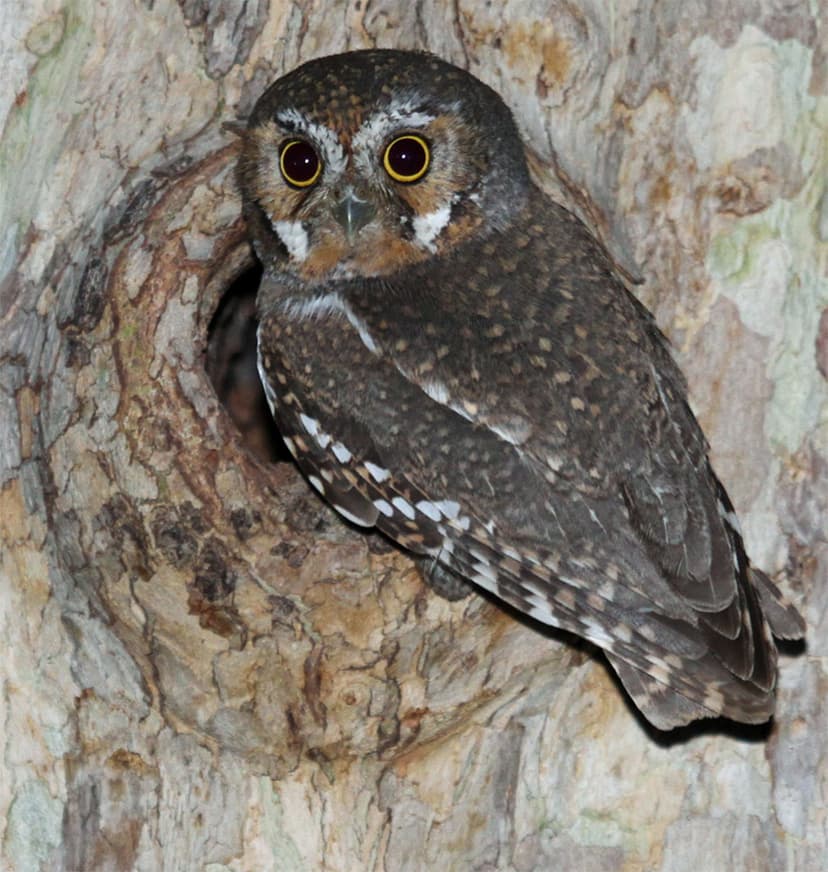
Elf owl
The Elf owl is the world's smallest owl, a tiny bird found in the southwestern United States, central Mexico, and the Baja California peninsula. Distinctive for its pale yellow eyes and gray bill, it frequently inhabits woodpecker holes in saguaro cacti. Primarily feeding on insects, this nocturnal owl is known for its complex vocalizations, which vary between sexes and play a role in territorial defense and mating.