
Yungas pygmy owl
The Yungas pygmy owl (Glaucidium bolivianum) is a small owl species native to the eastern Andes of South America, found in Argentina, Bolivia, and Peru. It is distinguished by its three color morphs (gray, brown, and rufous), pale dorsal spotting, and distinctive "false eyes" on its nape.
Key Facts
- ›Inhabits montane forests and cloud forests with dense undergrowth.
- ›Found on the eastern slopes of the Andes, typically between 1,400 and 3,000 meters in elevation.
- ›Has three color morphs: gray, brown, and rufous.
- ›Feeds on insects, arthropods, small birds, and possibly reptiles.
- ›Its song is characterized by a slow series of hollow notes, sometimes preceded by whistled notes.
- ›Assessed by the IUCN as Least Concern, though population decline is suspected due to habitat destruction.

Yungus Pygmy Owl
Montane Forest, Cloudforest With Heavy Undergrowth, Moss and Epiphytes, Podocarpus Forest
Argentina, Bolivia, Peru
Insects, Arthropods, Small Birds, Reptiles
About Yungas pygmy owl
The Yungas pygmy owl (Glaucidium bolivianum) is a small owl species found in the montane forests and cloud forests of the Andes in South America, specifically in Peru, Bolivia, and Argentina. While it has been historically treated as a subspecies of the Andean pygmy owl, it is now recognized as a distinct species and is closely related to Glaucidium jardinii.
Description and Appearance
This owl measures around 16 cm (6.3 inches) in length. It is notable for having three color morphs: a rare gray morph, and the more common brown and rufous morphs. All variations display pale dots on their crown, back, and upper wings, along with pale bands on their tail. A characteristic feature is the presence of "false eyes" on the nape of its neck, which may serve a defensive purpose. The underside of the Yungas pygmy owl is pale, marked with brownish streaks on its flanks and belly.
Distribution and Habitat
The Yungas pygmy owl inhabits the eastern slopes of the Andes, with its range extending from Peru southward through Bolivia and into northwestern Argentina. It typically occupies elevations between 1,400 and 3,000 meters (4,600 to 9,800 feet), though it can be found as low as 900 meters and as high as 3,900 meters in Bolivia. Its preferred habitat includes dense montane forests and cloud forests rich with undergrowth, mosses, and epiphytes, as well as Podocarpus forests. The owl is usually observed from the mid-levels of the forest canopy upwards.
Behavior and Diet
The Yungas pygmy owl is primarily nocturnal and crepuscular, meaning it is most active during the night and twilight hours. However, it is also capable of activity during daylight. Its foraging behavior takes place mostly in the canopy and within dense foliage below it. The diet consists mainly of insects and other arthropods, supplemented by small birds and potentially small reptiles.
Vocalization
The song of the Yungas pygmy owl is characterized by a series of hollow notes that are equally spaced and delivered at a relatively slow pace. This primary call may occasionally be introduced by two or three whistled notes.
Breeding
Information regarding the breeding habits of the Yungas pygmy owl is scarce. Existing knowledge suggests that they likely nest in cavities, specifically old woodpecker holes.
Conservation Status
The International Union for Conservation of Nature (IUCN) has assessed the Yungas pygmy owl as Least Concern. While its exact population size is not determined, it is believed to have experienced a decline since its initial description. The primary threats to the species are forest destruction and degradation, although the inaccessibility of some parts of its range may offer a degree of protection.
Source: Wikipedia ↗
Frequently Asked Questions
What is the scientific name of the Yungas pygmy owl?
The scientific name of the Yungas pygmy owl is Glaucidium bolivianum. It belongs to the Strigidae family of owls.
Where can the Yungas pygmy owl be found?
This species is distributed along the eastern slopes of the Andes Mountains, ranging from Peru southward through Bolivia and into northwestern Argentina.
What does the Yungas pygmy owl look like?
It is a small owl, approximately 16 cm in length, with three common color morphs: gray, brown, and rufous. All morphs feature pale dots on their upperparts and tail, and possess 'false eyes' on their napes.
What is the typical habitat of the Yungas pygmy owl?
The Yungas pygmy owl prefers montane forests and cloud forests characterized by heavy undergrowth, mosses, and epiphytes. It is often found in the mid-levels of the forest up to the canopy.
What does the Yungas pygmy owl eat?
Its diet primarily consists of insects and other arthropods. It also preys on small birds and potentially small reptiles.
What is the conservation status of the Yungas pygmy owl?
The International Union for Conservation of Nature (IUCN) classifies the Yungas pygmy owl as Least Concern. However, there are concerns about population decline due to forest destruction and degradation.
Related Owl species
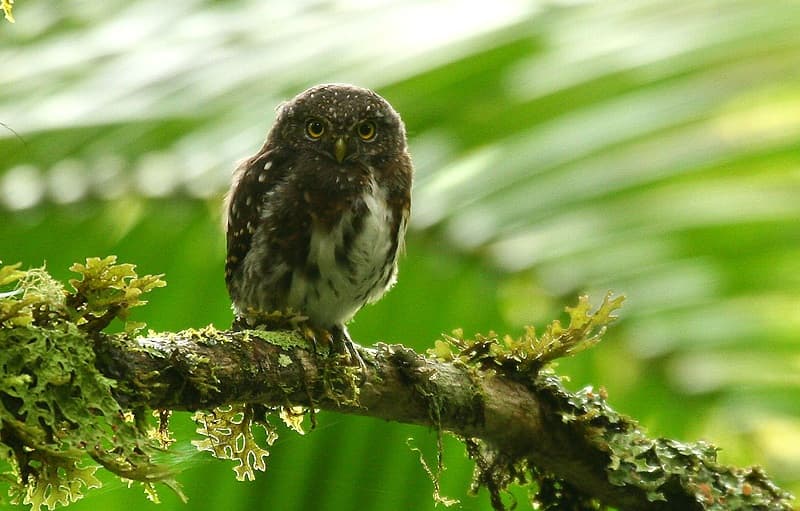
Costa Rican pygmy owl
The Costa Rican pygmy owl is a small owl species found in the montane forests of Costa Rica and Panama. It is known for its distinctive "eye spots" on the back of its head and its varied vocalizations. This species is a year-round resident and forages for prey both day and night.

Pacific pygmy owl
The Pacific pygmy owl, also known as the Peruvian pygmy owl, is a small owl species found on the western slopes of the Andes in Chile, Ecuador, and Peru. It is distinguished by its varied color morphs, including gray, brown, and rufous, and its distinctive vocalizations which help differentiate it from similar species.
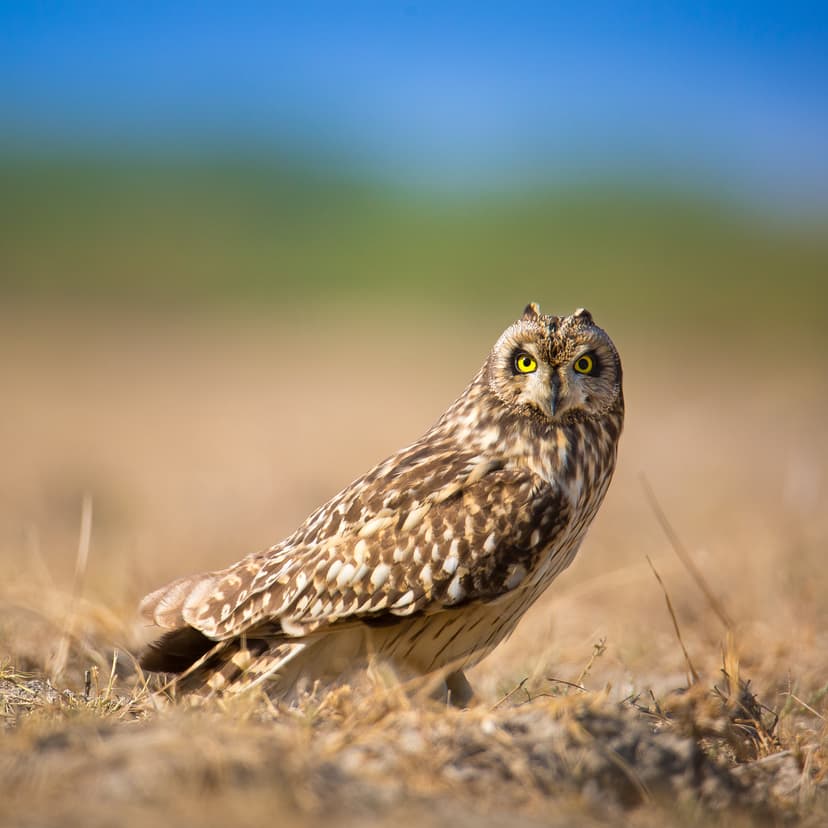
Short-eared owl
The short-eared owl (Asio flammeus) is a widely distributed grassland species known for its distinctive "ear" tufts, which are usually not visible but can be displayed when defensive. This medium-sized owl is found on open country and grasslands across most continents, feeding primarily on rodents like voles.