
Dusky eagle-owl
The dusky eagle-owl (Ketupa coromanda) is a large owl species found across South and Southeast Asia, known for its prominent ear tufts and greyish-brown plumage. It inhabits a variety of environments, including forests, wetlands, and agricultural areas with trees. While largely nocturnal, it can be active during daylight, especially in cloudy conditions.
Key Facts
- ›Widespread in South and Southeast Asia.
- ›Characterized by prominent ear tufts and greyish-brown coloration.
- ›Inhabits forests, wooded wetlands, and agricultural areas with scattered trees.
- ›Largely active at night but can hunt during the day under certain conditions.
- ›Nests are typically reused from other large birds like woolly-necked storks.
- ›Considered Least Concern by the IUCN Red List.

Dusky Eagle-Owl, Bubo Coromandus
- Forests
- Wooded wetlands
- Agricultural areas with scattered groves and trees
- Roadside avenues with old large trees
- Oil palm plantations
South Asia, Southeast Asia, Pakistan, India, Nepal, Bangladesh, Myanmar, Thailand, Malaysia, China
About Dusky eagle-owl
The dusky eagle-owl, scientifically known as Ketupa coromanda, is a large owl species native to South and Southeast Asia. Its common name is derived from its predominantly greyish-brown coloration, complemented by prominent ear tufts. This owl is a significant resident of diverse habitats, ranging from dense forests and wooded wetlands to agricultural landscapes dotted with trees and even mature roadside avenues.
Description and Characteristics
Physically, the dusky eagle-owl is characterized by its large size, greyish-brown upperparts, and lighter, greyish-white underparts streaked with dark brown. Its wings are dark brown and exhibit some whitish streaks. A recognized subspecies, Ketupa coromanda klossii, is notably darker and lacks these prominent whitish markings on its wings and scapulars. The species's wingspan typically falls between 380 and 435 mm, with tail lengths ranging from 187 to 224 mm.
Distribution and Habitat
The geographic range of the dusky eagle-owl is extensive, spanning across South and Southeast Asia. It has been recorded in countries such as Pakistan, India, Nepal, Bangladesh, Myanmar, Thailand, Malaysia, and parts of China. Its preferred habitats include forests, wooded wetlands, and agricultural areas that feature scattered tree groves. Notably, it has also been observed in oil palm plantations in Peninsular Malaysia.
Behavior and Ecology
The dusky eagle-owl is primarily nocturnal, emerging from its roost shortly before sunset. However, it is adaptable and has been seen hunting during daylight hours, particularly when weather conditions are cloudy. The nesting season typically occurs between November and April, with peak breeding activity in December and January. A distinctive aspect of their nesting behavior is the reuse of stick nests constructed by other large bird species, most notably woolly-necked storks. These owls often show a preference for specific tree species and areas with a high density of stork nests, suggesting a reliance on observing the breeding patterns of these stork populations for successful nesting.
Conservation Status
The dusky eagle-owl is currently listed as Least Concern on the IUCN Red List. While its estimated extent of occurrence is vast, some data suggests this figure might be an overestimation. The species has been documented in agricultural environments that support agroforestry, highlighting the importance of such multifunctional landscapes for maintaining healthy breeding populations.
Source: Wikipedia ↗
Frequently Asked Questions
What is the scientific name of the dusky eagle-owl?
The scientific name of the dusky eagle-owl is Ketupa coromanda. It was first described by John Latham in 1790 as Strix coromanda.
Where is the dusky eagle-owl found?
The dusky eagle-owl is found from Pakistan, India, Nepal, and Bangladesh to Myanmar, Thailand, Malaysia, and into China. It inhabits forests, wooded wetlands, agricultural areas with scattered groves, and roadside avenues with old large trees.
What does the dusky eagle-owl look like?
It is a large greyish-brown owl with prominent ear tufts. Its underparts are greyish white with dark brown streaks, and its dark brown wings have some whitish streaks.
When is the nesting season for dusky eagle-owls?
The nesting season for the dusky eagle-owl is from November to April, with most breeding activity observed during December and January. They often reuse stick nests built by other large birds.
What is the conservation status of the dusky eagle-owl?
The dusky eagle-owl is listed as Least Concern on the IUCN Red List. Its estimated extent of occurrence is vast, though some sources suggest this might be an over-estimate.
Are dusky eagle-owls active during the day?
While largely active at night, the dusky eagle-owl is not deterred by daylight and has been observed hunting during the day, particularly in cloudy weather. They emerge from their roost shortly before sunset.
Related Owl species

Cuban pygmy owl
The Cuban pygmy owl (Glaucidium siju) is a small owl species endemic to Cuba, recognized for its two color morphs: gray-brown and rufous. It inhabits various forest types and open areas across the island, from sea level to high elevations. This owl is notable for its active hunting during both day and night, feeding on a varied diet of insects, reptiles, small mammals, birds, and frogs.

Pacific screech owl
The Pacific screech owl (Megascops cooperi) is a medium-sized owl native to Central America, found in countries like Mexico, Costa Rica, and Nicaragua. It is distinguished by its prominent ear tufts, bright yellow eyes, and subspecies-specific vocalizations, which set it apart from related screech owl species. This owl inhabits a diverse range of environments, from forests and mangroves to arid woodlands.
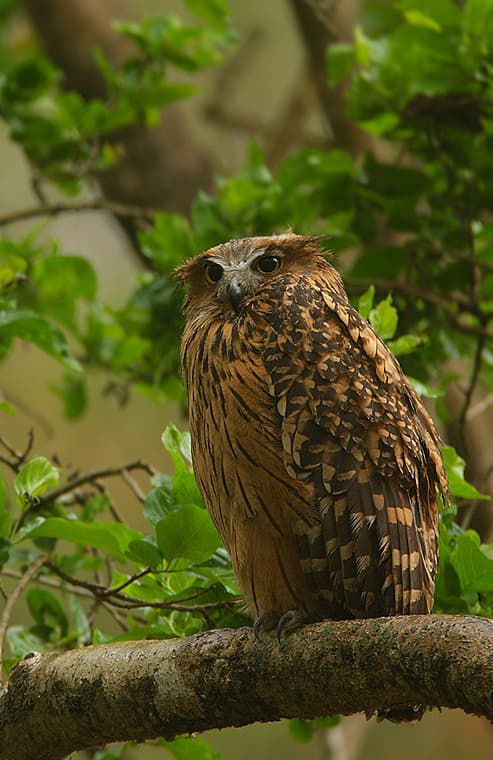
Tawny fish owl
The Tawny fish owl is a species of fish owl native to a wide range across Asia, from southern Nepal to Vietnam and China. It is distinguished by its orangey-rufous plumage with blackish markings, large, messy ear tufts, and yellow eyes, making it one of the more visually striking fish owl species. Primarily nocturnal, it inhabits forests near mountain streams and is known for its powerful hunting of fish and other small prey.