
Pacific screech owl
The Pacific screech owl (Megascops cooperi) is a medium-sized owl native to Central America, found in countries like Mexico, Costa Rica, and Nicaragua. It is distinguished by its prominent ear tufts, bright yellow eyes, and subspecies-specific vocalizations, which set it apart from related screech owl species. This owl inhabits a diverse range of environments, from forests and mangroves to arid woodlands.
Key Facts
- ›Native to Mexico, Costa Rica, El Salvador, Guatemala, Honduras, and Nicaragua.
- ›Features prominent ear tufts and bright yellow eyes.
- ›Has distinct vocalizations that differentiate it from western and eastern screech owls.
- ›Inhabits various environments including forests, mangroves, and arid woodlands.
- ›Primarily feeds on large insects, scorpions, and small vertebrates.
- ›Breeds in tree cavities, typically old woodpecker holes.

Pacific Screech Owl
Swamp forest, Mangroves, Arid woodland, Semi-arid woodland, Scrub, Open country with scattered trees and cacti, Secondary forest
Mexico, Guatemala, Honduras, El Salvador, Nicaragua, Costa Rica
Large Insects, Arthropods, Scorpions, Small Vertebrates, Birds, Flying Squirrels
About Pacific screech owl
The Pacific screech owl (Megascops cooperi) is a medium-sized owl species found across several Central American countries, including Mexico, Guatemala, El Salvador, Honduras, Nicaragua, and Costa Rica. While sometimes considered a race of other screech owl species, its vocalizations are distinct, setting it apart.
Description and Habitat
This owl is characterized by prominent ear tufts and bright yellow eyes. Size varies slightly between its two recognized subspecies, M. c. cooperi and M. c. lambi. The nominate subspecies typically ranges from 23 to 26 cm in length and weighs between 145 to 175 grams, featuring pale tawny gray upperparts with dusky and black markings, and off-white underparts with a herringbone pattern. The subspecies M. c. lambi is slightly smaller, measuring 20 to 22 cm and weighing 115 to 130 grams, with additional dark bars and streaks on its crown. The Pacific screech owl inhabits a wide array of environments, from swamp forests and mangroves to arid woodlands, open country with scattered trees, and secondary forests, generally found from sea level up to elevations of 1,000 to 1,300 meters.
Behavior and Diet
The Pacific screech owl is primarily nocturnal and crepuscular, hunting from low perches in clearings or at woodland edges. It captures prey by pouncing or sallying. Its diet consists mainly of large insects, but also includes other arthropods like scorpions and small vertebrates such as birds and flying squirrels.
Breeding and Vocalization
Details about the breeding phenology of the Pacific screech owl are not extensively documented, but it is believed to breed during the dry season. Nests are typically constructed in tree cavities, frequently utilizing old woodpecker holes, where clutches of three to four eggs are laid. The vocalizations of the two subspecies are notably different: the nominate subspecies has a song described as "prrr pu-pu-PU-PU-PU-pu-pu," while M. c. lambi produces a "staccato croarrr-gogogogogogok." Both also have secondary songs.
Conservation Status
The International Union for Conservation of Nature (IUCN) has assessed the Pacific screech owl as Least Concern. Its estimated population exceeds 50,000 mature individuals, although there are indications that the population is decreasing.
Source: Wikipedia ↗
Frequently Asked Questions
What is the scientific name of the Pacific screech owl?
The scientific name of the Pacific screech owl is Megascops cooperi. It belongs to the family Strigidae.
Where can the Pacific screech owl be found?
The Pacific screech owl is found in Costa Rica, El Salvador, Guatemala, Honduras, Mexico, and Nicaragua. Its range extends along the Pacific slope of these countries.
What makes the Pacific screech owl distinctive?
Distinctive features include its prominent ear tufts and bright yellow eyes. Furthermore, its vocalizations are unique and differ from those of the western and eastern screech owls.
What does the Pacific screech owl eat?
Its diet primarily consists of large insects. It also consumes other arthropods like scorpions and small vertebrates such as birds and flying squirrels.
What are the nesting habits of the Pacific screech owl?
The Pacific screech owl typically nests in tree cavities. These are often old woodpecker holes, where it lays its clutch of eggs.
What is the conservation status of the Pacific screech owl?
The Pacific screech owl is assessed by the IUCN as being of Least Concern. Its population is estimated to exceed 50,000 mature individuals, though it is believed to be decreasing.
Related Owl species

Cuban pygmy owl
The Cuban pygmy owl (Glaucidium siju) is a small owl species endemic to Cuba, recognized for its two color morphs: gray-brown and rufous. It inhabits various forest types and open areas across the island, from sea level to high elevations. This owl is notable for its active hunting during both day and night, feeding on a varied diet of insects, reptiles, small mammals, birds, and frogs.

Dusky eagle-owl
The dusky eagle-owl (Ketupa coromanda) is a large owl species found across South and Southeast Asia, known for its prominent ear tufts and greyish-brown plumage. It inhabits a variety of environments, including forests, wetlands, and agricultural areas with trees. While largely nocturnal, it can be active during daylight, especially in cloudy conditions.
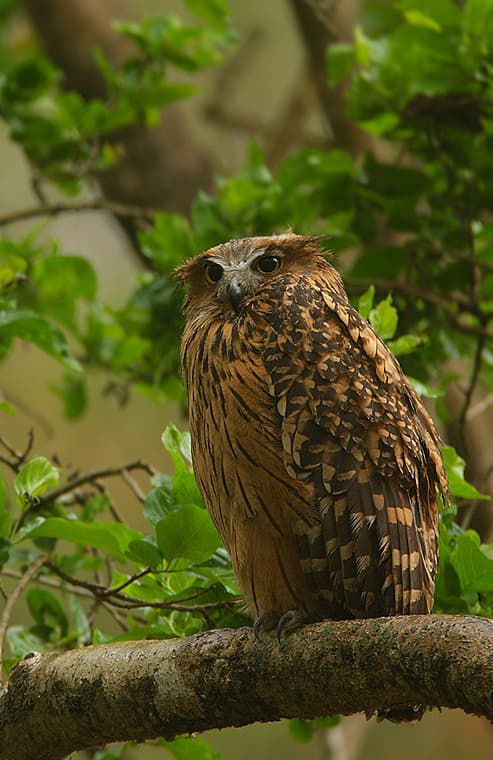
Tawny fish owl
The Tawny fish owl is a species of fish owl native to a wide range across Asia, from southern Nepal to Vietnam and China. It is distinguished by its orangey-rufous plumage with blackish markings, large, messy ear tufts, and yellow eyes, making it one of the more visually striking fish owl species. Primarily nocturnal, it inhabits forests near mountain streams and is known for its powerful hunting of fish and other small prey.