
Tawny fish owl
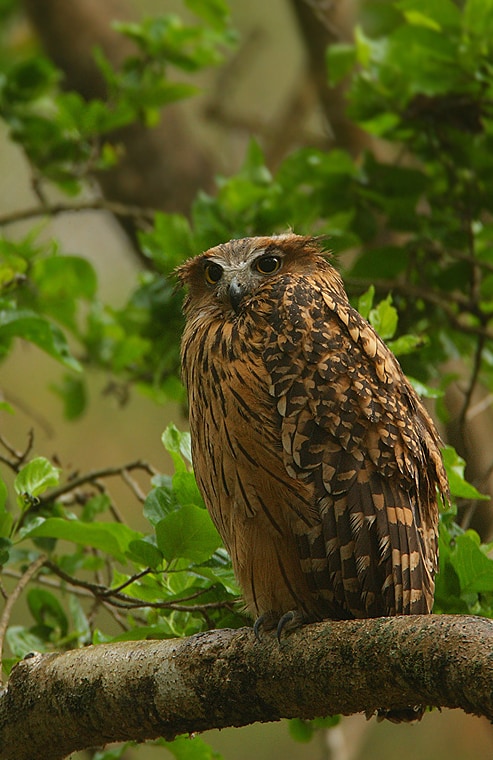
The Tawny fish owl is a species of fish owl native to a wide range across Asia, from southern Nepal to Vietnam and China. It is distinguished by its orangey-rufous plumage with blackish markings, large, messy ear tufts, and yellow eyes, making it one of the more visually striking fish owl species. Primarily nocturnal, it inhabits forests near mountain streams and is known for its powerful hunting of fish and other small prey.
Key Facts
- ›Native to southern Nepal, northern India, Bangladesh, Bhutan, China, Laos, Myanmar, Taiwan, and Vietnam.
- ›Possesses distinctive orangey-rufous upperparts with blackish markings and large, tousled ear tufts.
- ›Has yellow eyes, distinguishing it from some other owl species.
- ›Primarily nocturnal but can exhibit diurnal activity, especially when feeding young or on cloudy days.
- ›Preys on fish, crabs, frogs, toads, lizards, snakes, small mammals, and birds.
- ›Known for its powerful build and adaptations for catching fish, including rough toe textures and strong talons.
Subtropical To Temperate Forests, Forest Tracts With Mountain Streams, Riparian Zones
Southern Nepal, Northern India, Bangladesh, Bhutan, China, Laos, Myanmar, Taiwan, Vietnam
Fish, Crabs, Shrimps, Frogs, Toads, Lizards, Snakes, Small Mammals, Rodents, Bamboo Rats, Birds
About Tawny fish owl
The Tawny fish owl (Ketupa flavipes) is a visually striking owl species belonging to the family Strigidae, native to a broad swathe of southern Asia. Its range extends from southern Nepal eastward through India, Bangladesh, Bhutan, China, Laos, Myanmar, Taiwan, and Vietnam. Its wide distribution has led to its classification as 'Least Concern' on the IUCN Red List.
Description and Adaptations
This owl is recognized for its distinctive orangey-rufous plumage on its crown and upperparts, adorned with blackish markings. It features prominent, often messy ear tufts that usually droop to the sides of its head, and striking yellow eyes. Unlike many owls specialized for silent flight, the Tawny fish owl's feathers are not soft, and it lacks the specialized fringes on its primaries, meaning its wing beats produce sound. This suggests a greater reliance on vision for hunting. Its legs are feathered about two-thirds of the way down, and the lower parts are greenish-yellow with greyish talons. These physical traits, along with its powerful build, relatively large wings, and long legs, are adaptations for its piscivorous lifestyle, aiding in the capture of aquatic prey. The rough texture on the bottom of its toes is particularly useful for grasping slippery fish, a feature shared with diurnal fish-hunting raptors.
Habitat and Distribution
The Tawny fish owl inhabits subtropical to temperate forests, with a specific requirement for forest tracts that contain mountain streams. It is often found in Himalayan foothills and prefers remote wilderness areas with fast-flowing waters, avoiding disturbed habitats such as agricultural land or areas near villages. Its range overlaps with that of the brown fish owl in regions like Laos and Vietnam.
Behavior and Diet
Primarily nocturnal, the Tawny fish owl typically leaves its daytime roosts around sunset and returns before sunrise. It is most active and forages during twilight. However, it can exhibit diurnal activity, particularly in the late afternoon, on cloudy days, or when feeding its young. When disturbed, these owls tend to remain still rather than flee. Their diet is diverse, consisting mainly of fish, but also including freshwater crabs, shrimps, frogs, toads, lizards, snakes, small mammals like rodents and bamboo rats, and even birds such as Mandarin ducks and large ground birds. They hunt by swooping down to the water's surface or by wading into shallows. They are known for their surprisingly active hunting style.
Reproduction
These owls are highly solitary and territorial. The breeding season generally occurs between November and February. Tawny fish owls do not construct nests; instead, they lay their eggs on the bare ground in natural cavities such as holes in river banks, caves in cliffs, or in the forks of large trees. They also sometimes utilize abandoned nests of other raptors, like Pallas's fish eagles. Typically, two eggs are laid per clutch, though sometimes only one is. Further details regarding their reproductive biology are not extensively documented but are presumed to be similar to other fish owl species.
Source: Wikipedia ↗
Frequently Asked Questions
What is the scientific name for the Tawny fish owl?
The scientific name for the Tawny fish owl is Ketupa flavipes. It was first described by Brian Houghton Hodgson in 1836.
What does the Tawny fish owl eat?
The Tawny fish owl has a varied diet that includes fish, freshwater crabs, shrimps, frogs, toads, lizards, snakes, small mammals like moles and rodents, and even birds such as Mandarin ducks and junglefowl.
Where does the Tawny fish owl live?
This species is found in subtropical to temperate forests across southern Asia, specifically in southern Nepal, northern India, Bangladesh, Bhutan, China, Laos, Myanmar, Taiwan, and Vietnam. It prefers forest tracts with mountain streams.
What are the distinctive physical characteristics of the Tawny fish owl?
Tawny fish owls are notable for their orangey-rufous crown and upperparts with blackish markings, large and messy ear tufts that hang to the sides, and bright yellow eyes. They also have feathering on two-thirds of their tarsi, with greenish-yellow legs.
Is the Tawny fish owl active during the day?
While primarily nocturnal, the Tawny fish owl can be at least partially diurnal. Daytime activity may occur in the late afternoon, and they might hunt before nightfall, especially on cloudy days or when feeding fledglings.
What sounds does the Tawny fish owl make?
The territorial call of the Tawny fish owl is a deep 'whoo-hoo'. It is also known to make a sound described as a cat-like meow.
How does the Tawny fish owl hunt?
They typically hunt by swooping down to the water's surface to catch fish. They are also known to hunt on foot, wading into shallows, and will pursue terrestrial prey like toads, lizards, snakes, and small mammals.
What are the nesting habits of the Tawny fish owl?
Tawny fish owls do not build their own nests. They lay their eggs on the bare ground in locations such as large holes in river banks, caves in cliffs, or the forks of large trees. They may also use abandoned nests of other birds, like Pallas's fish eagles.
Related Owl species

Cuban pygmy owl
The Cuban pygmy owl (Glaucidium siju) is a small owl species endemic to Cuba, recognized for its two color morphs: gray-brown and rufous. It inhabits various forest types and open areas across the island, from sea level to high elevations. This owl is notable for its active hunting during both day and night, feeding on a varied diet of insects, reptiles, small mammals, birds, and frogs.
Costa Rican pygmy owl
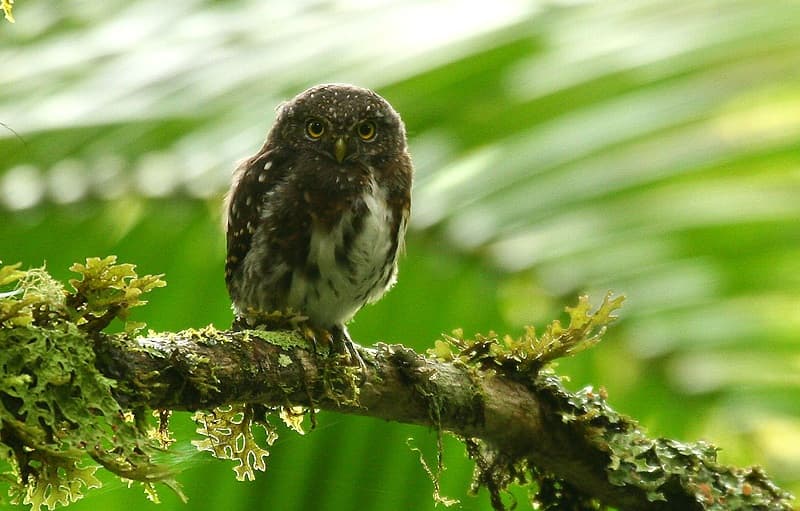
The Costa Rican pygmy owl is a small owl species found in the montane forests of Costa Rica and Panama. It is known for its distinctive "eye spots" on the back of its head and its varied vocalizations. This species is a year-round resident and forages for prey both day and night.

Pacific pygmy owl
The Pacific pygmy owl, also known as the Peruvian pygmy owl, is a small owl species found on the western slopes of the Andes in Chile, Ecuador, and Peru. It is distinguished by its varied color morphs, including gray, brown, and rufous, and its distinctive vocalizations which help differentiate it from similar species.