
Eastern grass owl
The eastern grass owl is a medium-sized owl found in grasslands and swamps across Asia, Australia, and parts of the western Pacific. It is distinguished by its dark brown upper parts, pale spots, and a heart-shaped facial disk. While globally listed as Least Concern, a subspecies in Taiwan faces significant threats from rodenticides and habitat alteration.
Key Facts
- ›Medium-sized owl with dark brown or tan upper parts and pale spots.
- ›Prefers tall grasslands and swamps, often roosting in vegetation tunnels.
- ›Primarily feeds on small rodents, using its long legs to seize prey in dense cover.
- ›Its call is a harsh, hissing screech, louder than a common barn owl but softer than a masked owl.
- ›Globally considered Least Concern, but the Taiwan subspecies is classified as critically endangered.
- ›Threatened in Taiwan by rodenticides and habitat loss due to afforestation.

Chinese Grass Owl, Australasian Grass Owl
Tall Grasslands, Swamps
Eastern Asia, Southern Asia, Southeast Asia, New Guinea, Philippines, Australia, Western Pacific
Small Rodents
About Eastern grass owl
The eastern grass owl (Tyto longimembris), also known by the common names Chinese grass owl and Australasian grass owl, is a species of owl belonging to the family Tytonidae. This medium-sized owl shares similarities in size with the common barn owl. Adult males typically range from 32 to 38 cm in length, while the slightly larger females measure between 35 and 42 cm. Their wingspan can extend from 100 to 116 cm, with females weighing around 460g and males about 400g.
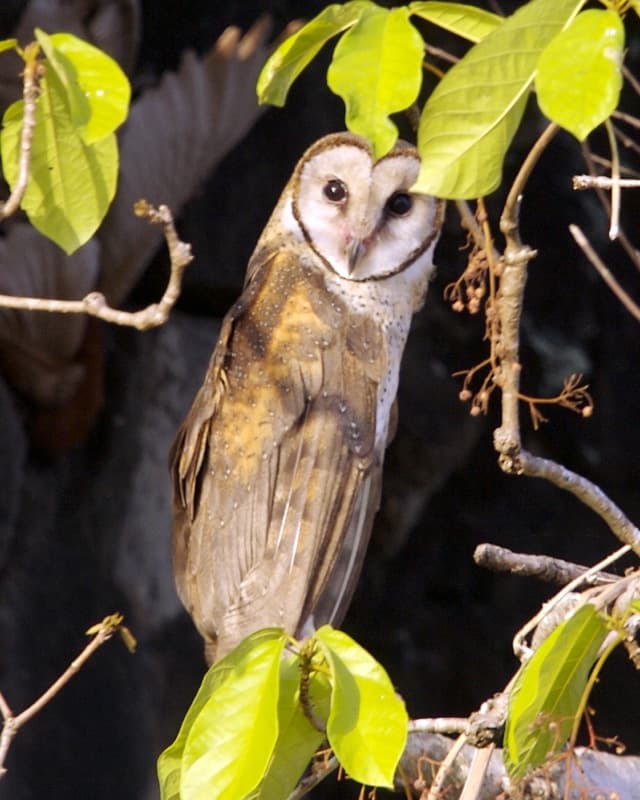
The plumage of the eastern grass owl features dark brown or tan upper parts marked with pale spots, and its wings display black and tan bars. It has a very pale beak, legs covered in feathers, and dark brown eyes. Like other owls in the Tyto genus, it possesses a distinctive heart-shaped facial disk that is brown buff in color and bordered with white.
Habitat and Distribution
This species prefers habitats of tall grasslands and swamps. Roosting sites commonly consist of flattened vegetation found within intricate systems of 'tunnels' that snake through the swamp vegetation. Nesting activities also take place in similar environments.
The eastern grass owl's distribution spans across eastern, southern, and southeast Asia, extending to parts of New Guinea, the Philippines, Australia (primarily in Queensland), and the western Pacific region.
Diet and Hunting
The primary food source for the eastern grass owl consists of small rodents. Studies conducted in parts of Australia have identified the long-haired rat and the cane rat as common prey items. The owl detects its prey while in flight and uses its notably long legs to penetrate dense ground cover in order to seize its quarry.
Vocalization
The vocalization of the eastern grass owl is characterized by a harsh, hissing screech or 'scream'. This call is comparable to those of other Tyto species but is generally louder than that of the common barn owl (Tyto alba) and softer than the call of the masked owl (Tyto novaehollandiae).
Conservation Status
On a global scale, the eastern grass owl is classified as 'Least Concern' by the IUCN, largely attributed to its extensive geographic range. However, the conservation status varies significantly at regional levels. Within Australia, the species is considered vulnerable under the New South Wales Threatened Species Conservation Act (1995).
In Taiwan
A specific subspecies, Tyto longimembris pithecops, endemic to Taiwan, is notably rare and possesses a small population. It is legally protected in Taiwan as a Category I species, denoting 'Endangered' status. This subspecies faces substantial threats, including mortality linked to anticoagulant rodenticides used in agricultural practices, which can affect raptors that prey on rodents. Furthermore, the conversion of abandoned farmland into forests has reduced and altered the suitable open habitats required by the owl. In response, Taiwan has implemented measures such as reducing rodenticide distribution and initiating incentive programs for farmers to adopt wildlife-friendly practices, with the eastern grass owl designated as a priority species for conservation efforts.
Source: Wikipedia ↗
Frequently Asked Questions
What is the scientific name of the eastern grass owl?
The scientific name of the eastern grass owl is Tyto longimembris. It is sometimes considered conspecific with the African grass owl, Tyto capensis, by some authorities.
What does the eastern grass owl look like?
The eastern grass owl is similar in size to the barn owl, with adult males measuring 32-38 cm and females 35-42 cm in length. It has dark brown or tan upper parts with pale spots, black and tan bars on its wings, a very pale beak, feathered legs, and dark brown eyes. Its heart-shaped facial disk is brown buff with a white border.
What is the geographic range of the eastern grass owl?
Eastern grass owls are found in eastern, southern, and southeast Asia, parts of New Guinea, the Philippines, Australia (primarily Queensland), and the western Pacific.
What is the conservation status of the eastern grass owl?
Globally, the eastern grass owl is classified as 'Least Concern' due to its wide distribution. However, the subspecies found in Taiwan, Tyto longimembris pithecops, is rare and considered critically endangered, protected under Taiwan's Wildlife Conservation Act.
What are the threats to the eastern grass owl, particularly in Taiwan?
In Taiwan, the eastern grass owl faces threats from rodenticides used in agricultural pest control, which can lead to secondary poisoning. Habitat alteration and reduction due to afforestation on abandoned farmland also impact its suitable open habitats.
How does the eastern grass owl hunt?
The eastern grass owl detects prey from the air and utilizes its long legs to penetrate dense ground cover to capture its prey. Studies indicate that its primary food sources are small rodents, such as the long-haired rat and cane rat in Australia.
Related Owl species

Lesser sooty owl
The lesser sooty owl (Tyto multipunctata) is a medium-sized masked owl native to the wet tropics of northeastern Australia. It is distinguished by its dark plumage, heavy white speckling, and higher-pitched call compared to its larger relatives. This owl is a habitat specialist, preferring dark, sheltered old-growth rainforests, and is vulnerable to habitat disturbance.
Sulawesi masked owl
The Sulawesi masked owl (Tyto rosenbergii) is a species of owl endemic to the Indonesian islands of Sulawesi, Sangihe, and Peleng. It is distinguished by its charcoal grey upperparts, buff underparts with dark spots, and a white facial mask. This owl hunts at night in various habitats and is currently listed as a species of least concern by the IUCN.

Sri Lanka bay owl
The Sri Lanka bay owl (Phodilus assimilis) is a species of bay owl found in the montane forests of Sri Lanka and the Western Ghats of India. Previously considered a subspecies of the Oriental bay owl, it is now recognized as a distinct species due to differences in its call and plumage. This owl inhabits subtropical and tropical moist montane forests and high-altitude grasslands, and is currently threatened by habitat loss.