
Sri Lanka bay owl
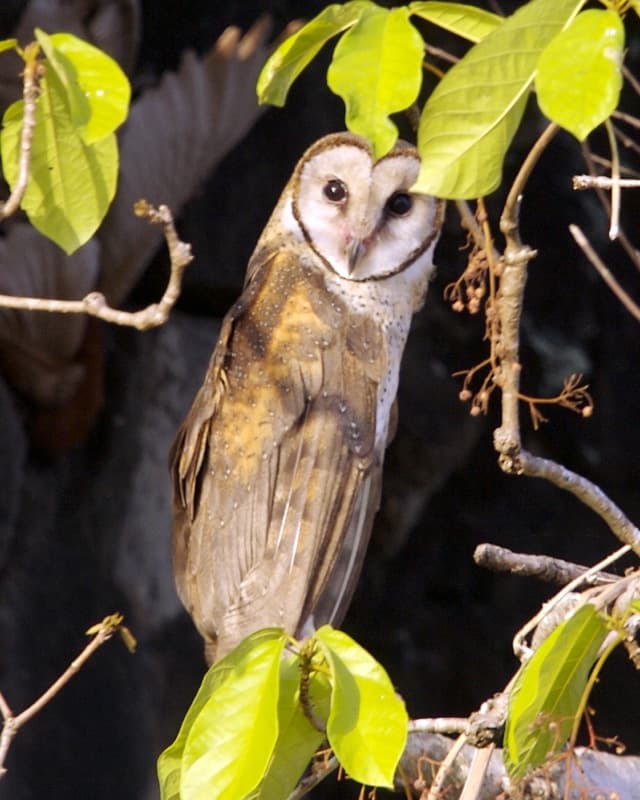
The Sri Lanka bay owl (Phodilus assimilis) is a species of bay owl found in the montane forests of Sri Lanka and the Western Ghats of India. Previously considered a subspecies of the Oriental bay owl, it is now recognized as a distinct species due to differences in its call and plumage. This owl inhabits subtropical and tropical moist montane forests and high-altitude grasslands, and is currently threatened by habitat loss.
Key Facts
- ›Endemic to Sri Lanka and the Western Ghats of India.
- ›Distinguished from the Oriental bay owl by its unique call and plumage.
- ›Inhabits subtropical or tropical moist montane forests and high-altitude grasslands.
- ›Breeding season occurs in winter.
- ›Its presence in the Western Ghats is often detected through injured individuals due to its secretive nature.
- ›Threatened by habitat loss.

Sri Lanka Bay Owl
- Subtropical Or Tropical Moist Montane Forests
- Subtropical Or Tropical High-Altitude Grassland
Sri Lanka, India
Not Specified In Text
Not Specified In Text
About Sri Lanka bay owl
The Sri Lanka bay owl, scientifically known as Phodilus assimilis, is a distinct species of bay owl belonging to the family Tytonidae. This owl is endemic to specific regions, primarily inhabiting the island of Sri Lanka and extending to the Western Ghats in Kerala, South Western India. Previously categorized as a subspecies of the Oriental bay owl (Phodilus badius), it has since been elevated to full species status, a distinction supported by its unique vocalizations, plumage characteristics, and a disjunct geographic distribution.
Habitat and Distribution
The natural habitats favored by the Sri Lanka bay owl are subtropical or tropical moist montane forests and subtropical or tropical high-altitude grasslands. These environments provide the necessary cover and conditions for its survival. The species is unfortunately facing threats, with habitat loss being a significant concern for its continued existence. The Indian subspecies, Phodilus assimilis ripleyi, is found along the Western Ghats, though its secretive nature means records are infrequent, often coming to light only when injured individuals are discovered.
Taxonomy and Identification
The Sri Lanka bay owl was first described by Allan Octavian Hume in 1873, with the binomial name Phodilus assimilis introduced in 1877. The genus name Phodilus is derived from Ancient Greek terms meaning 'light' or 'daylight' and 'timid' or 'cowardly,' reflecting some perceived characteristics of the bird. The specific epithet assimilis is Latin for 'similar' or 'like.' The recognition of Phodilus assimilis as a separate species from Phodilus badius is based on observed differences in their calls and plumage.
Two subspecies are officially recognized: Phodilus assimilis ripleyi Hussain & Reza Khan, 1978, which is found in the Western Ghats, and Phodilus assimilis assimilis A. O. Hume, 1877, native to central and southern Sri Lanka.
Vocalizations and Breeding
The breeding season for the Sri Lanka bay owl takes place during the winter months. A notable characteristic of this period is the bird's distinctive song, which comprises multiple whistles exhibiting inflections. This vocalization plays a role in communication during the breeding cycle.
Source: Wikipedia ↗
Frequently Asked Questions
What is the scientific name of the Sri Lanka bay owl?
The scientific name of the Sri Lanka bay owl is Phodilus assimilis. The genus name Phodilus derives from Ancient Greek words meaning 'light' or 'daylight' and 'timid' or 'cowardly'.
Where is the Sri Lanka bay owl found?
This species is endemic to the island of Sri Lanka and the Western Ghats region in Kerala, South Western India. It inhabits subtropical or tropical moist montane forests and high-altitude grasslands in these areas.
Why is it considered a separate species from the Oriental bay owl?
The Sri Lanka bay owl is treated as a full species, rather than a subspecies of the Oriental bay owl (Phodilus badius), due to its distinctive call, plumage, and a disjunct geographical distribution.
When is the breeding season for the Sri Lanka bay owl?
The breeding season for the Sri Lanka bay owl occurs in winter. During this time, its distinctive song, composed of multiple whistles with inflections, can be heard.
What are the recognized subspecies of the Sri Lanka bay owl?
Two subspecies are recognized: Phodilus assimilis ripleyi, found in the Western Ghats, and Phodilus assimilis assimilis, found in central and southern Sri Lanka.
Related Owl species

Eastern grass owl
The eastern grass owl is a medium-sized owl found in grasslands and swamps across Asia, Australia, and parts of the western Pacific. It is distinguished by its dark brown upper parts, pale spots, and a heart-shaped facial disk. While globally listed as Least Concern, a subspecies in Taiwan faces significant threats from rodenticides and habitat alteration.

Lesser sooty owl
The lesser sooty owl (Tyto multipunctata) is a medium-sized masked owl native to the wet tropics of northeastern Australia. It is distinguished by its dark plumage, heavy white speckling, and higher-pitched call compared to its larger relatives. This owl is a habitat specialist, preferring dark, sheltered old-growth rainforests, and is vulnerable to habitat disturbance.
Sulawesi masked owl
The Sulawesi masked owl (Tyto rosenbergii) is a species of owl endemic to the Indonesian islands of Sulawesi, Sangihe, and Peleng. It is distinguished by its charcoal grey upperparts, buff underparts with dark spots, and a white facial mask. This owl hunts at night in various habitats and is currently listed as a species of least concern by the IUCN.