
Sulawesi masked owl
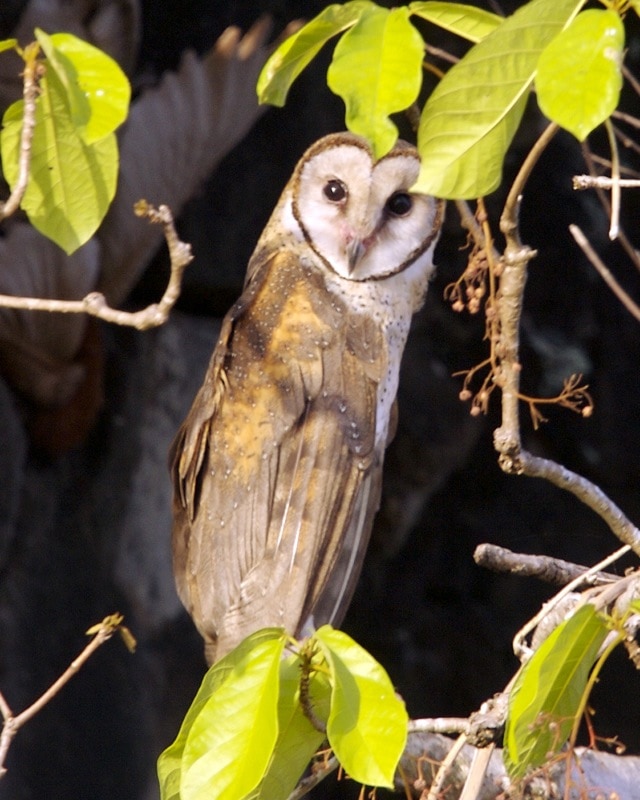
The Sulawesi masked owl (Tyto rosenbergii) is a species of owl endemic to the Indonesian islands of Sulawesi, Sangihe, and Peleng. It is distinguished by its charcoal grey upperparts, buff underparts with dark spots, and a white facial mask. This owl hunts at night in various habitats and is currently listed as a species of least concern by the IUCN.
Key Facts
- ›Endemic to the Indonesian islands of Sulawesi, Sangihe, and Peleng.
- ›Scientific name: Tyto rosenbergii.
- ›Hunts at night in secondary forest, agricultural land, grassland, and open country.
- ›Diet primarily consists of rats and shrews, based on pellet examinations.
- ›Listed as 'least concern' by the IUCN due to its wide range and stable population.
- ›Distinctive call is an eerie, long, drawn-out screech, often heard in flight.
Rosenberg's Owl, Rosenberg's Barn-Owl, Sulawesi Owl, Sulawesi Barn-Owl, Celebes Barn-Owl, Celebes Masked-Owl, Celebes Owl
Secondary Forest, Agricultural Land, Grassland, Open Country, Cultivated Areas, Scrubland
Sulawesi, Sangihe, Peleng
Rats, Shrews
About Sulawesi masked owl
The Sulawesi masked owl, scientifically known as Tyto rosenbergii, is a species of owl native to the Indonesian islands of Sulawesi, Sangihe, and Peleng. It belongs to the family Tytonidae, commonly known as barn owls. The owl is named for its distinctive white or whitish-brown facial mask, which contrasts with its otherwise dark plumage.
Description and Taxonomy
This owl typically measures between 43 and 46 centimeters in length. Males exhibit charcoal grey upperparts adorned with scattered white spots and streaks, while their underparts are buff with dark spots and streaks. The specific name "rosenbergii" honors Hermann von Rosenberg, a German surveyor and naturalist who collected specimens in the East Indies. The species is divided into two subspecies: T. r. rosenbergii, found in Sulawesi and Sangihe, and T. r. pelengensis, inhabiting Peleng in the Banggai Island group. Other common names include Rosenberg's owl and various combinations of "Celebes" and "Sulawesi" with "owl" or "barn-owl."
Ecology and Diet
Much of the Sulawesi masked owl's ecology remains little known. It is an active hunter during the night, preying in habitats such as secondary forests, agricultural lands, grasslands, and open country. Analysis of regurgitated pellets indicates that its diet primarily consists of rats and shrews. Individuals are frequently observed in cultivated areas and scrubland, particularly during early morning excursions.
Conservation Status
The International Union for Conservation of Nature (IUCN) lists the Sulawesi masked owl as a species of 'least concern.' This classification is based on its wide geographic distribution across Sulawesi, Sangihe, and Peneng, and the assessment that its population numbers are believed to be stable, despite not being particularly common. Its call is described as an eerie, long, drawn-out screech, often heard when the bird is in flight.
Source: Wikipedia ↗
Frequently Asked Questions
What is the Sulawesi masked owl?
The Sulawesi masked owl is a species of owl belonging to the Tytonidae family. It is native to the Indonesian islands of Sulawesi, Sangihe, and Peleng.
What are the physical characteristics of the Sulawesi masked owl?
This owl measures about 43 to 46 cm in length. Males have charcoal grey upperparts with white spots and streaks, buff underparts with dark markings, and a distinctive white or whitish-brown facial mask.
What does the Sulawesi masked owl eat?
Examinations of regurgitated pellets suggest that the diet of the Sulawesi masked owl includes rats and shrews. It hunts at night in various open habitats.
What is the conservation status of the Sulawesi masked owl?
The Sulawesi masked owl is listed as 'least concern' on the IUCN Red List. This is due to its wide geographic range and the belief that its population numbers are stable.
What sounds does the Sulawesi masked owl make?
The call of the Sulawesi masked owl is described as an eerie, long, and drawn-out screech. This sound is typically emitted while the owl is in flight.
Related Owl species

Eastern grass owl
The eastern grass owl is a medium-sized owl found in grasslands and swamps across Asia, Australia, and parts of the western Pacific. It is distinguished by its dark brown upper parts, pale spots, and a heart-shaped facial disk. While globally listed as Least Concern, a subspecies in Taiwan faces significant threats from rodenticides and habitat alteration.

Lesser sooty owl
The lesser sooty owl (Tyto multipunctata) is a medium-sized masked owl native to the wet tropics of northeastern Australia. It is distinguished by its dark plumage, heavy white speckling, and higher-pitched call compared to its larger relatives. This owl is a habitat specialist, preferring dark, sheltered old-growth rainforests, and is vulnerable to habitat disturbance.

Sri Lanka bay owl
The Sri Lanka bay owl (Phodilus assimilis) is a species of bay owl found in the montane forests of Sri Lanka and the Western Ghats of India. Previously considered a subspecies of the Oriental bay owl, it is now recognized as a distinct species due to differences in its call and plumage. This owl inhabits subtropical and tropical moist montane forests and high-altitude grasslands, and is currently threatened by habitat loss.