
Elf owl
Strigiformes·Endangered (California); Not globally threatened
The Elf owl is the world's smallest owl, a tiny bird found in the southwestern United States, central Mexico, and the Baja California peninsula. Distinctive for its pale yellow eyes and gray bill, it frequently inhabits woodpecker holes in saguaro cacti. Primarily feeding on insects, this nocturnal owl is known for its complex vocalizations, which vary between sexes and play a role in territorial defense and mating.
Key Facts
- ›The Elf owl is the smallest and lightest owl species globally.
- ›It primarily inhabits woodpecker holes in saguaro cacti and other tree cavities.
- ›Its diet consists mainly of insects, including moths, crickets, and scorpions.
- ›Elf owls are nocturnal, most active during dusk and before dawn.
- ›Vocalizations are complex and differ between males and females, serving territorial and mating functions.
- ›Populations have declined due to habitat loss, leading to an 'endangered' status in California.
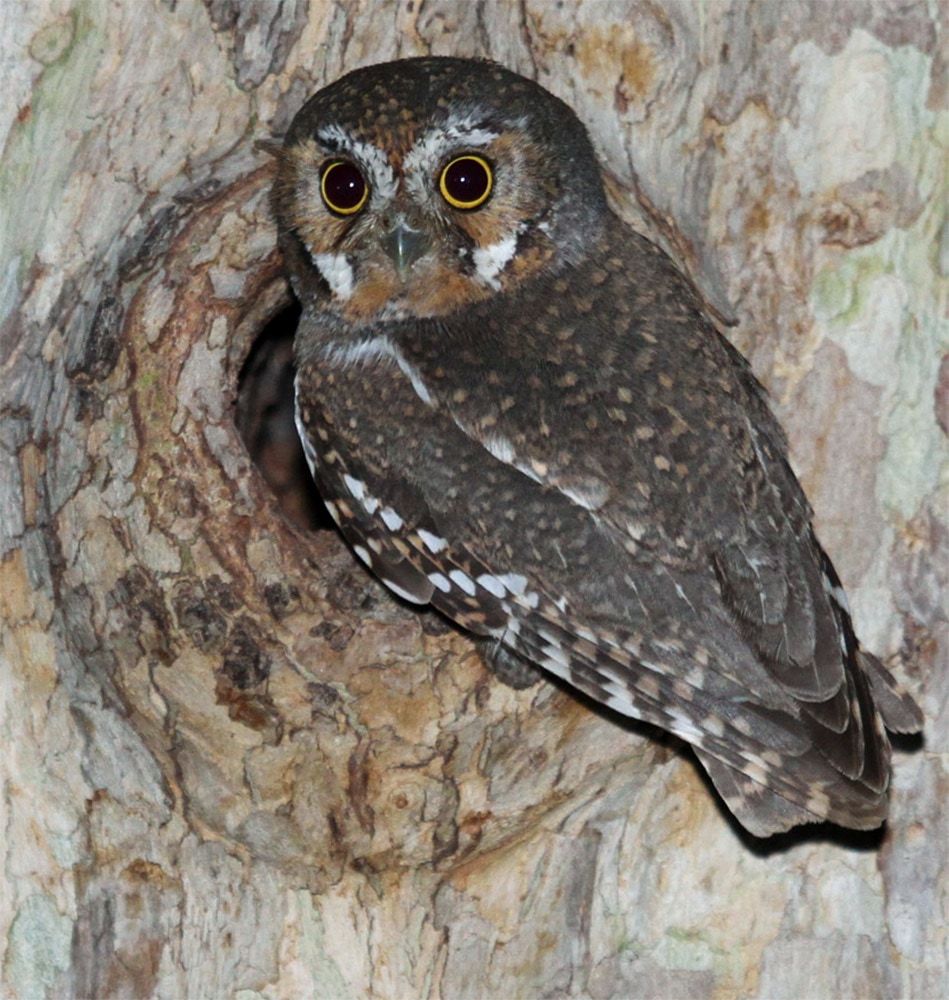
Whitney's Owl
Chaparral, Desert Riparian Areas, Woodpecker Holes In Saguaro Cacti, Natural Tree Cavities
Southwestern United States, Central Mexico, Baja California Peninsula
Insects, Scorpions, Centipedes, Small Mammals, Reptiles, Birds
Jays, Hawks, Owls
About Elf owl
The Elf Owl
The Elf owl (Micrathene whitneyi), also known as Whitney's Owl, is the smallest owl species in the world, a tiny raptor found in the arid landscapes of the southwestern United States, central Mexico, and the Baja California peninsula. Its diminutive size, comparable to a sparrow, along with its pale yellow eyes and gray bill, makes it a unique inhabitant of desert ecosystems.
Habitat and Distribution
Elf owls are intrinsically linked to desert environments, frequently making their homes in abandoned woodpecker holes within saguaro cacti. They also utilize natural cavities in trees like sycamores and cottonwoods, and have adapted to nesting in man-made structures such as telephone poles in urban fringe areas. Their geographic range extends across the southwestern U.S. (California, Arizona, New Mexico, Texas) for breeding during spring and summer, migrating to central and southern Mexico for the winter. Resident populations are found in parts of south-central Mexico and along the Baja peninsula.
Behavior and Diet
Primarily nocturnal, the Elf owl is most active during the twilight hours of dawn and dusk. Its diet consists mainly of arthropods, including moths, crickets, scorpions, and beetles, often foraged from agave and ocotillo flowers or attracted to artificial lights in urban areas. They are adept at hunting flying insects and are known to extract stingers from scorpions before consumption without apparent ill effect. During vulnerable encounters, they may feign death to escape predators.
Reproduction and Vocalizations
During the breeding season, Elf owls form monogamous pairs and typically lay one to five eggs, with three being a common clutch size. The eggs are incubated for about 24 days, and the young owlets fledge around 10 weeks old. Their vocalizations are a notable characteristic, with males exhibiting complex songs for territorial defense and courtship, while females use locational calls. These calls are often described as high-pitched whinnies or chuckles.
Conservation Concerns
Despite their resilience, Elf owl populations have faced declines due to habitat loss, particularly in the desert regions of California. Human activities such as water diversion and construction, along with invasive species, have degraded their essential desert and riparian habitats. Consequently, the species is listed as 'endangered' in California, prompting conservation efforts including captive breeding programs and habitat preservation initiatives.
Source: Wikipedia ↗
Frequently Asked Questions
What makes the Elf owl the smallest owl?
The Elf owl holds the distinction of being the world's smallest and lightest owl species. While other owls like the long-whiskered owlet are of similar length, the Elf owl's diminutive size is a defining characteristic.
Where do Elf owls typically make their homes?
Elf owls commonly nest in abandoned woodpecker cavities, particularly those found in saguaro cacti. They also utilize natural tree cavities in species like sycamores and cottonwoods, and have occasionally been observed nesting in man-made structures.
What do Elf owls eat?
The diet of the Elf owl is primarily composed of arthropods. This includes a variety of insects like moths, crickets, and beetles, as well as arachnids such as scorpions and centipedes. They have also been known to consume small vertebrates on occasion.
How do Elf owls communicate?
Elf owls possess complex vocalizations that vary significantly between males and females. Males have a wider repertoire, using songs for territorial proclamations and to attract females, while females also use locational calls. Their calls can sound like a high-pitched whinny or chuckle.
What is the conservation status of the Elf owl?
While not globally threatened, the Elf owl is listed as 'endangered' in California due to a significant population decline. Habitat loss in desert and riparian areas is a primary concern, leading to efforts for habitat preservation and captive breeding programs.
When are Elf owls most active?
Elf owls are primarily nocturnal. They are most active during the twilight hours, specifically around dusk and just before dawn. During these periods, they are often heard calling to one another.
Related Owl species
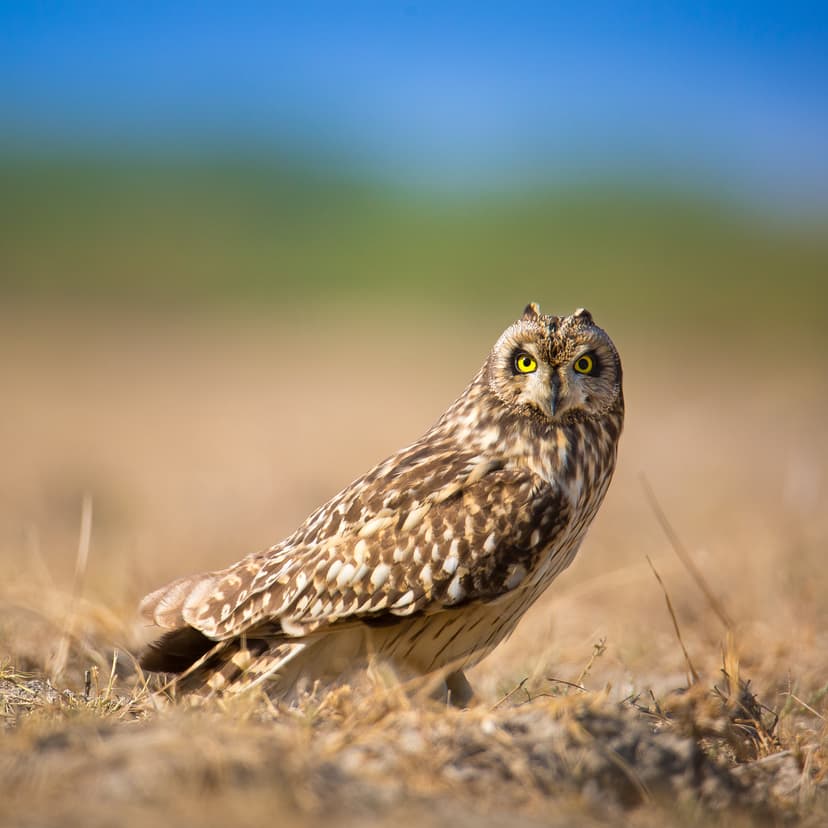
Short-eared owl
The short-eared owl (Asio flammeus) is a widely distributed grassland species known for its distinctive "ear" tufts, which are usually not visible but can be displayed when defensive. This medium-sized owl is found on open country and grasslands across most continents, feeding primarily on rodents like voles.

Burrowing owl
The burrowing owl (Athene cunicularia) is a small, long-legged owl found in open landscapes across North and South America. Unlike most owls, they are often active during the day and are known for their unique habit of living in burrows, often those excavated by other animals. Their adaptive behaviors and reliance on specific habitats make them a subject of conservation interest.

Boreal owl
The boreal owl, also known as Tengmalm's owl, is a small owl found in the taiga forests of North America and Eurasia. It is distinguished by its pearly-white spots on brown plumage, remarkable confiding nature when encountered, and a unique asymmetrical skull structure that aids in pinpointing prey.