
Eurasian pygmy owl
The Eurasian pygmy owl (Glaucidium passerinum) is the smallest owl species found in Europe, distinguished by its dark reddish to greyish-brown plumage with spotted sides and a distinctive white half-collar on the back of its neck. It inhabits the boreal forests of Northern and Central Europe extending into Siberia, where it is a sedentary resident.
Key Facts
- ›Smallest owl species in Europe.
- ›Inhabits boreal forests of Northern and Central Europe to Siberia.
- ›Sedentary species, with adults remaining in their territory year-round.
- ›Prey includes small mammals like voles and mice, and small birds.
- ›Nests in old woodpecker holes or artificial hollows.
- ›Active during daylight hours near sunrise and sunset (crepuscular).

Eurasian Pygmy Owl
- Boreal forests
- Coniferous forests
- Taiga
- Higher mountainous regions with coniferous and mixed forests
- Edges of clearings surrounded by moist or swampy land with a water source
Northern Europe, Central Europe, Siberia, Mongolia, Northeast China
Small Mammals, Small Birds, Lizards, Fish, Insects
About Eurasian pygmy owl
The Eurasian pygmy owl (Glaucidium passerinum) holds the distinction of being the smallest owl species found in Europe. Its plumage is a characteristic dark reddish to greyish-brown, marked with spots on its sides and a unique white half-ring encircling the back of its neck. This species is native to the extensive boreal forests stretching across Northern and Central Europe and into Siberia.
Distribution and Habitat
This owl thrives in the coniferous forests of the taiga and in higher mountainous areas featuring mixed woodlands. It generally favors locations with cooler temperatures and higher rainfall, often residing near the edges of clearings adjacent to moist or swampy terrain, typically with a nearby water source. The Eurasian pygmy owl is a sedentary species, with adults remaining within their established territories throughout the year, although they may occasionally move south during particularly harsh winters.
Description and Behavior
Physically, the Eurasian pygmy owl is small, measuring between 15.2 to 19 cm in length, with females being slightly larger than males. It has a rounded head lacking ear tufts, distinctive yellow eyes, and white to grey eyebrows. Its beak is a greyish-yellow and curved. The species is noted for its disproportionately large feet, an adaptation for carrying larger prey. A key behavioral trait is its crepuscular activity pattern, meaning it is most active during the twilight hours of dawn and dusk.
Diet and Breeding
The diet of the Eurasian pygmy owl is varied, consisting mainly of small mammals like voles, lemmings, and mice, as well as small birds. They are adept at hunting and can even catch birds in flight. In autumn, they exhibit food hoarding behavior, storing large quantities of prey to supplement their diet during winter. Breeding pairs form from autumn through early spring. Nests are typically established in old woodpecker holes or suitable artificial cavities. The female lays approximately four to seven eggs, usually in April, which are incubated for about four weeks. Both parents share in the care of the young, with the male providing food for the female and chicks during the initial nesting period. Young owls fledge around 30 to 34 days after hatching.
Source: Wikipedia ↗
Frequently Asked Questions
What is the Eurasian pygmy owl's scientific name and classification?
The scientific name of the Eurasian pygmy owl is Glaucidium passerinum. It belongs to the order Strigiformes, which encompasses all owl species.
Where does the Eurasian pygmy owl live?
This owl species is found in the boreal forests of Northern and Central Europe, extending all the way to Siberia. It prefers coniferous forests and higher mountainous regions with coniferous and mixed forests.
What does the Eurasian pygmy owl eat?
Its diet primarily consists of small mammals such as voles, lemmings, bats, and mice, as well as small birds like thrushes and finches. They are also capable of catching birds in flight and may consume lizards, fish, and insects.
What are the physical characteristics of the Eurasian pygmy owl?
It is typically reddish to greyish-brown with dots on its back and a tail marked with five narrow, whitish bars. It has a small head, white to grey eyebrows, yellow eyes, and lacks ear tufts. Females are slightly larger than males.
When is the Eurasian pygmy owl most active?
The Eurasian pygmy owl is crepuscular, meaning it is active during the daylight hours, particularly around sunrise and sunset.
How does the Eurasian pygmy owl breed?
Pairs typically form in autumn or early spring. The female lays about four to seven eggs, usually in April, in tree cavities or old woodpecker holes. Both parents participate in raising the young.
Related Owl species
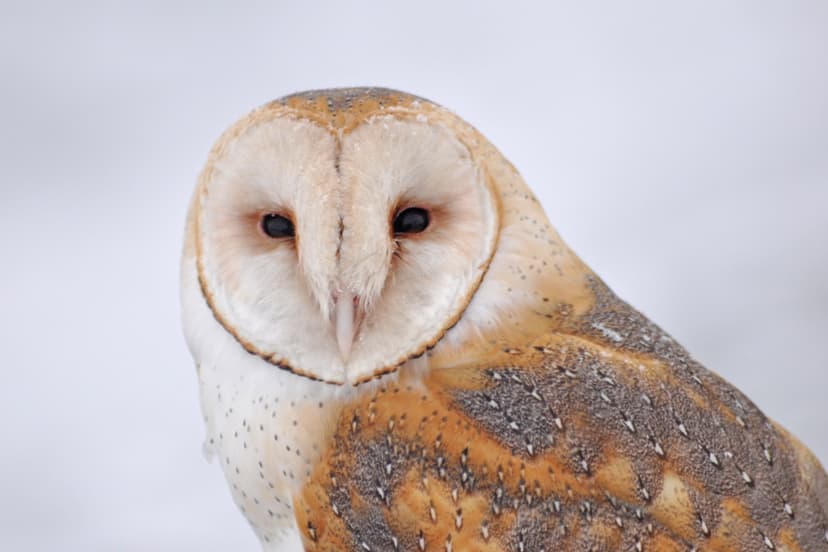
American barn owl
The American barn owl, scientifically known as Tyto furcata, is a widespread owl species native to North and South America. It is distinguished by its pale, heart-shaped facial disc, long wings, and undulating flight pattern, and plays a crucial role in rodent control due to its specialized diet.

Australian boobook
The Australian boobook (Ninox boobook) is the smallest owl species native to mainland Australia, also found in southern New Guinea, Timor, and the Sunda Islands. It is distinguished by its characteristic "boo-book" call and its predominantly dark-brown plumage marked with pale spots. This nocturnal hunter primarily preys on insects and small vertebrates, nesting in tree hollows and is considered of least concern by the IUCN.

Blakiston's fish owl
Blakiston's fish owl is the largest living species of owl, native to China, Japan, and the Russian Far East. It is a fish owl, a sub-group of eagle-owls that specifically hunt in riparian areas, distinguished by its large size, broad ear tufts, and yellow irises. The species requires old-growth forests with large tree cavities near unfrozen waterways for nesting and hunting.