
Fearful owl
The fearful owl (Asio solomonensis) is a medium-sized owl native to the Solomon Islands archipelago, specifically Bougainville, Choiseul, and Santa Isabel Islands. It is distinguished by its rufous facial disk with white eyebrows and a call resembling a human scream. This species inhabits tall lowland and hill forests, facing threats from logging and deforestation.
Key Facts
- ›Inhabits lowland and hill forests up to 2,000 meters elevation.
- ›Features a rufous facial disk with distinct white eyebrows.
- ›Its call is described as a clear, escalating human scream.
- ›Primarily preys on the northern common cuscus.
- ›Listed as near Threatened due to a small and declining population.
- ›Threatened by logging and deforestation activities.
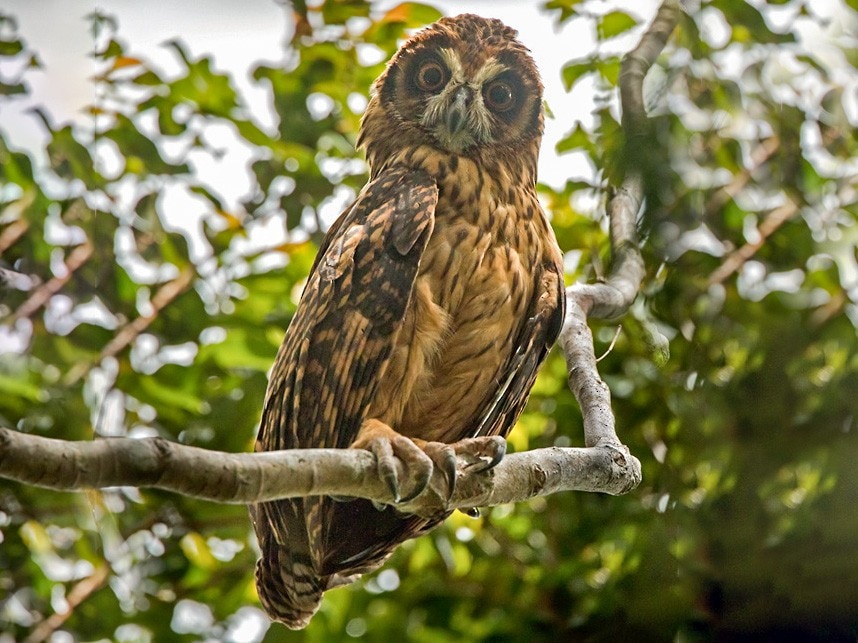
Fearful Owl
Lowland Forests, Hill Forests, Primary Forests, Secondary Forests, Woodland Edges
Solomon Islands, Papua New Guinea
Northern Common Cuscus
About Fearful owl
What is the Fearful Owl?
The fearful owl, scientifically known as Asio solomonensis, is a medium-sized owl species endemic to the Solomon Islands archipelago. It is found on the islands of Bougainville, Choiseul, and Santa Isabel, typically inhabiting tall lowland and hill forests at elevations up to 2,000 meters (6,600 ft).
Physical Characteristics and Behavior
This large forest owl typically measures around 38 cm (15 in) in length. Its most distinctive features include a rufous facial disk, prominent white eyebrows, and a white inner edge to the facial disk. The plumage is generally mottled brown with deep ochre underparts and blackish streaks.
The fearful owl's vocalization is notable, often described as resembling a clear human scream that increases in volume and pitch when emitted in a series, with pulses repeated at ten-second intervals. Its diet primarily consists of the northern common cuscus (Phalanger orientalis).
Nesting habits involve tree holes and cracks, but nests have also been found on branches of large fig trees covered in epiphytes, both in primary forest and near forest edges and gardens.
Conservation Status
The fearful owl is currently listed as Near Threatened on the IUCN Red List. This classification is based on criteria indicating a small and declining population. The primary threats to its survival are logging and deforestation, which lead to habitat loss.
Source: Wikipedia ↗
Frequently Asked Questions
What does the fearful owl look like?
The fearful owl is a large forest owl, approximately 38 cm in length. It has a rufous facial disk with distinct white eyebrows and is typically mottled brown with deep ochre underparts and blackish streaks.
Where is the fearful owl found?
This owl is endemic to the Solomon Islands archipelago, specifically found on Bougainville Island in Papua New Guinea, and on Choiseul Island and Santa Isabel Island in the Solomon Islands.
What is the habitat of the fearful owl?
The fearful owl inhabits old-growth lowland and hill forests, usually primary forests, but also sometimes found in nearby secondary forests and woodland edges up to 2,000 meters above sea level.
What does the fearful owl eat?
Its primary food source is the northern common cuscus (Phalanger orientalis).
What are the conservation concerns for the fearful owl?
The fearful owl is listed as Near Threatened due to its small and declining population, which is threatened by logging and deforestation.
Related Owl species

Chaco owl
The Chaco owl is a species of owl native to southern South America, inhabiting the Gran Chaco region of Argentina, Bolivia, and Paraguay. It is distinguished by its lack of ear tufts, pale facial disk with dark lines, and barred plumage. Primarily nocturnal hunters, they are vocally active during twilight hours.

Javan scops owl
The Javan scops owl (Otus angelinae), also known locally as Celepuk Jawa, is a small owl endemic to the high volcanic mountains of western Java. It is distinguished by its rusty-brown facial disc, prominent white eyebrows and ear-tufts, and a unique alarm call. This nocturnal predator primarily hunts insects and other small invertebrates in montane forests.

Mantanani scops owl
The Mantanani scops owl is a small owl species found on islands between Borneo and the Philippines. It is characterized by its buff facial disk, dark brown upperparts with pale markings, and pale underparts with dark streaks. The species is listed as "near threatened" due to its limited and fragmented range and the ongoing degradation of its forest habitat.