
Forest owlet
The forest owlet is a small, stocky owl endemic to the forests of central India. It was once thought extinct but was rediscovered in 1997. This species is critically endangered due to extensive deforestation.
Key Facts
- ›Endemic to central India, found in deciduous forests.
- ›Listed as Endangered on the IUCN Red List with a population estimated at fewer than 1,000 mature individuals.
- ›Primary threat is habitat loss and degradation from deforestation, logging, and human encroachment.
- ›Distinctive features include unspotted crown, heavily banded wings and tail, and yellow eyes.
- ›Diet primarily consists of lizards and skinks, followed by rodents, birds, invertebrates, and frogs.
- ›Appears to be strongly diurnal, often hunting during the day.
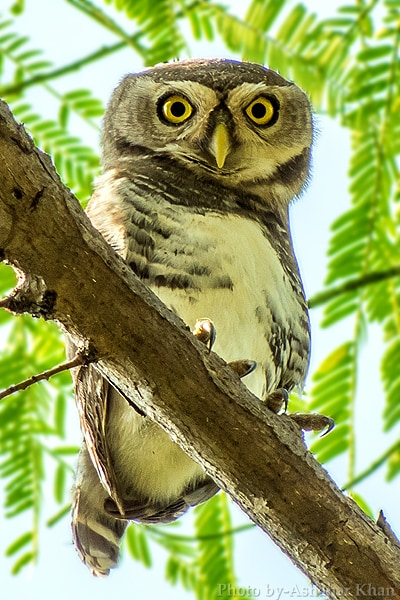
Forest Owlet
- Dense to open deciduous forests
- Forests with Tectona grandis, Lagerstroemia parvifolia, Boswellia serrata, and Lannea grandis trees
- Areas with open canopy and dense undergrowth
- Human-disturbed forests with clearings
Central India, Maharashtra, Madhya Pradesh, Gujarat, Chhattisgarh, Odisha
Lizards, Skinks, Rodents, Birds, Invertebrates, Frogs
About Forest owlet
The forest owlet (Athene blewitti) is a small, stocky owl species endemic to the forested regions of central India. Once believed to be extinct after its last confirmed sighting in 1884, it was famously rediscovered in 1997 by ornithologist Pamela Rasmussen, whose research revealed that a previously recorded specimen had been mislabeled.
Taxonomy and Discovery
First described by Allan Octavian Hume in 1873 as Heteroglaux blewitti, the species was placed in a new genus due to perceived differences from other Athene species, such as a smaller head and a more strongly notched lower mandible. Phylogenetic studies later indicated its placement within the Athene clade. The rediscovery was significant, as for many years, museum specimens were the only evidence of its existence, with searches in their purported locations proving futile due to falsified locality data on a stolen specimen.
Description and Habitat
Forest owlets are characterized by their relatively unspotted crowns and heavily banded wings and tails, distinguishing them from the spotted owlet. They possess a dark grey-brown upper plumage, a brown upper breast, and yellow eyes. These owls inhabit dense to open deciduous forests, often in areas with specific tree species like Teak (Tectona grandis), Lagerstroemia parvifolia, Boswellia serrata, and Lannea grandis. They appear to favor human-disturbed forests with more clearings and utilize areas with open canopies and dense undergrowth for foraging.
Behavior and Diet
The forest owlet is primarily diurnal, often hunting from perches and being active during daylight hours. When hunting, it flicks its tail rapidly. Its diet predominantly consists of lizards and skinks, making up nearly 60% of its prey, followed by rodents, birds, invertebrates, and frogs. During the breeding season, males hunt and provide food for the female and young.
Conservation Status
Despite its rediscovery, the forest owlet faces severe threats, primarily from deforestation and habitat degradation caused by illegal logging, human encroachment, forest fires, and infrastructure development. This has led to its classification as Endangered on the IUCN Red List, with an estimated population of fewer than 1,000 mature individuals. The species is also listed in CITES Appendix I, indicating its vulnerability and the need for international protection.
Source: Wikipedia ↗
Frequently Asked Questions
What is the scientific name of the forest owlet?
The scientific name of the forest owlet is Athene blewitti. It was previously placed in its own genus, Heteroglaux, but phylogenetic studies indicate it belongs to the Athene clade.
Where can the forest owlet be found?
The forest owlet is found in central India, specifically in states like Odisha, Chhattisgarh, Madhya Pradesh, Maharashtra, and Gujarat. It inhabits deciduous forests, often preferring areas with open canopy and dense undergrowth.
What does the forest owlet eat?
The forest owlet is a generalist predator. Lizards and skinks make up nearly 60% of its diet, with rodents accounting for about 15%. It also consumes birds, invertebrates, and frogs.
Why is the forest owlet endangered?
The forest owlet is listed as Endangered primarily due to deforestation and habitat degradation. Factors contributing to this include illegal logging, human encroachment, forest fires, and the construction of irrigation dams.
When was the forest owlet rediscovered?
The forest owlet was rediscovered in November 1997 by a group of American ornithologists. Before this, it had been considered extinct for many years after its last confirmed sighting in 1884.
What are the distinguishing physical characteristics of the forest owlet?
The forest owlet is small and stocky, measuring about 23 cm in length. It has a rather unspotted crown, heavily banded wings and tail, dark grey-brown upperparts, and yellow eyes. It has fewer and fainter spots on its crown and back compared to the spotted owlet.
Related Owl species
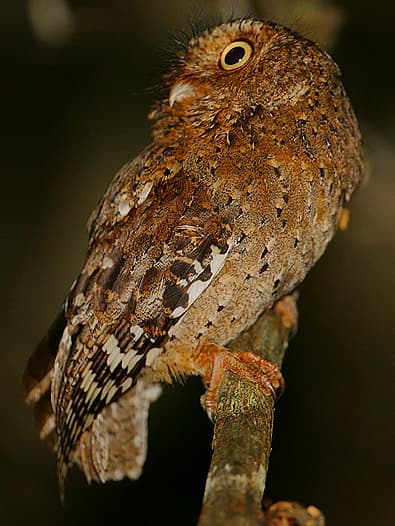
Sokoke scops owl
The Sokoke scops owl (Otus ireneae) is a small, highly localized owl species found in the lowland forests of Kenya and Tanzania. It is distinguished by its plain appearance with small spotted underparts, varied color morphs from grey to rufous, and a distinctive repetitive "too-too-too-too-too" call. Its survival is critically dependent on undisturbed forest habitats, making it vulnerable to human disturbance.
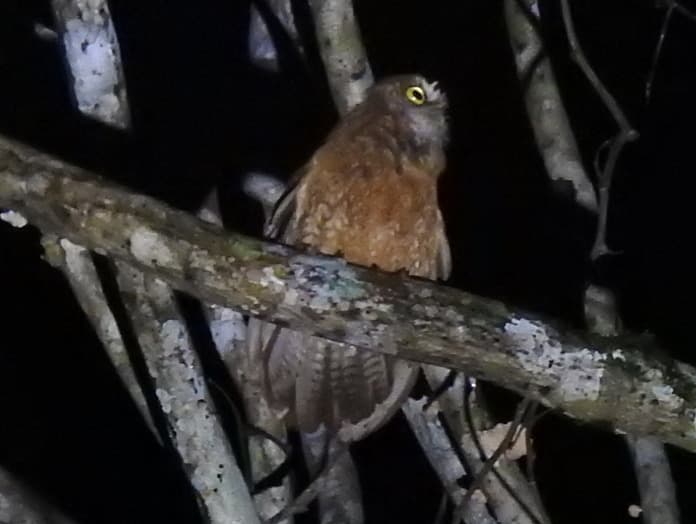
Least boobook
The least boobook, also known as the little Sumba hawk-owl, is a species of owl endemic to the Indonesian island of Sumba. It is distinguished by its small size, grey head with white eyebrows, and a characteristic low whistling call. This species inhabits subtropical or tropical moist lowland forests and is currently classified as Endangered.
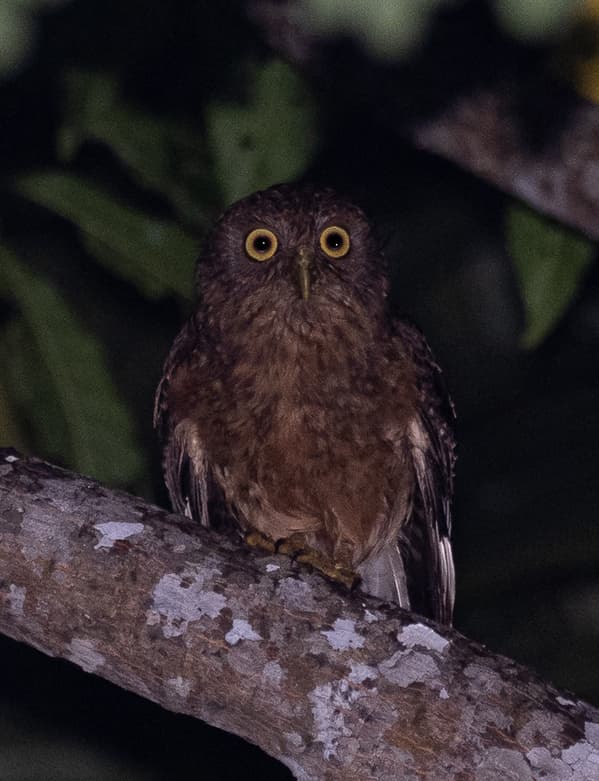
Romblon boobook
The Romblon boobook, also known as the Romblon hawk-owl, is a species of owl endemic to the Philippines, found exclusively on the islands of Tablas, Sibuyan, and Romblon. It was reclassified as a distinct species in 2012 due to vocal and other evidence. This earless owl inhabits tropical moist lowland forests and is currently classified as endangered.