
Koepcke's screech owl
Koepcke's screech owl is a species of owl endemic to Peru, named in honor of German ornithologist Maria Koepcke. It is characterized by its distinctive vocalizations and inhabits diverse Peruvian landscapes, from evergreen forests to dry scrublands.
Key Facts
- ›Endemic to Peru, with two subspecies: M. k. koepckeae and M. k. hockingi.
- ›Named after ornithologist Maria Koepcke, who conducted extensive research in Peru.
- ›Inhabits evergreen forests and dry intermontane valleys at varying elevations.
- ›Primarily nocturnal, with a diet believed to consist mainly of insects.
- ›Its territorial song is a loud, staccato series of notes with increasing volume.
- ›Assessed by the IUCN as a species of Least Concern, with a believed stable population.

Koepcke's Screech Owl
Evergreen Forests, Dry Forest, Scrubby Areas
Peru
Insects, Small Vertebrates
About Koepcke's screech owl
Koepcke's screech owl (Megascops koepckeae) is a species of owl native exclusively to Peru. Named in honor of the German ornithologist Maria Koepcke, this owl is a member of the Strigidae family and is considered a sister species to the tropical screech owl.
Description and Habitat
This owl measures approximately 24 cm in length. Its physical characteristics include a whitish gray facial disc, yellow eyes, and upperparts ranging from grayish brown to dark brown with streaks and barring. The underparts are grayish white with distinctive dark brown streaks. Koepcke's screech owl inhabits a variety of Peruvian landscapes. The nominate subspecies, M. k. koepckeae, is found in evergreen forests at elevations between 1,840 and 4,500 meters. The subspecies M. k. hockingi occupies dry forest and scrubby areas in intermontane valleys, typically found below 2,000 meters.
Behavior and Diet
Koepcke's screech owl is primarily nocturnal. While its diet has not been extensively studied, it is believed to consist mainly of insects, with potential inclusion of small vertebrates. The breeding phenology is largely undocumented, though breeding has been observed in February and March in south-central Peru. Nests are typically assumed to be in tree cavities, but a reported nest was found in an earthen bank.
Vocalization
The species is known for its distinctive calls. The territorial song is described as a loud, staccato series of notes that increases in pace and volume, often rendered as "ko-ko-ko-ko ka ka KA KAH!". The subspecies M. k. hockingi has a similar but longer and higher-pitched song. Aggressive vocalizations involve quieter, short hoots that vary in pitch, and pairs have been observed singing duets.
Conservation Status
The International Union for Conservation of Nature (IUCN) classifies Koepcke's screech owl as a species of Least Concern. Although its population size is undetermined, it is believed to be stable. The species demonstrates a notable ability to adapt to highly degraded habitats, provided that sufficient trees remain for roosting and nesting purposes.
Source: Wikipedia ↗
Frequently Asked Questions
What is Koepcke's screech owl?
Koepcke's screech owl is a species of owl belonging to the family Strigidae. It is found exclusively in Peru and is distinguished by its unique vocalizations and habitat preferences.
Where does Koepcke's screech owl live?
This owl species is endemic to Peru. The nominate subspecies inhabits evergreen forests in northern departments, while the subspecies M. k. hockingi is found in dry forests and scrubby areas in southern intermontane valleys.
What does Koepcke's screech owl look like?
Koepcke's screech owl is about 24 cm long. It features a whitish gray facial disc, short whitish brows, yellow eyes, and dark brown upperparts with speckles and streaks. Its underparts are grayish white with dark brown streaks and irregular bars.
What does Koepcke's screech owl eat?
While its diet has not been extensively studied, Koepcke's screech owl is believed to be primarily insectivorous. It may also consume small vertebrates.
What is the call of Koepcke's screech owl like?
The territorial song is described as a loud, staccato series of notes that slows in pace and rises in volume, such as 'ko-ko-ko-ko ka ka KA KAH!'. M. k. hockingi has a similar but longer and higher-pitched song. An aggressive song consists of quieter, short hoots that rise and fall in pitch.
What is the conservation status of Koepcke's screech owl?
The International Union for Conservation of Nature (IUCN) has assessed Koepcke's screech owl as Least Concern. Its population is believed to be stable, and the species appears to adapt well to degraded habitats as long as trees for nesting and roosting remain.
Related Owl species
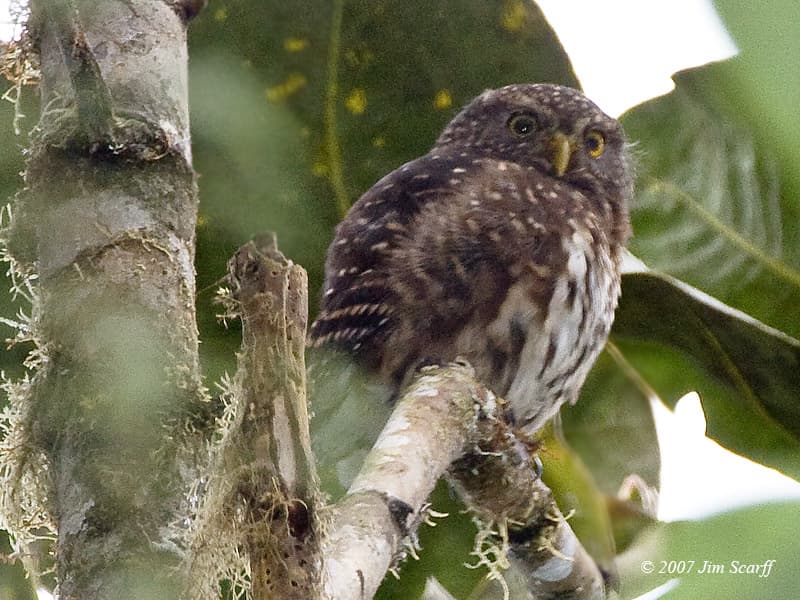
Andean pygmy owl
The Andean pygmy owl is a small owl species native to the Andes mountains of South America, found in countries like Colombia, Ecuador, Peru, and Venezuela. It is distinguished by its two color morphs, white facial markings including prominent "brows" and "moustaches," and a distinctive face-like pattern on its nape. This owl is an opportunistic predator, active both day and night, feeding on a variety of small invertebrates, birds, and mammals.
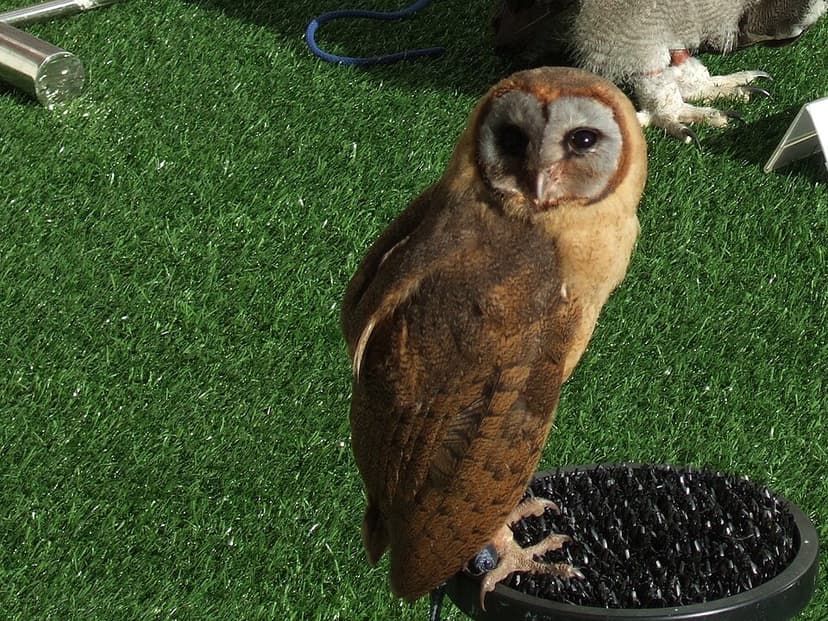
Ashy-faced owl
The ashy-faced owl (Tyto glaucops) is a species of barn owl native to Hispaniola and several islands in the Lesser Antilles. It is distinguished by its silvery-gray facial disc (in the nominate subspecies), a preference for a mix of open hunting spaces and canopy cover, and a varied diet of small vertebrates and invertebrates. This species plays a crucial role as a nocturnal predator in its island ecosystems.

Austral pygmy owl
The austral pygmy owl is a small owl species found in central and southern Chile and parts of southern Argentina. It is distinctive for its gray-brown and red color morphs and its ability to hunt both during the day and at night. This owl is known for its varied vocalizations, including contact whistles, territorial trills, and courtship calls.