
Long-tufted screech owl
The long-tufted screech owl (Megascops sanctaecatarinae) is a species of typical owl native to Argentina, Brazil, and Uruguay. It is characterized by prominent ear tufts and is found in various open and semi-open landscapes. This owl is a nocturnal hunter with a diet consisting of arthropods and small vertebrates.
Key Facts
- ›Native to southeastern Brazil, northeastern Argentina, and northern Uruguay.
- ›Inhabits sparse woodlands, pastures with trees, and forest edges.
- ›Possesses prominent ear tufts and occurs in brown, gray, and rufous color morphs.
- ›Primarily a nocturnal hunter, preying on arthropods and small vertebrates.
- ›Nests in tree cavities, with clutches typically consisting of one or two young.
- ›Its conservation status is Least Concern according to the IUCN.

Long-Tufted Screech Owl
Sparse Woodland, Pastures With Trees, Edges of Dense Forest, Secondary Forest, Woodlots Near Villages
Argentina, Brazil, Uruguay
Arthropods, Small Vertebrates, Rodents, Birds, Amphibians, Fish
About Long-tufted screech owl
The long-tufted screech owl, scientifically known as Megascops sanctaecatarinae, is a species of typical owl found in the southeastern regions of South America. It inhabits Argentina, Brazil, and Uruguay, preferring a variety of open and semi-open landscapes such as sparse woodlands, pastures with scattered trees, and the edges of denser forests.
Taxonomy and History
This owl has a complex taxonomic history. Initially described by Osbert Salvin in 1897 as Scops sanctae-catarinae, it was later placed in the genus Otus and subsequently in the current genus Megascops, which now encompasses 23 species of screech owls. For a time, it was considered a subspecies or synonym of the black-capped screech owl (Megascops atricapilla), and other authors grouped it with the Yungas screech owl (M. hoyi) and the Middle American screech owl (M. guatemalae). However, morphological, vocal, and genetic studies have confirmed its status as a distinct species, not closely related to these others. Further taxonomic complications exist regarding populations in southern Brazil and Argentina, with the possibility that the specific epithet argentinus might be the correct designation due to the principle of priority.
Physical Characteristics
A relatively large and bulky screech owl, the long-tufted screech owl measures between 25 and 28 cm in length. Males typically weigh between 155 and 194 grams, while females are slightly heavier, ranging from 174 to 211 grams. A key distinguishing feature is its very prominent ear tufts. The species exhibits three color morphs: brown, gray, and rufous, with the brown morph being the most prevalent. In the common brown morph, adults display dark brown upperparts with fine, indistinct pale markings and a somewhat lighter crown. The facial disc is brown, bordered by a darker rim, and the underparts are marked with irregular bars, streaks, and vermiculation in brown tones. Its eyes are pale yellow to orange-yellow, its bill is greenish gray, and its feet are a pale grayish brown.
Behavior and Ecology
The long-tufted screech owl is considered a year-round resident throughout its range. It is primarily nocturnal, hunting by dropping from a perch onto its prey. Its diet consists of arthropods and small vertebrates, including rodents, birds, amphibians, and fish.
Breeding and Vocalization
The breeding season appears to include August and September, though it is not well-defined. Nests are typically found in tree cavities, either natural or those created by woodpeckers. Known nests have yielded one or two young, and it is believed that only the female incubates the eggs. Little else is documented about the species' breeding phenology.
Vocalizations are distinctive. The male's primary song is a guttural, fast trill lasting five to ten seconds. The female's song is similar but shorter and higher pitched. Males also produce a secondary song with short, fast notes that lengthen and become more spaced. Females have a very different call, a loud, hoarse, extraordinary 'bababa...' sound, unique among screech owls.
Conservation Status
The International Union for Conservation of Nature (IUCN) has assessed the long-tufted screech owl as Least Concern. While it possesses a relatively large range, its population size is unknown and is thought to be declining. The primary threat to the species is habitat loss, resulting from overgrazing, burning, and tree-felling.
Source: Wikipedia ↗
Frequently Asked Questions
What is the scientific name of the long-tufted screech owl?
The scientific name of the long-tufted screech owl is Megascops sanctaecatarinae. It was originally described by Osbert Salvin in 1897 as Scops sanctae-catarinae.
Where is the long-tufted screech owl found?
This owl species is found in southeastern Brazil, specifically in the states of Paraná, Santa Catarina, and Rio Grande do Sul. It also inhabits Misiones Province in northeastern Argentina and adjoining northern Uruguay.
What kind of habitats does the long-tufted screech owl prefer?
The long-tufted screech owl inhabits a variety of open and semi-open landscapes. These include sparse woodland, pastures with trees, the edges of dense forest, secondary forest, and woodlots near villages.
What does the long-tufted screech owl eat?
It is a nocturnal hunter whose diet includes arthropods and small vertebrates. Known prey items include rodents, birds, amphibians, and fish.
What are the distinctive vocalizations of the long-tufted screech owl?
The male's primary song is a guttural, fast trill lasting 5-10 seconds. The female's song is similar but shorter and higher pitched. The male also has a secondary song with short, fast notes that become longer and more spaced, while the female produces a loud, hoarse, 'bababa...' call.
What is the conservation status of the long-tufted screech owl?
The IUCN has assessed the long-tufted screech owl as Least Concern. Despite a fairly large range, its population size is unknown and believed to be decreasing, with habitat loss being a major threat.
Related Owl species
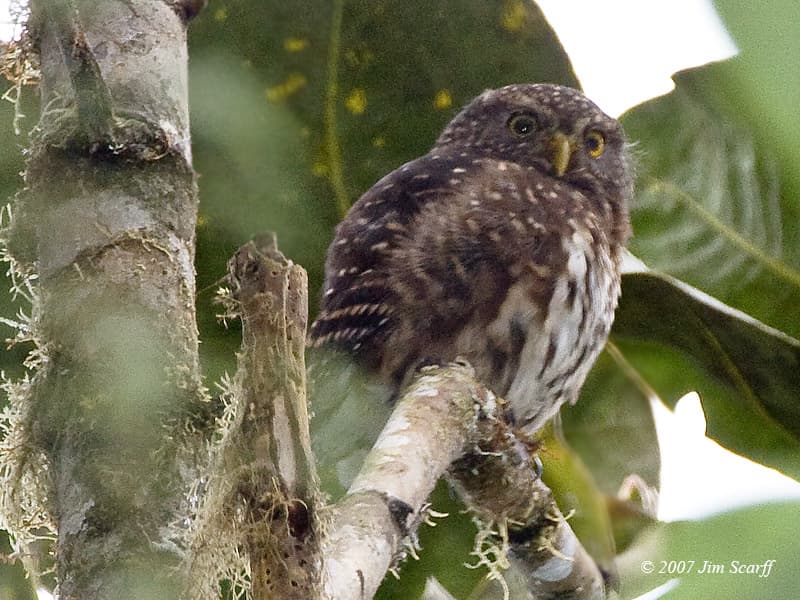
Andean pygmy owl
The Andean pygmy owl is a small owl species native to the Andes mountains of South America, found in countries like Colombia, Ecuador, Peru, and Venezuela. It is distinguished by its two color morphs, white facial markings including prominent "brows" and "moustaches," and a distinctive face-like pattern on its nape. This owl is an opportunistic predator, active both day and night, feeding on a variety of small invertebrates, birds, and mammals.
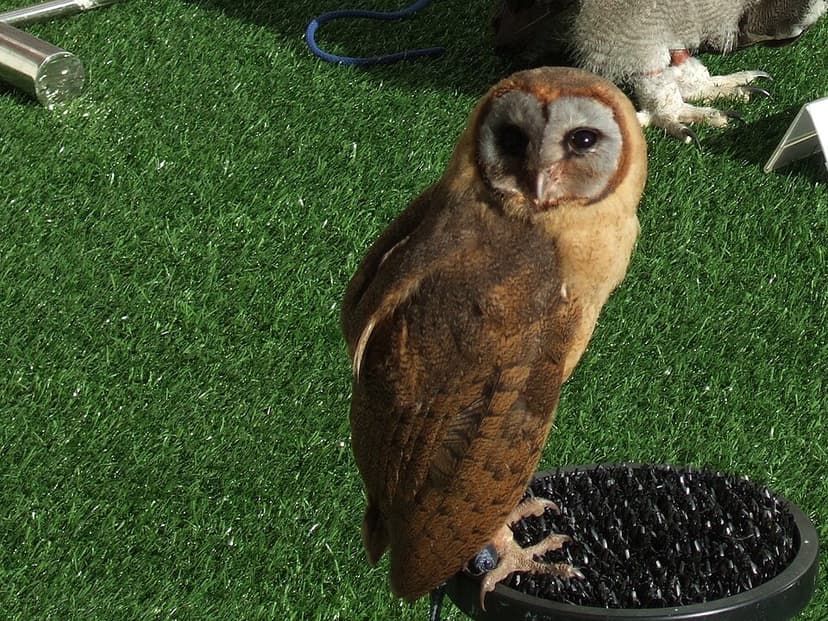
Ashy-faced owl
The ashy-faced owl (Tyto glaucops) is a species of barn owl native to Hispaniola and several islands in the Lesser Antilles. It is distinguished by its silvery-gray facial disc (in the nominate subspecies), a preference for a mix of open hunting spaces and canopy cover, and a varied diet of small vertebrates and invertebrates. This species plays a crucial role as a nocturnal predator in its island ecosystems.

Austral pygmy owl
The austral pygmy owl is a small owl species found in central and southern Chile and parts of southern Argentina. It is distinctive for its gray-brown and red color morphs and its ability to hunt both during the day and at night. This owl is known for its varied vocalizations, including contact whistles, territorial trills, and courtship calls.