
Long-whiskered owlet
The long-whiskered owlet (Xenoglaux loweryi) is a small, vulnerable owl species endemic to a limited region in northern Peru. It is distinguished by the long, thin feathers forming a ruff around its eyes, giving it its common name. This elusive bird inhabits humid montane and elfin forests, and its diet and breeding habits remain largely unstudied.
Key Facts
- ›One of the world's smallest owls, measuring 13-14 cm in length.
- ›Endemic to a small area in Amazonas and San Martín departments of northern Peru.
- ›Characterized by long, thin feathers around the eyes forming a distinctive ruff.
- ›Inhabits humid montane and elfin forests, often in fog-shrouded areas with dense vegetation.
- ›Its diet and breeding biology are not well-documented, but insect remains have been found in one specimen.
- ›Currently listed as Vulnerable by the IUCN due to its restricted range and small population.

Long-Whiskered Owlet
Humid Montane Forest, Elfin Forest
Peru
Insects
About Long-whiskered owlet
The long-whiskered owlet, scientifically known as Xenoglaux loweryi, is a diminutive species of owl found exclusively in a small region of northern Peru. It belongs to the family Strigidae and is the sole member of its genus, Xenoglaux. This species is notable for its small size and a distinctive facial feature: long, thin feathers that form a ruff around its eyes, which inspired its common name.
Discovery and Taxonomy
First described in 1977 from specimens collected the previous year, the long-whiskered owlet was placed in a new genus, Xenoglaux, derived from Greek words meaning "strange owl." Its specific epithet, loweryi, honors George H. Lowery, Jr., for his contributions to neotropical ornithology. Molecular studies have since confirmed its closest relatives are the elf owl and the collared owlet, though its exact placement within owl phylogeny continues to be refined.
Physical Characteristics
Measuring between 13 and 14 centimeters in length, the long-whiskered owlet is among the smallest owls globally. Individuals weigh around 48 grams. Both sexes share similar plumage. Their upperparts are brown with fine black barring, while their underparts exhibit a salt-and-pepper pattern. The most striking feature is the facial ruff, composed of elongated, wispy feathers around the eyes. The iris is amber, and the bill is greenish-gray with a yellowish tip.
Distribution and Habitat
This species is endemic to the Andes of northern Peru, with known locations concentrated in the Amazonas and San Martín departments, particularly around Abra Patricia. It inhabits humid montane and elfin forests, often found in fog-shrouded environments rich with mosses, bromeliads, and epiphytes. The habitat typically includes dense thickets of bamboo, palms, and tree ferns, at elevations ranging from 1,900 to 2,600 meters.
Behavior and Ecology
Much of the long-whiskered owlet's behavior remains a mystery. It is a year-round resident within its range. While its diet has not been extensively studied, insect remains have been found in one specimen. Breeding biology is also poorly understood, though it is hypothesized that breeding occurs between November and June, as specimens collected later in the year showed no signs of active breeding. Its vocalizations are described as a single, slightly hoarse hoot and a rarely heard rapid, low-pitched trill.
Conservation Status
The long-whiskered owlet is classified as Vulnerable by the IUCN. Its limited geographic distribution and an estimated population of 250 to 1000 mature individuals contribute to this status. The primary threat is habitat clearance for timber, agriculture, and mining. However, conservation efforts, including the establishment of private protected areas and reserves, are in place to protect the species and its fragile montane forest habitat.
Source: Wikipedia ↗
Frequently Asked Questions
What makes the long-whiskered owlet distinctive?
The long-whiskered owlet is most distinctive for its facial features, which include a ruff of long, thin feathers around the eyes. This unique characteristic gives the species its common name and sets it apart from other small owls.
Where is the long-whiskered owlet found?
This owl is endemic to a very specific and limited area in the northern Peruvian Andes, primarily in the Amazonas and San Martín departments. Its known locations are concentrated around Abra Patricia and nearby sites like La Esperanza in the Cordillera Colán.
What is the habitat of the long-whiskered owlet?
The long-whiskered owlet inhabits humid montane forests and elfin forests. These areas are typically characterized by fog, abundant mosses, bromeliads, epiphytes, and dense undergrowth, including bamboo thickets, palms, and tree ferns.
What is the conservation status of the long-whiskered owlet?
The long-whiskered owlet is classified as Vulnerable by the International Union for Conservation of Nature (IUCN). This status reflects its limited geographic range and a population estimated between 250 and 1000 mature individuals.
What is known about the diet of the long-whiskered owlet?
Little is definitively known about the diet and feeding behavior of the long-whiskered owlet. However, examination of one specimen revealed insect remains in its stomach, suggesting insects are part of its diet.
When is the long-whiskered owlet believed to breed?
The breeding biology of the long-whiskered owlet is not well understood. Based on specimens collected between late July and October showing no signs of active breeding, it is hypothesized that the species breeds between November and June.
Related Owl species
Camiguin boobook
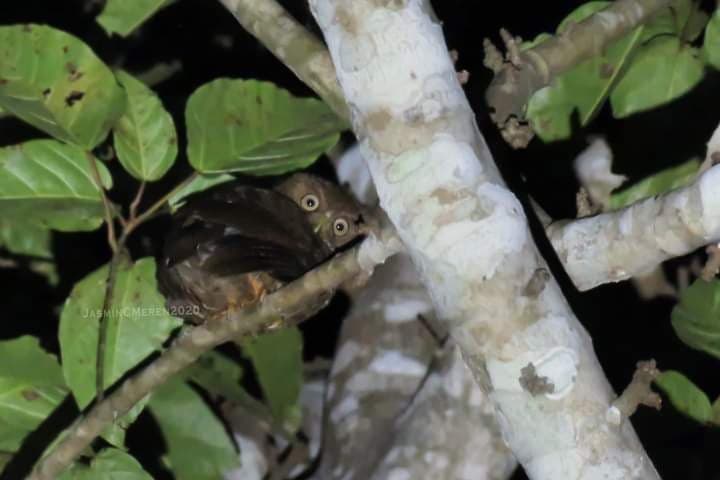
The Camiguin boobook (Ninox leventisi), also known by its native name kugkug, is an owl species endemic to Camiguin island in the Philippines. It is distinguished by its unique greenish-yellow or grayish eyes, a trait not found in its closely related species. This species was reclassified from a subspecies of the Philippine hawk-owl in 2012 based on vocal and other evidence indicating its distinctiveness.
Flores scops owl
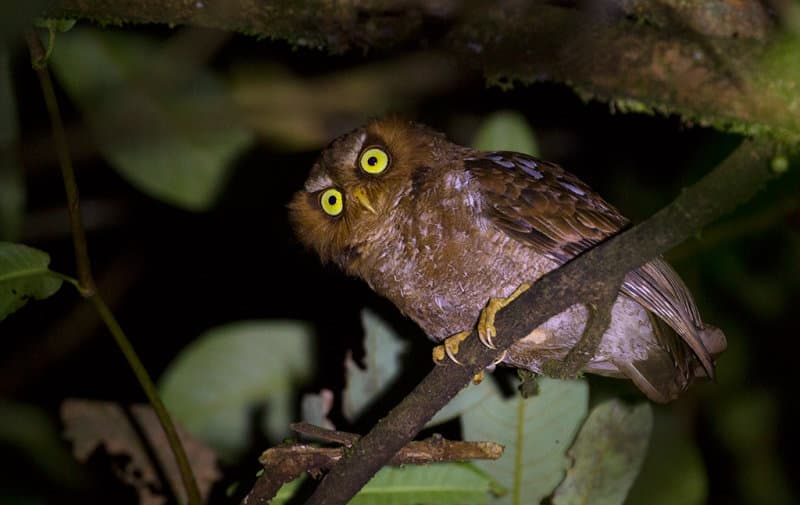
The Flores scops owl (Otus alfredi) is a small owl species found exclusively on the island of Flores in Indonesia. It is distinguished by its short, rounded ear-tufts, white forehead vermiculation, and orange-yellow beak with long, reddish rictal bristles. This vulnerable species is threatened by significant habitat loss.

Golden masked owl
The golden masked owl (Tyto aurantia) is a barn owl species native to New Britain, Papua New Guinea. It is characterized by its distinctive heart-shaped, white facial disc and is a poorly studied, largely solitary, and nocturnal predator of small mammals and insects. Habitat loss due to deforestation poses a significant threat to its vulnerable conservation status.