
Maghreb owl
Strigiformes·Not evaluated (IUCN)
The Maghreb owl (Strix mauritanica) is a medium-sized owl native to northwestern Africa, recently recognized as a distinct species in 2020. It differs genetically, morphologically, and vocally from its closest relative, the tawny owl. This owl inhabits a variety of environments, from forests to urban areas, and possesses a diverse diet.
Key Facts
- ›Endemic to northwestern Africa, found from Morocco to Tunisia and Mauritania.
- ›Previously considered a subspecies of the tawny owl (Strix aluco mauritanica).
- ›Distinguished by its dark grey-brown plumage and lack of color morphs.
- ›Its diet includes mammals, insects, birds, reptiles, and amphibians.
- ›Known for its deeper-pitched vocalizations compared to the tawny owl.
- ›Breeds in monogamous pairs, raising one clutch of three to five eggs annually.

Maghreb Tawny Owl
Urban Habitats, Mediterranean Forests, Mixed Forests, Deciduous Forests, Coniferous Forests, Rocky Country, Large Gardens, Parks, Open Farmland
Northwestern Africa, Morocco, Algeria, Tunisia, Mauritania
Mammals, Insects, Birds, Reptiles, Amphibians, Rodents, Bats, Beetles, Partridges, Hares
About Maghreb owl
The Maghreb owl (Strix mauritanica) is a medium-sized owl native to northwestern Africa, recently distinguished as a unique species in 2020. Previously classified as a subspecies of the tawny owl (Strix aluco mauritanica), it was separated due to significant genetic, morphological, and vocal differences, as well as distinct geographic distribution patterns.
Habitat and Distribution
The Maghreb owl is endemic to the northwestern regions of Africa, including Morocco, Algeria, Tunisia, and Mauritania. Its habitat is remarkably diverse, ranging from lush Mediterranean forests to more open rocky country. It also readily adapts to human-influenced environments, inhabiting urban areas, large gardens, parks, and open farmland, provided mature trees or open spaces are available nearby. As a sedentary and non-migratory species, it remains in its chosen territory for extended periods.
Description and Characteristics
This owl is characterized by a rounded head that lacks ear tufts. Its plumage is consistently dark grey-brown, with no variation through color morphs, a key distinction from the tawny owl. The underside features barring, and the overall appearance is heavily marked with a darker grey upper side. Subtle, pale cap bands are present above its eyes. Like many owl species, Maghreb owls exhibit reversed sexual dimorphism, with females being larger and heavier than males. Recorded female weights range from 390 to 575 grams, while males weigh between 325 and 470 grams.
Diet and Behavior
The Maghreb owl is a carnivorous predator with a broad diet. It preys on a variety of animals, including mammals, insects, birds, reptiles, and amphibians. Studies in its native regions have shown mammals, such as rodents and bats, forming a significant portion of its diet. In urban settings, its diet often comprises rodents and local bird species. Vocalizations are prominent, particularly on calm nights, with males advertising their territories. Their songs are noted for a deeper pitch compared to the tawny owl.
Reproduction
Maghreb owls are monogamous and territorial. Mating pairs typically raise one clutch per year, with laying commencing in late winter or early spring. They lay between three to five eggs, which the female incubates for approximately 28-29 days while the male hunts for food. Young owls fledge after about 29-35 days and achieve independence around three months after hatching. They are believed to reach sexual maturity within a year.
Conservation
The conservation status of the Maghreb owl is currently 'not evaluated' by the IUCN due to its recent species designation. However, when considered as part of the tawny owl subspecies, it was assessed as 'least concern' with stable population trends. Potential threats identified include transportation corridors, service corridors, and pollution. The species is listed under CITES Appendix II, indicating that international trade is regulated to prevent potential future endangerment.
Source: Wikipedia ↗
Frequently Asked Questions
When was the Maghreb owl recognized as a distinct species?
The Maghreb owl was officially recognized as a distinct species in 2020 with Version 10.1 of the IOC World Birds List. Prior to this, it was classified as a subspecies of the tawny owl.
What are the main differences between the Maghreb owl and the tawny owl?
The Maghreb owl differs from the tawny owl in genetics, morphology, vocalizations, and distribution. It also has a consistently grey-brown plumage, unlike the tawny owl which exhibits color morphs, and possesses a 20% wider wingspan.
What kind of habitats does the Maghreb owl prefer?
The Maghreb owl is adaptable and can be found in diverse habitats. These include mixed and deciduous forests, coniferous forests, rocky areas, and human-settled regions like large gardens, parks, open farmland, and cities, provided there is mature growth nearby.
What does the Maghreb owl eat?
The Maghreb owl has a carnivorous diet that includes a wide range of prey. Its diet consists of mammals, insects, birds, reptiles, and amphibians. In some urban areas, its diet is dominated by rodents and urban birds.
What are the nesting habits of the Maghreb owl?
Maghreb owls do not construct their own nests. Instead, they seek out natural cavities such as holes or crevices in trees, abandoned nests of other birds, ground depressions or burrows, or undisturbed human structures like attics or barns.
What is the conservation status of the Maghreb owl?
As a recently recognized species, the Maghreb owl's conservation status is 'not evaluated' by the IUCN. However, when previously assessed as a subspecies of the tawny owl, it was considered 'least concern' with stable population trends.
Related Owl species
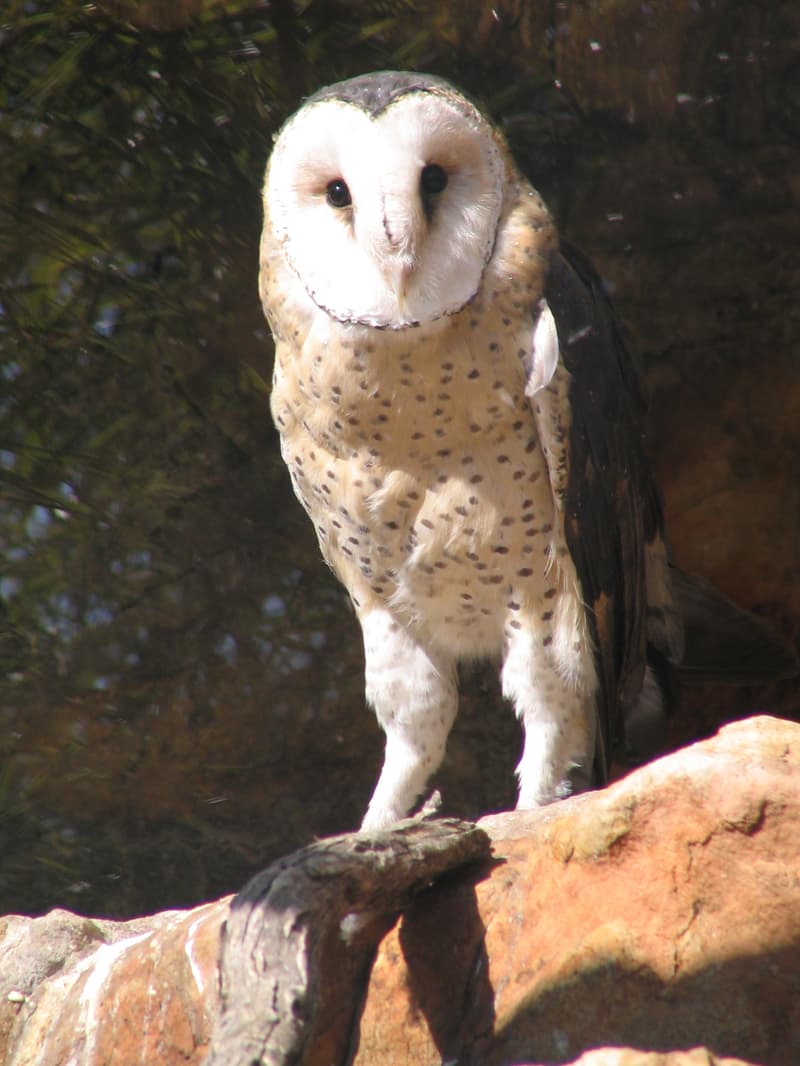
African grass owl
The African grass owl (Tyto capensis) is a medium-sized owl found in sub-Saharan Africa, known for its uniform sooty blackish-brown upperparts and heart-shaped facial disc. It primarily inhabits moist grasslands and savannas, where it hunts rodents and other small mammals at night.

African scops owl
The African scops owl (Otus senegalensis) is a small owl native to sub-Saharan Africa, characterized by its cryptic greyish-brown plumage and bright yellow eyes. It is a strictly nocturnal hunter, often overlooked during the day due to its remarkable camouflage. Its distinctive call is a monotonous "prrrp" sound.

African wood owl
The African wood owl (Strix woodfordii), also known as Woodford's owl, is a common forest owl species native to sub-Saharan Africa. It is distinguished by its rounded head, large dark eyes with white eyebrows, and a distinctive hooting call that can be heard over long distances. This owl is strictly nocturnal and primarily inhabits indigenous forests and woodlands.