
Mountain scops owl
The mountain scops owl (Otus spilocephalus), also known as the spotted scops owl, is a species of owl found across south and southeast Asia. Its range spans from Pakistan and the Himalayas eastward to Taiwan, Thailand, and Malaysia. A distinctive feature is its plumage, which can be more russet in the nominate subspecies from the eastern Himalayas, and it is known for its altitudinal migration patterns.
Key Facts
- ›Native to south and southeast Asia, including Pakistan, the Himalayas, Taiwan, Thailand, and Malaysia.
- ›Known for its altitudinal migration.
- ›Possesses a short, high-pitched call, often described as a two-note whistle like "plew-plew" or "he-he".
- ›Plumage can vary, with the nominate subspecies from the eastern Himalayas exhibiting a more russet coloration.
- ›Belongs to the family Strigidae.

Spotted Scops Owl
Mountainous Regions
Pakistan, Himalayas, Taiwan, Thailand, Malaysia
About Mountain scops owl
The mountain scops owl (Otus spilocephalus), also known by the common name spotted scops owl, is a species of owl belonging to the family Strigidae. Its natural distribution is widespread across a significant portion of south and southeast Asia.
Geographic Range and Habitat
This species inhabits a broad area that stretches from Pakistan and the Himalayas in the northwest, extending eastward through Taiwan, Thailand, and Malaysia in the south. While specific habitat details are not elaborated, its name and migratory behavior suggest it is found in mountainous environments.
Behavior and Vocalization
The mountain scops owl is noted for being an altitudinal migrant, meaning it likely moves between different elevations seasonally. Its vocalization is distinctive, characterized by a short, high-pitched call that sounds like a two-note whistle, often described as "plew-plew" or "he-he." It is also mentioned that the calls can vary among different geographic populations, and the vocalizations of females are seldom heard.
Physical Characteristics
While detailed physical descriptions are limited, the plumage of the mountain scops owl can exhibit regional variations. Specifically, the nominate subspecies found in the eastern Himalayas is known to have a more russet-colored plumage.
Source: Wikipedia ↗
Frequently Asked Questions
What is another name for the mountain scops owl?
The mountain scops owl is also commonly referred to as the spotted scops owl. This alternative name highlights its patterned plumage.
Where can the mountain scops owl be found?
Its geographic range is extensive, covering much of south and southeast Asia. This includes countries and regions such as Pakistan, the Himalayas, Taiwan, Thailand, and Malaysia.
What does the mountain scops owl sound like?
The mountain scops owl has a distinctive vocalization that is a short, high-pitched call. It is often described as a two-note whistle, sounding like "plew-plew" or "he-he".
Are there any variations in the mountain scops owl's appearance?
Yes, plumage can vary. The nominate subspecies found in the eastern Himalayas is noted for having a more russet-colored plumage compared to other populations.
Does the mountain scops owl move seasonally?
The mountain scops owl is an altitudinal migrant. This means it moves between different elevations, likely in response to seasonal changes.
Related Owl species
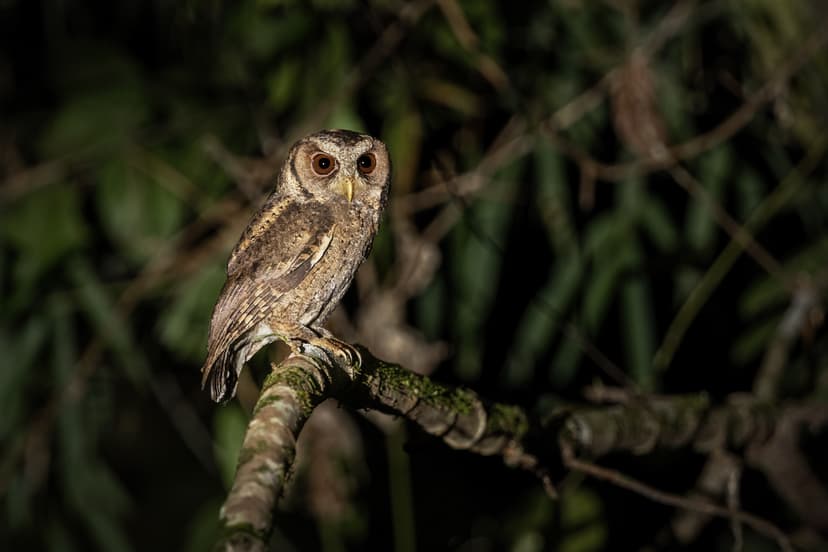
Collared scops owl
The Collared scops owl (Otus lettia) is a resident breeder in South Asia, found from Pakistan and Nepal eastward to southern China and Taiwan. It is a distinctive small owl, notable for its size among scops owls, with head tufts and a buff neckband. Primarily nocturnal insectivores, they are often revealed by smaller birds mobbing their daytime roosts.

Japanese scops owl
The Japanese scops-owl (Otus semitorques), also known as the Oriental scops-owl, is a small owl species native to East Asia, including Japan, China, Korea, and Russia. Distinctive for its grey-brown plumage, red eyes, and prominent ear tufts, this owl inhabits forests and woodlands, preying primarily on invertebrates and small rodents.
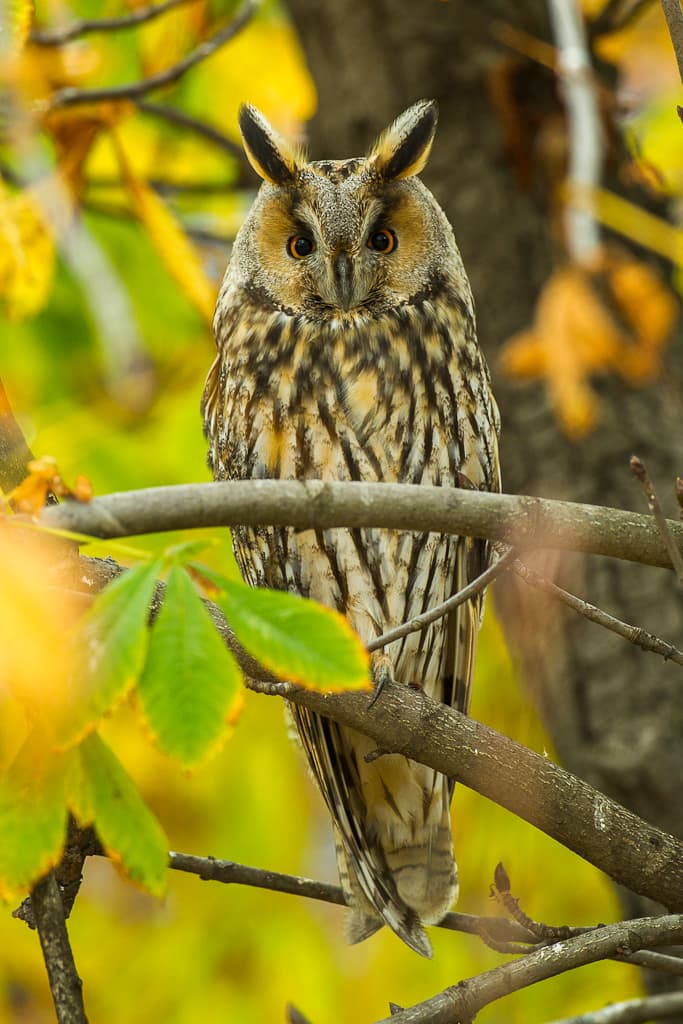
Long-eared owl
The long-eared owl (Asio otus) is a medium-sized owl species with a wide distribution across North America and the Palearctic region. It is characterized by its prominent ear tufts, which are actually feathered extensions and not true ears, and its preference for woodland edges and open hunting grounds. This owl is a specialized predator, primarily feeding on small rodents, particularly voles.