
Northern saw-whet owl
Strigiformes·Low concern (globally)
The northern saw-whet owl (Aegolius acadicus) is one of the smallest owl species native to North America. Named for its call, which resembles the sound of sharpening a saw, this owl is known for its secretive nature and preference for dense coniferous forests. Despite its widespread distribution, it is difficult to spot, making population tracking challenging.
Key Facts
- ›One of the smallest owl species in North America, measuring 17-22 cm in length.
- ›Known for its distinctive call that sounds like a saw being sharpened.
- ›Primarily inhabits dense coniferous forests but can be found in mixed or deciduous woods.
- ›Hunts small mammals, with a strong preference for rodents like deer mice and voles.
- ›Possesses asymmetrical ears for precise prey localization, allowing it to hunt by sound alone in darkness.
- ›Has a unique fluorescence in its wing feathers under UV light, used for aging.

Saw-Whet Owl, Acadian Owl
Coniferous Forests, Mixed Forests, Deciduous Woods, Dense Thickets, Wetlands
North America, Alaska, Canada, United States, Mexico
Small Mammals, Rodents, Shrews, Squirrels, Small Birds, Crustaceans, Frogs, Aquatic Insects
Larger Birds of Prey, Martens, Corvids
About Northern saw-whet owl
The northern saw-whet owl (Aegolius acadicus) is one of North America's smallest owl species, recognized by its distinctive call that echoes the sound of a saw being sharpened. This secretive bird inhabits a wide range across the continent, favoring dense coniferous forests but also found in mixed and deciduous woods.
Description and Identification
Adults typically measure between 17 and 22 cm in length with a wingspan of 42 to 56.3 cm. They possess a round, pale face with brown and cream streaks, yellow eyes, and a dark beak. The upper parts are brown or reddish with white spots, while the underparts are pale with darker markings. A notable feature is a distinct white, Y-shaped marking between their eyes. While plumage does not differ between sexes, females are generally larger than males. Interestingly, their flight feathers fluoresce a neon pink under UV light, a trait used for aging.
Habitat and Distribution
The northern saw-whet owl's range spans most of North America, extending from Alaska and Canada south through the United States and into central Mexico. They are most commonly found nesting in dense coniferous forests near wetlands, though they may also breed in mixed-deciduous forests at the southern reaches of their territory. Wintering birds seek out conifer stands or shrub thickets near water. While many populations are migratory, some are permanent residents, particularly in isolated areas like the Allegheny Plateau and the southern Appalachian Mountains.
Diet and Hunting Behavior
These owls are adept hunters, primarily feeding on small mammals, with a strong preference for rodents such as deer mice and voles. Their hunting prowess is enhanced by vertically asymmetrical ears, which allow for extremely precise sound localization, enabling them to hunt effectively by hearing alone in complete darkness. They perch on high vantage points at night and then swoop down on their unsuspecting prey. While mammals form the bulk of their diet, they will also consume small birds, and in coastal areas, may eat crustaceans, frogs, and aquatic insects.
Vocalization and Behavior
The characteristic call of the northern saw-whet owl, which gives it its name, is a repeated tooting whistle. Males are particularly vocal during the breeding season, which generally runs from January to early July, using these calls to attract mates. Researchers have identified at least 11 different vocalizations, including advertising calls, rapid calls, and whines. They are secondary cavity nesters, utilizing existing holes and cavities for their nests. The species exhibits sequential polyandry, where females may mate with multiple males in a single breeding season.
Conservation Status
Globally, the northern saw-whet owl is listed as a species of low conservation concern, with an estimated global breeding population of 2 million. However, habitat loss due to factors like logging and pollution has led to declines in certain regions, with local populations in areas like North Carolina and British Columbia facing threats. Efforts to mitigate habitat loss include the use of nest boxes, which the owls readily adopt.
Source: Wikipedia ↗
Frequently Asked Questions
What does the northern saw-whet owl sound like?
The northern saw-whet owl is named for its vocalization, which is described as a repeated tooting whistle, resembling the sound of a saw being sharpened on a whetting stone. Males often produce these calls while seeking mates, particularly from January through early July.
Where can I find a northern saw-whet owl?
These owls inhabit coniferous forests, as well as mixed or deciduous woods, across North America. They often reside in dense thickets, sometimes at eye level, but can also be found higher up in trees.
What do northern saw-whet owls eat?
Their diet consists primarily of small mammals, with a significant focus on rodents such as deer mice and voles. They may occasionally supplement their diet with small birds, crustaceans, frogs, and aquatic insects, particularly on the Pacific coast.
Are northern saw-whet owls endangered?
Globally, the northern saw-whet owl is considered a species of low conservation concern with a large breeding population. However, some local populations, such as those in North Carolina and parts of British Columbia, are threatened due to habitat loss.
How do northern saw-whet owls hunt?
These owls hunt by perching at night and swooping down on their prey. They possess vertically asymmetrical ears, enabling them to precisely locate prey by sound alone, even in complete darkness.
Related Owl species

Boreal owl
The boreal owl, also known as Tengmalm's owl, is a small owl found in the taiga forests of North America and Eurasia. It is distinguished by its pearly-white spots on brown plumage, remarkable confiding nature when encountered, and a unique asymmetrical skull structure that aids in pinpointing prey.
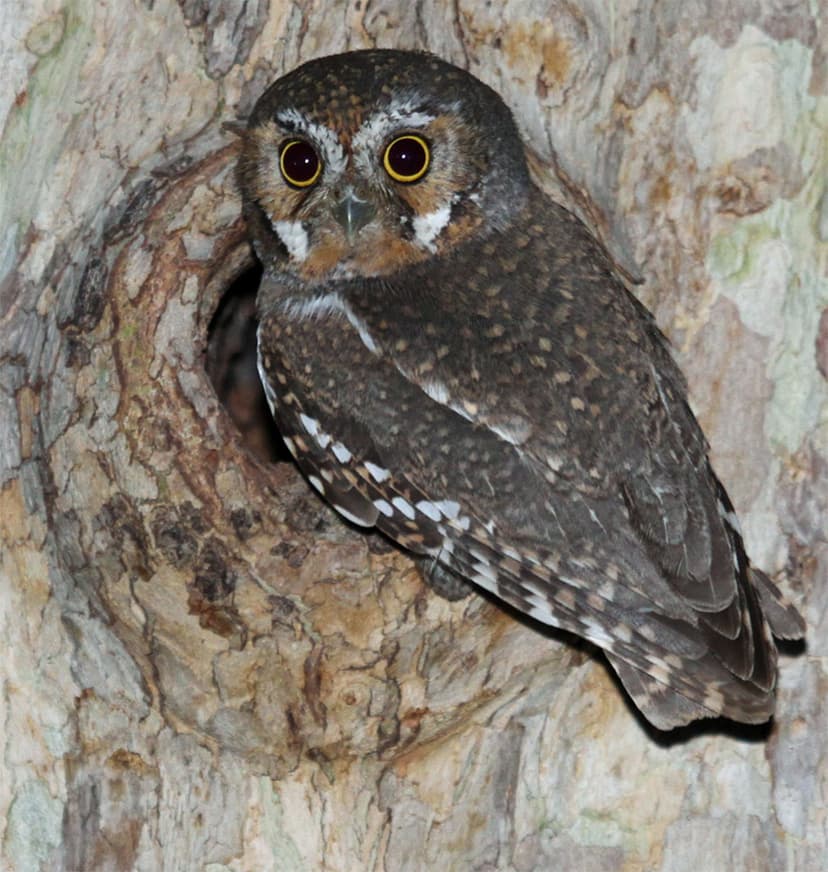
Elf owl
The Elf owl is the world's smallest owl, a tiny bird found in the southwestern United States, central Mexico, and the Baja California peninsula. Distinctive for its pale yellow eyes and gray bill, it frequently inhabits woodpecker holes in saguaro cacti. Primarily feeding on insects, this nocturnal owl is known for its complex vocalizations, which vary between sexes and play a role in territorial defense and mating.

Eurasian scops owl
The Eurasian scops owl (Otus scops) is a small owl native to southern Europe and extending eastwards into Siberia and the Himalayas. This migratory species is distinctive for its small size, ear tufts, and a call resembling that of midwife toads. It primarily inhabits open woodlands and can be found wintering in sub-Saharan Africa.