
Omani owl
Strigiformes·Data Deficient
The Omani owl (Strix butleri) is a bird species discovered in 2013, native to shrubland and rocky areas of Oman, Iran, and the United Arab Emirates. It is characterized by its bi-colored face, orange eyes, and distinct vocalizations. Following its discovery, a previously identified owl species, Hume's owl, was reclassified.
Key Facts
- ›Native to Oman, Iran, and the United Arab Emirates.
- ›Found in shrubland and rocky cliff habitats.
- ›Distinguished by a bi-colored face, orange eyes, and streaked underparts.
- ›Discovered as a new species in 2013.
- ›Its scientific name, Strix butleri, was originally given to a different owl before taxonomic revisions.

Omani Owl
Shrubland, Rocky Areas, High Rocky Cliffs
Oman, Iran, United Arab Emirates
About Omani owl
The Omani owl, scientifically known as Strix butleri, is a species of owl that was formally described in 2013. It is found in the shrubland and rocky terrains of Oman, Iran, and the United Arab Emirates. This owl is distinguished by its unique physical characteristics, including a bi-colored pale and dark grey face, striking orange eyes, and plumage featuring dark greyish-brown upperparts and pale underparts adorned with long, narrow vertical dark streaks. Its legs are relatively long, and both its wings and tail are banded.
Discovery and Taxonomy
The original specimen that led to the scientific description of Strix butleri was collected by Colonel Edward Arthur Butler and described by Allan Octavian Hume in 1878, who named it in Butler's honor. For many years, owls observed in the Middle East were presumed to belong to this single species. However, a significant taxonomic revision occurred in 2015. Researchers identified a distinct population of Strix owls in Oman that differed morphologically and vocally from the widely recognized Hume's owl. This newly identified population was initially named Strix omanensis, or the Omani owl.
Subsequent analysis of the original holotype of Strix butleri revealed it was more closely related to the newly described Omani owl than to other specimens previously identified as Hume's owl. This led to the conclusion that Strix omanensis is likely a synonym of Strix butleri. Consequently, the more widespread Middle Eastern species was renamed Strix hadorami, commonly known as the desert owl. The conservation status for Strix omanensis was listed as data deficient by the IUCN, a classification that now more appropriately applies to Strix hadorami due to taxonomic changes.
Source: Wikipedia ↗
Frequently Asked Questions
When was the Omani owl discovered?
The Omani owl was discovered as a distinct species in 2013. This discovery led to a re-evaluation of other owl species in the region.
What are the key physical features of the Omani owl?
The Omani owl has a bi-colored face, with pale and dark grey markings, and striking orange eyes. Its upperparts are dark greyish-brown, while its underparts are pale with narrow, dark vertical streaks. It also possesses relatively long legs, banded wings, and a banded tail.
Where does the Omani owl live?
This owl species inhabits shrubland and rocky areas. Specifically, it has been observed in high rocky cliffs, though not typically in adjacent wadis.
What is the scientific name of the Omani owl?
The scientific name for the Omani owl is Strix butleri. This name was originally applied to a different owl and later reassigned following taxonomic revisions.
What was the taxonomic history of the Omani owl?
Initially identified in 2013 as a new species, Strix omanensis, further analysis in 2015 revealed it was likely the same as Strix butleri. The more widespread owl previously known as Hume's owl was then reclassified as Strix hadorami.
Related Owl species
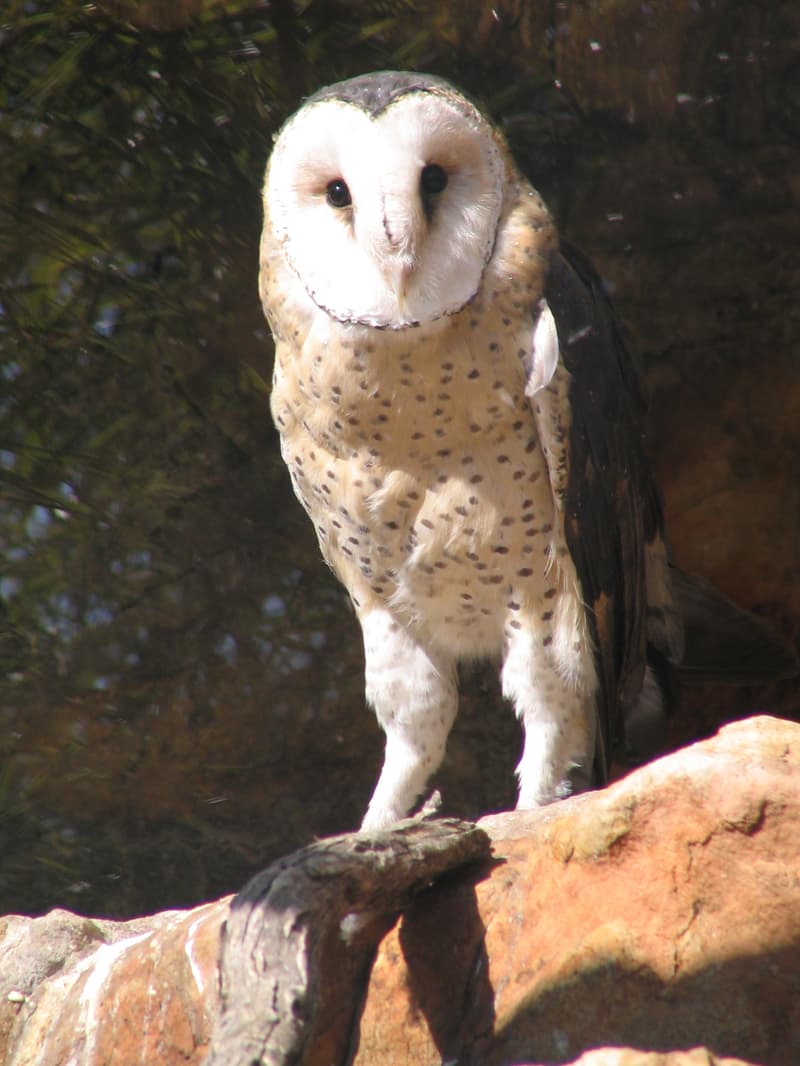
African grass owl
The African grass owl (Tyto capensis) is a medium-sized owl found in sub-Saharan Africa, known for its uniform sooty blackish-brown upperparts and heart-shaped facial disc. It primarily inhabits moist grasslands and savannas, where it hunts rodents and other small mammals at night.

African scops owl
The African scops owl (Otus senegalensis) is a small owl native to sub-Saharan Africa, characterized by its cryptic greyish-brown plumage and bright yellow eyes. It is a strictly nocturnal hunter, often overlooked during the day due to its remarkable camouflage. Its distinctive call is a monotonous "prrrp" sound.

African wood owl
The African wood owl (Strix woodfordii), also known as Woodford's owl, is a common forest owl species native to sub-Saharan Africa. It is distinguished by its rounded head, large dark eyes with white eyebrows, and a distinctive hooting call that can be heard over long distances. This owl is strictly nocturnal and primarily inhabits indigenous forests and woodlands.