
Oriental bay owl
The Oriental bay owl (Phodilus badius) is a small, nocturnal owl species found across Southeast Asia and parts of India. It is distinguished by its heart-shaped face with ear-like extensions and a unique vocalization combining hoots, screams, and whistles. This elusive bird is well-camouflaged within its woodland and swampy habitats, making it difficult to spot.
Key Facts
- ›Completely nocturnal and primarily active at night.
- ›Features a distinctive heart-shaped face with ear-like tufts.
- ›Vocalizations include hoots, screams, and melancholic whistle songs.
- ›Inhabits woodlands, plantations, and mangrove swamps.
- ›Diet consists of small rodents, bats, birds, snakes, frogs, lizards, and large arthropods.
- ›Females are generally larger than males.

Oriental Bay Owl
Woodland, Plantations, Mangrove Swamps, Tropical Moist Forests, Tropical Wet Evergreen Forest, Montane Forests
Southeast Asia, India, Nepal, Sikkim, Assam, Nagaland, Manipur, Burma, Thailand, South China, Malay Peninsula, Greater Sundas, Philippines
Small Rodents, Bats, Birds, Snakes, Frogs, Lizards, Magpies, Large Arthropods
About Oriental bay owl
The Oriental bay owl (Phodilus badius) is a species of bay owl found across a wide range in Southeast Asia and parts of India. This small, elusive bird is characterized by its completely nocturnal habits and a distinctive heart-shaped face with ear-like extensions. Its plumage features a deep chestnut on the upperparts and a cream to tanish underside, with large, striking black eyes that stand out against its face.
Distribution and Habitat
Oriental bay owls inhabit woodlands, plantations, and mangrove swamps, often at considerable altitudes, reaching up to 2,300 meters in some areas. They are found from Nepal and India eastward through Burma and Thailand to South China, and south through the Malay Peninsula to the Greater Sundas, including the Philippines.
Behavior and Diet
As a nocturnal species, the Oriental bay owl hunts primarily at night. Its diet is varied, including small rodents, bats, birds, snakes, frogs, lizards, and large arthropods like beetles and spiders. They are adept hunters, utilizing their short, rounded wings to maneuver through trees and catch prey. Their vocalizations are notable, ranging from hoots and screams to distinctive melancholic whistle songs.
Reproduction
Breeding typically occurs between March and May. The owls nest in hollowed-out tree trunks or other cavities, laying clutches of 3 to 5 white eggs. Both parents exhibit care towards their offspring, with the father responsible for hunting and providing food, while the mother incubates the eggs and protects the nestlings. Incubation lasts approximately 36–42 days, and the young develop quickly under parental protection.
Taxonomy and Status
Four subspecies of the Oriental bay owl are recognized: Phodilus badius arixuthus, Phodilus badius badius, Phodilus badius parvus, and Phodilus badius saturatus. Historically, other species like the Congo bay owl and Sri Lanka bay owl were considered subspecies, but their classification has been revised. A population on Samar Island in the Philippines is believed to have become extinct in the 20th century.
Source: Wikipedia ↗
Frequently Asked Questions
What are the main physical characteristics of the Oriental bay owl?
The Oriental bay owl has a heart-shaped face with ear-like extensions and large, striking black eyes. The top and back of its body are a deep chestnut, while its underside and stomach are cream and tanish. They are small and tend to stand upright, making them difficult to spot.
Where is the Oriental bay owl found?
This species is distributed throughout Southeast Asia and parts of India, including Nepal, Sikkim, Assam, Burma, Thailand, the Malay Peninsula, and the Greater Sundas. They are found in woodland, plantations, and mangrove swamps.
What does the Oriental bay owl eat?
Their diet includes small rodents, bats, birds, snakes, frogs, lizards, and large arthropods such as beetles, grasshoppers, and spiders. They hunt from a perch and fly through trees to catch their prey.
What sounds does the Oriental bay owl make?
The Oriental bay owl's vocalizations are remarkable, including hoots, screams, and high-pitched whistle songs. Their songs typically consist of four to seven melancholic whistles, sometimes alternating with a shorter 'kleet-kleet-kleet' or 'kleek-kleek-kleek' whistle.
How do Oriental bay owls breed?
Breeding typically occurs from March to May, with eggs laid between March and July. They nest in hollowed-out tree trunks or other cavities, laying 3 to 5 white eggs. Both parents care for the young, with the father hunting and the mother incubating the eggs.
What is the size of an Oriental bay owl?
Oriental bay owls are small, with a total body length ranging from 22.5 to 29 cm. Their wingspan is between 172–237 mm, and their tail length is 168–239 mm. They typically weigh between 255–308 g.
Related Owl species

African scops owl
The African scops owl (Otus senegalensis) is a small owl native to sub-Saharan Africa, characterized by its cryptic greyish-brown plumage and bright yellow eyes. It is a strictly nocturnal hunter, often overlooked during the day due to its remarkable camouflage. Its distinctive call is a monotonous "prrrp" sound.
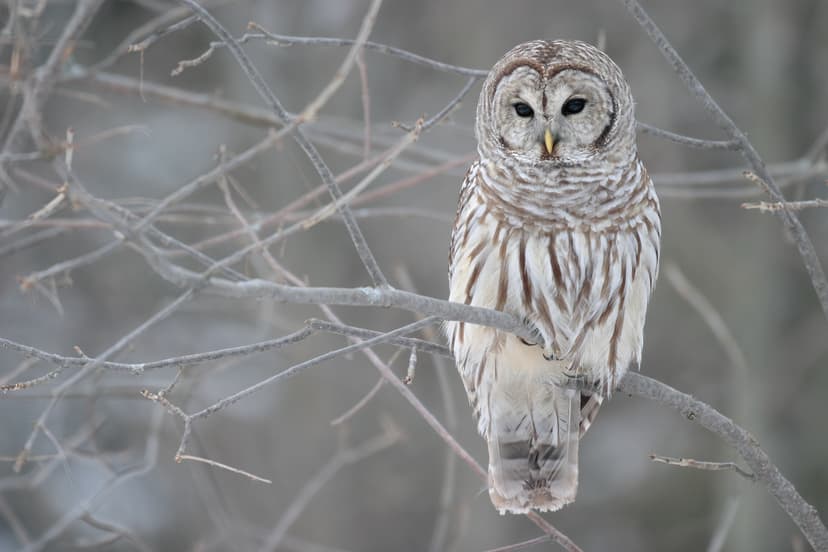
Barred owl
The barred owl (Strix varia) is a large North American owl known for its distinctive "Who cooks for you, who cooks for you all" call. Primarily found in mature forests and woodlands in eastern North America, it has expanded its range westward, where it is considered an invasive species. This owl is characterized by its brown to gray plumage with dark striping on its underside and its large, rounded head without ear tufts.

Eastern screech owl
The eastern screech owl is a stocky, short-tailed owl native to Eastern North America, found from Mexico to Canada. It is a midsized screech owl, adaptable to various woodland habitats and even urban environments, though its strictly nocturnal habits often make it elusive. Distinctive features include prominent ear tufts, yellow eyes, and a unique tremolo call.