
Pallid scops owl
The pallid scops owl (Otus brucei) is a small owl native to western and central Asia, extending into the Middle East. It is distinguished from similar species by its more pronounced streaks on its back and less complex plumage markings. This species inhabits semi-open country with trees and bushes, and some populations undertake seasonal migrations.
Key Facts
- ›Ranges from the Middle East to west and central Asia.
- ›Inhabits semi-open country with trees and bushes.
- ›Primarily an insectivore, also consuming lizards, spiders, and small mammals.
- ›Breeds between April and June, laying 4 to 6 eggs.
- ›Its call is described as a series of low, hollow, dove-like notes.
- ›Distinctive features include more pronounced back streaks compared to similar owl species.

Striated Scops Owl
Semi-Open Country With Trees and Bushes, Palm Plantations
Middle East, West Asia, Central Asia, Arabian Peninsula, Egypt, Pakistan, India
Insects, Lizards, Spiders, Small Mammals, Bats
About Pallid scops owl
The pallid scops owl (Otus brucei), sometimes referred to as the striated scops owl, is a small owl found across a wide range from the Middle East into west and central Asia. Its habitat typically consists of semi-open country dotted with trees and bushes, and it has been observed nesting in man-made environments like palm plantations.
Description and Identification
Visually, the pallid scops owl resembles the Eurasian scops owl, but it possesses more distinct streaks along its back and less elaborate plumage markings. These subtle differences help distinguish it from its close relatives.
Distribution and Migration
Its breeding range spans a considerable area, estimated at 6,190,000 km². During the non-breeding season, this area reduces to 3,560,000 km² as some populations undertake migrations. These migrations can take them as far south as the Arabian Peninsula, Egypt, and Pakistan. Recent observations have noted significant populations in the Rift Valley of Israel and in Jordan, particularly within palm plantations.
Behavior and Diet
The pallid scops owl is primarily insectivorous, but its diet is varied. It supplements its insect intake with lizards, spiders, and small mammals. Uniquely, it has been observed hunting during daylight hours and is known to catch bats and insects in flight.
Reproduction
The breeding season for the pallid scops owl generally occurs between April and June. Females lay clutches of 4 to 6 eggs, which are incubated for approximately 27 days. The young owls, known as owlets, fledge and leave the nest about 30 days after hatching.
Vocalizations
The call of the pallid scops owl is distinctive, described as a series of low, hollow notes that are reminiscent of a dove's cooing.
Source: Wikipedia ↗
Frequently Asked Questions
What is the geographic range of the pallid scops owl?
The pallid scops owl is found from the Middle East across to west and central Asia. Some individuals migrate to areas like the Arabian Peninsula, Egypt, and Pakistan during winter.
What kind of habitat does the pallid scops owl prefer?
This owl prefers semi-open country that features a mix of trees and bushes. They have been observed nesting in palm plantations in Israel and Jordan.
What does the pallid scops owl eat?
Its diet is predominantly insects, but it also consumes lizards, spiders, and small mammals. It is known to hunt bats and insects in flight.
When does the pallid scops owl breed and how many eggs does it lay?
Breeding occurs between April and June. During this period, the female typically lays between 4 to 6 eggs.
What does the pallid scops owl sound like?
The vocalization of the pallid scops owl is characterized by a series of low, hollow notes that resemble those of a dove.
Related Owl species

Boreal owl
The boreal owl, also known as Tengmalm's owl, is a small owl found in the taiga forests of North America and Eurasia. It is distinguished by its pearly-white spots on brown plumage, remarkable confiding nature when encountered, and a unique asymmetrical skull structure that aids in pinpointing prey.
Elf owl
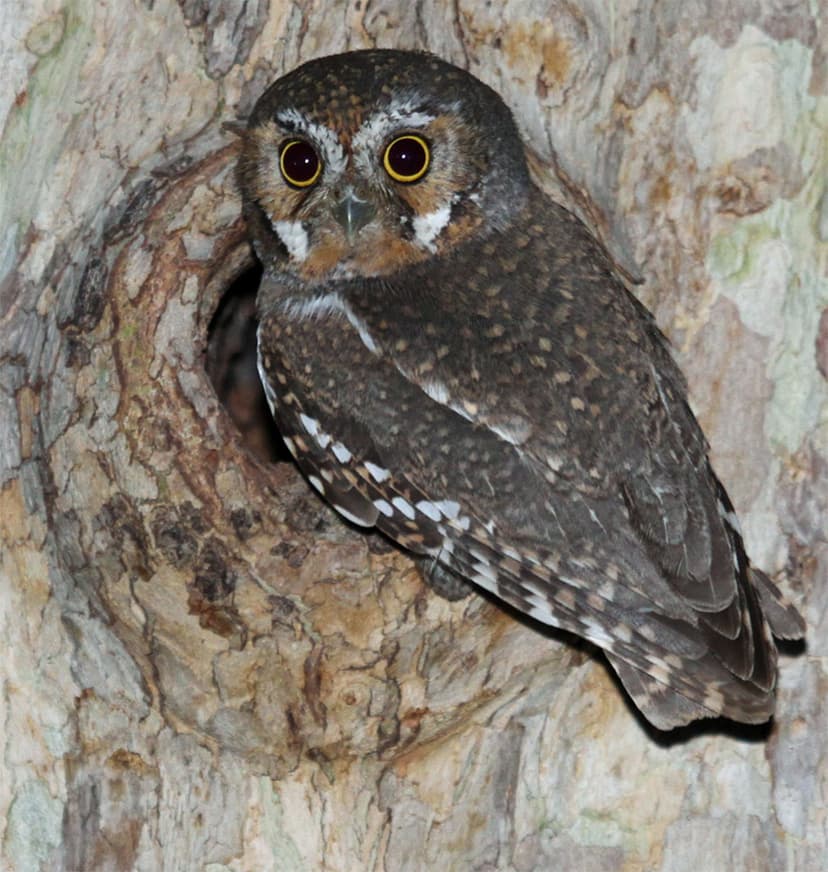
The Elf owl is the world's smallest owl, a tiny bird found in the southwestern United States, central Mexico, and the Baja California peninsula. Distinctive for its pale yellow eyes and gray bill, it frequently inhabits woodpecker holes in saguaro cacti. Primarily feeding on insects, this nocturnal owl is known for its complex vocalizations, which vary between sexes and play a role in territorial defense and mating.

Eurasian scops owl
The Eurasian scops owl (Otus scops) is a small owl native to southern Europe and extending eastwards into Siberia and the Himalayas. This migratory species is distinctive for its small size, ear tufts, and a call resembling that of midwife toads. It primarily inhabits open woodlands and can be found wintering in sub-Saharan Africa.