
Pearl-spotted owlet
The pearl-spotted owlet (Glaucidium perlatum) is a small bird of prey native to sub-Saharan Africa. Distinctive for its heavy white spotting on brown plumage and two prominent false "eyes" on the back of its head, this pygmy owl inhabits savannas and open woodlands. It is known for its varied vocalizations, which can occur both day and night, and its diet primarily consists of arthropods but can include small vertebrates.
Key Facts
- ›Smallest owls in Africa, measuring 17-21 cm in length.
- ›Possesses two prominent black false 'eyes' on the back of its head for defense.
- ›Plumage is brownish with heavy white spotting, with cinnamon-brown upperparts.
- ›Diet consists mainly of arthropods like grasshoppers and crickets, but also includes small vertebrates.
- ›Breeds in old tree cavities excavated by barbets or woodpeckers.
- ›Classified as 'Least Concern' by the IUCN due to a stable population and large range.

Pearl-Spotted Pygmy Owl
Savanna, Woodland, Bushveld, Mopane Savanna, Open Thorn Savanna
Sub-Saharan Africa, Southern Africa, Namibia, Botswana, Zimbabwe, Sudan, Senegal, Angola, Mozambique, Ethiopia, South Africa, Gambia
Arthropods, Grasshoppers, Crickets, Solifuges, Rodents, Bats, Lizards, Snakes, Small Birds
Red Colobus
About Pearl-spotted owlet
The pearl-spotted owlet (Glaucidium perlatum) is a small but distinctive bird of prey found across sub-Saharan Africa. Belonging to the genus Glaucidium, commonly known as pygmy owls, these birds are recognized for their small size and their striking plumage. They are characterized by a brownish coloration heavily marked with white spots. A particularly notable feature is the presence of two prominent, black false "eyes" on the back of their head, which likely serve as a defense mechanism against predators.
Description and Identification
Measuring between 17 to 21 cm in length, the pearl-spotted owlet is one of the smallest owls on the African continent. Females are slightly larger and heavier than males. Both sexes share similar plumage, with off-white facial discs and bright yellow eyes. The upper parts are a cinnamon-brown heavily speckled with white. The tail and flight feathers display brown coloration with large white spots that form bars during flight. Their bill and cere are a pale greenish-yellow, while their legs are covered in white feathers, and their feet are yellow. Juveniles exhibit similar characteristics to adults but may have fewer or reduced head and back spots, with their false 'face' being particularly pronounced.
Distribution and Habitat
This species has an extensive range throughout sub-Saharan Africa, being widespread across savanna regions. Its distribution extends from southern Africa, through Namibia, Botswana, Zimbabwe, and up to Sudan and Senegal. They are also found in parts of Angola, Mozambique, Ethiopia, and South Africa. Pearl-spotted owlets thrive in a variety of woodland and bushveld environments, with a particular preference for mopane and open thorn savanna that features areas with sparse ground cover. They tend to avoid areas of dense woodland, forests, open grasslands, and shrublands.
Behavior and Diet
The pearl-spotted owlet is often active during the day, though it hunts and vocalizes primarily at night. They roost in relatively open locations, often beneath the canopies of small bushes or shrubs, maintaining a vigilant watch over their surroundings. When alarmed, they frequently flick or wag their tail feathers. Their flight is characterized by speed and an undulating pattern with whirring wings. While they hunt opportunistically during the day and may be mobbed by smaller birds, their primary hunting occurs at night from a low perch. They capture prey from the ground, snatch it from foliage, or take it from nests or in flight. Their diet is predominantly composed of arthropods such as grasshoppers, crickets, and solifuges. However, they are also capable hunters of small vertebrates, including rodents, bats, lizards, snakes, and small birds.
Vocalization and Breeding
Pearl-spotted owlets possess a distinctive vocalization, calling both day and night, especially prior to the breeding season, though they remain quiet while nesting. Their call is a series of shrill, short whistles that accelerate in tempo and volume, leading to a crescendo of long, loud whistles that descend in pitch. Breeding pairs may engage in duets, with the female's call being higher pitched. In situations of alarm, they emit soft whistles and peeps. These owls are monogamous and typically nest in old tree cavities previously excavated by large barbets or woodpeckers. They are solitary and highly territorial nesters, with the availability of suitable nest holes limiting their density. During courtship, the male provides food for the female, who spends considerable time calling softly from within the nest before laying her eggs. Females usually lay between two to four eggs, and the incubation period lasts approximately 29 days.
Conservation Status
The pearl-spotted owlet is classified as 'Least Concern' on the IUCN Red List. This status is attributed to its extremely large geographic range, which prevents it from meeting the criteria for threatened categories based on range size. The population trend is observed to be stable, and although the exact population size has not been quantified, it is not considered to be a cause for concern, indicating a healthy and widespread presence across its native habitats.
Source: Wikipedia ↗
Frequently Asked Questions
What distinguishes the pearl-spotted owlet from other small owls?
The pearl-spotted owlet is distinguished by its heavy white spotting on brown plumage and, most notably, two distinct black false 'eyes' on the back of its head. These features help deter predators. It is often confused with the African barred owlet, which has finely barred plumage and lacks these false eyes.
What is the typical habitat of the pearl-spotted owlet?
Pearl-spotted owlets are found in a variety of woodland and bushveld habitats across sub-Saharan Africa. They particularly favor mopane and open thorn savanna areas that have sparse ground cover. They tend to avoid dense woodlands, forests, open grasslands, and shrublands.
When are pearl-spotted owlets most active?
While they can call and be active by day, pearl-spotted owlets primarily hunt and call at night. They often roost in relatively open sites below the canopies of small bushes or shrubs, remaining alert to their surroundings.
What do pearl-spotted owlets eat?
Their diet predominantly consists of arthropods, with grasshoppers, crickets, and solifuges being common prey. However, they are also capable of hunting small vertebrates, including rodents, bats, lizards, snakes, and small birds.
How do pearl-spotted owlets reproduce?
Pearl-spotted owlets are monogamous and territorial nesters. They typically use old nest holes excavated by large barbets or woodpeckers. Females usually lay between 2 to 4 eggs, with an incubation period of approximately 29 days.
What is the conservation status of the pearl-spotted owlet?
The pearl-spotted owlet is listed as 'Least Concern' on the IUCN Red List. This classification is due to its extremely large range, stable population trend, and the fact that its population size is not believed to be a cause for concern.
Related Owl species

Central American pygmy owl
The Central American pygmy owl (Glaucidium griseiceps) is a small owl species native to the humid tropical forests and secondary growth areas of Central America and northwestern Colombia. It is distinguished by its small size, spotted crown, and the presence of dark "false eyes" on its nape, which are thought to deter predators. This owl is known to hunt both during the day and at night.
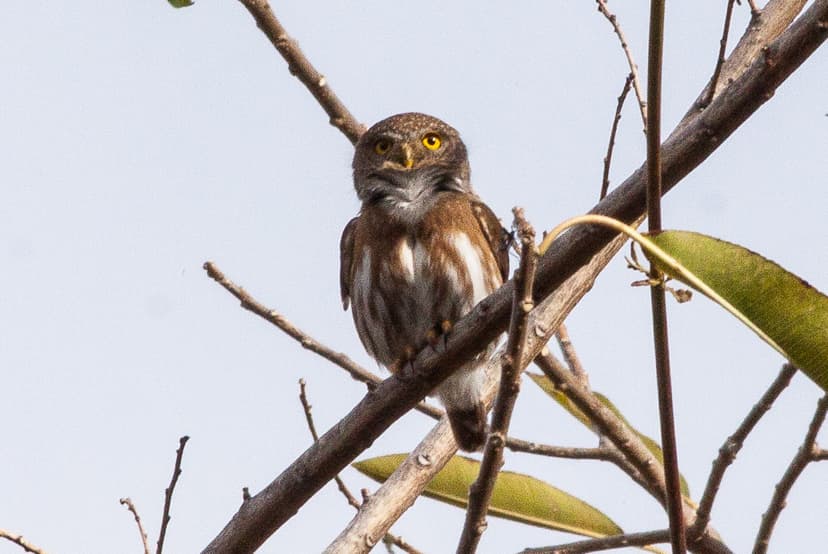
Colima pygmy owl
The Colima pygmy owl is a small owl species endemic to western Mexico, found in various forest types and coffee plantations. It is characterized by its brown plumage with white spots, distinctive "eyebrows," and a unique hooting song. While primarily nocturnal, it also exhibits daytime activity.

Cuban pygmy owl
The Cuban pygmy owl (Glaucidium siju) is a small owl species endemic to Cuba, recognized for its two color morphs: gray-brown and rufous. It inhabits various forest types and open areas across the island, from sea level to high elevations. This owl is notable for its active hunting during both day and night, feeding on a varied diet of insects, reptiles, small mammals, birds, and frogs.