
Rajah scops owl
The Rajah scops owl is a species of owl native to the islands of Borneo and Sumatra. Named after James Brooke, the Rajah of Sarawak, this owl is characterized by its fierce-looking face, dark brown plumage with black streaking, and a distinctive orange iris. Its taxonomic status is under review, with evidence suggesting it may be split into two distinct species.
Key Facts
- ›Found on the islands of Borneo and Sumatra.
- ›Named after James Brooke, Rajah of Sarawak.
- ›Distinguished by a fierce-looking face and orange iris.
- ›Inhabits montane forests above 1,100 meters.
- ›Subspecies O. b. brookii and O. b. solokensis may represent separate species.
- ›O. b. solokensis has a barking call described as 'owh' or 'owh-owh'.

Rajah Scops Owl
Montane Forests
Borneo, Sumatra
Not Specified In Text
About Rajah scops owl
The Rajah Scops Owl
The Rajah scops owl (Otus brookii) is an owl species found in the montane forests of Borneo and Sumatra. Named in honor of James Brooke, the Rajah of Sarawak, this owl is characterized by its somewhat fierce facial expression, dark brown plumage, and a striking orange iris. The species is typically found perched in the lower canopy of forests situated at elevations above 1,100 meters.
Taxonomy and Distribution
Two subspecies are recognized: O. b. brookii, the type subspecies, found on Borneo, and O. b. solokensis, inhabiting Sumatra. Current understanding of speciation patterns in the region suggests that these two subspecies may represent distinct species, a hypothesis that awaits further taxonomic confirmation. The subspecies O. b. solokensis has a considerable range throughout the Barisan Mountains. In contrast, O. b. brookii was historically known from a more limited mountainous area and had not been sighted for over 125 years until a photographically documented sighting in 2016, which also marked a new range extension for the subspecies. Further sightings were reported in 2021.
Physical Characteristics and Vocalizations
Adult Rajah scops owls have a dark brown body overall, with a blackish crown and conspicuous white ear-tufts. Their underparts are brownish with bold black streaking. The most distinctive visual feature is its vibrant orange iris. Plumage variations exist between subspecies; O. b. solokensis exhibits darker underparts, more pronounced streaking, and a less defined nuchal collar compared to O. b. brookii. The vocalizations of O. b. solokensis consist of an explosive 'owh' or 'owh-owh' barking call, lasting about half a second and repeated intermittently.
Source: Wikipedia ↗
Frequently Asked Questions
Where can the Rajah scops owl be found?
The Rajah scops owl is found on the islands of Borneo and Sumatra. Specifically, it inhabits montane forests at altitudes above 1,100 meters.
What does the Rajah scops owl look like?
Adults have a fierce-looking face, dark brown overall plumage, blackish crown, and white ear-tufts. They also possess brownish underparts with thick black streaking and a distinct orange iris.
What is notable about the Rajah scops owl's taxonomy?
There are two recognized subspecies, O. b. brookii on Borneo and O. b. solokensis on Sumatra. Patterns of speciation suggest these may represent two distinct species, though further taxonomic studies are needed.
What sounds does the Rajah scops owl make?
The subspecies O. b. solokensis is known to make an explosive 'owh' or 'owh-owh' barking call. This call lasts about a half-second and is repeated irregularly.
How is the Rajah scops owl's range distributed?
The subspecies O. b. solokensis has a wide distribution along the Barisan Mountains. The Bornean subspecies, O. b. brookii, was historically known from a smaller mountain range, but recent sightings have extended its known range.
Related Owl species

African scops owl
The African scops owl (Otus senegalensis) is a small owl native to sub-Saharan Africa, characterized by its cryptic greyish-brown plumage and bright yellow eyes. It is a strictly nocturnal hunter, often overlooked during the day due to its remarkable camouflage. Its distinctive call is a monotonous "prrrp" sound.
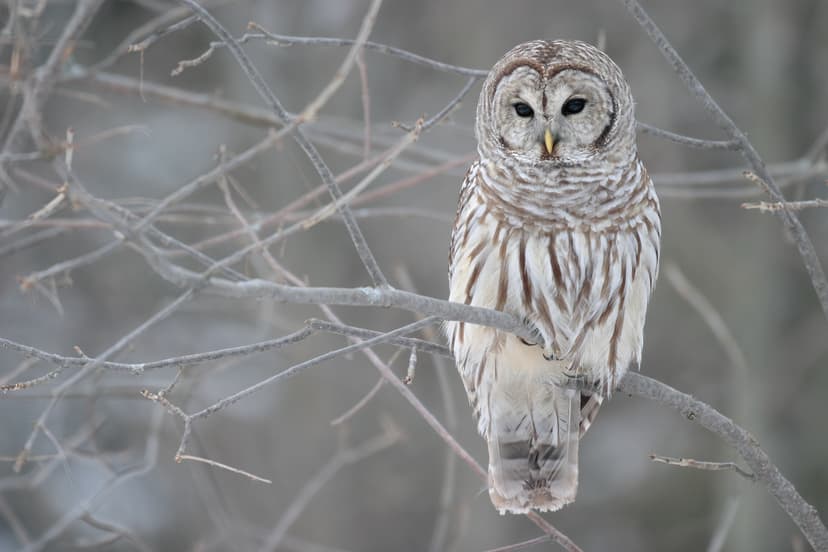
Barred owl
The barred owl (Strix varia) is a large North American owl known for its distinctive "Who cooks for you, who cooks for you all" call. Primarily found in mature forests and woodlands in eastern North America, it has expanded its range westward, where it is considered an invasive species. This owl is characterized by its brown to gray plumage with dark striping on its underside and its large, rounded head without ear tufts.

Eastern screech owl
The eastern screech owl is a stocky, short-tailed owl native to Eastern North America, found from Mexico to Canada. It is a midsized screech owl, adaptable to various woodland habitats and even urban environments, though its strictly nocturnal habits often make it elusive. Distinctive features include prominent ear tufts, yellow eyes, and a unique tremolo call.