
Red owl
The red owl (Tyto soumagnei), also known as the Madagascar red owl, is a rare owl species native to Madagascar. It is distinguished by its smaller size compared to the cosmopolitan barn owl and its rich orange plumage with small black spots. Once thought to be extremely rare, recent studies suggest it may have a wider distribution than previously believed, though it remains vulnerable due to habitat loss.
Key Facts
- ›Resembles the cosmopolitan barn owl but is smaller.
- ›Possesses rich orange plumage with small black spots.
- ›Feeds primarily on native small mammals and insects.
- ›Nests and roosts in tree cavities and along cliffs with dense vegetation.
- ›Its call is a screeching hiss with a slight downward frequency at the end.
- ›Vulnerable due to deforestation and habitat fragmentation.

Madagascar Red Owl, Madagascar Grass-Owl, Soumagne's Owl, Lesser Grass-Owl
Humid Evergreen Forest, Dry Deciduous Forest, Primary Forest, Disturbed Secondary Forest, Human Altered Open Areas, Rock Ledges In Ravines, Cave Entrances Near Degraded Vegetation
Madagascar
Native Small-Mammals, Tenrecs, Tufted-Tailed Rats, Insects, Frogs, Geckoes, Afrosoricidians, Rodents, Eastern Rufous Mouse Lemur
About Red owl
The red owl (Tyto soumagnei), also known by common names such as the Madagascar red owl or Soumagne's owl, is a species of owl belonging to the barn owl family, Tytonidae. This rare bird is endemic to the island of Madagascar. Once thought to be exceptionally scarce, its presence was largely unknown from its discovery in 1876 until its rediscovery in 1993 by researchers from the World Wide Fund for Nature. Despite recent findings suggesting a potentially wider distribution than previously understood, the red owl is currently classified as vulnerable, primarily due to significant habitat loss.
Physical Characteristics and Behavior
Resembling the more widespread barn owl, the red owl is distinguished by its smaller stature and its striking rich orange plumage, which is marked with small black spots. Its eyes are a dark, sooty-black, complemented by a pale grey beak and a flesh-colored cere. The species is known to inhabit a variety of forest types, including humid evergreen forests and dry deciduous forests, often found in primary or disturbed secondary forest areas, and even in human-altered open spaces. They exhibit reclusive behavior, which may have contributed to them being overlooked in surveys.
Diet and Vocalization
The diet of the red owl consists mainly of native small mammals, such as tenrecs and rats, differentiating it from the barn owl which often preys on introduced species. While captive individuals may consume frogs, wild red owls show a strong preference for small mammals. Their vocalization is described as a screeching hiss, similar to that of the barn owl but with a subtle downward frequency shift at the end, which helps distinguish it. These calls are made when leaving roost sites and in response to other red owls throughout the night.
Distribution and Conservation
The red owl's known distribution has expanded significantly since its rediscovery, with sightings now recorded across northern Madagascar, along the eastern half of the island, and in the southeastern lowlands. They have been observed at altitudes ranging from sea level up to 2,000 meters. This expanding range has led to the proposal that the species might be more reclusive than extremely rare. However, the overall population is estimated to be between 3,500 and 15,000 individuals, showing a decreasing trend. The primary threat to the red owl is the ongoing deforestation and fragmentation of its forest habitat, which has seen a substantial reduction in forest cover, particularly dry forests, impacting both the owls and their prey species.
Source: Wikipedia ↗
Frequently Asked Questions
What are the common names for Tyto soumagnei?
The red owl is also known by several other common names. These include the Madagascar red owl, Madagascar grass-owl, Soumagne's owl, and the lesser grass-owl.
Where is the red owl found?
The red owl is a resident of Madagascar. Its observed range has expanded with increased surveys and now includes northern Madagascar, along the eastern half of the island, and the extreme southeast lowlands.
What does the red owl eat?
The diet of the red owl primarily consists of small mammals native to Madagascar, such as tenrecs and tufted-tailed rats. While they may eat frogs in captivity, their wild diet shows little evidence of this, with a strong preference for native mammals.
What is the conservation status of the red owl?
The red owl is currently listed as vulnerable. This status is primarily due to the increasing rate of deforestation and fragmentation of its forest habitat on Madagascar.
How is the red owl's call different from a barn owl's?
The red owl's call is a screeching hiss of 1.5 to 2.0 seconds. A key distinction from the barn owl's call is a slight downward frequency modulation towards the end of its hiss.
What kind of habitat does the red owl prefer?
The red owl inhabits a range of forests, from dry deciduous to humid evergreen forests. They tend to prefer areas along the forest edge and in disturbed habitats, including rice paddies and areas cleared for cultivation, rather than closed canopy or mature forests.
Related Owl species
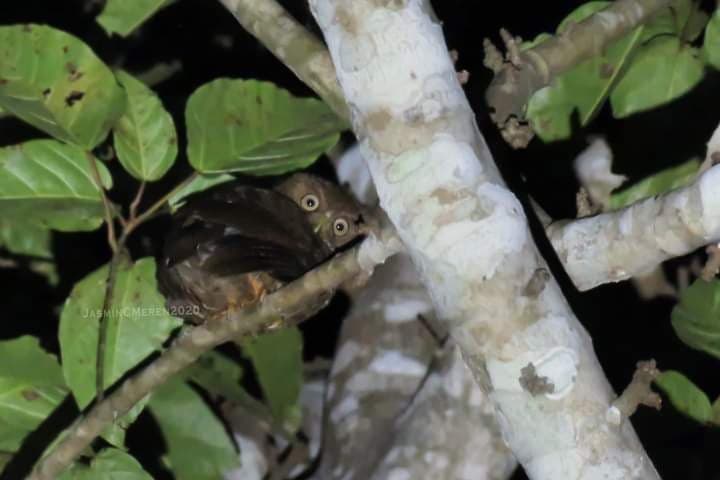
Camiguin boobook
The Camiguin boobook (Ninox leventisi), also known by its native name kugkug, is an owl species endemic to Camiguin island in the Philippines. It is distinguished by its unique greenish-yellow or grayish eyes, a trait not found in its closely related species. This species was reclassified from a subspecies of the Philippine hawk-owl in 2012 based on vocal and other evidence indicating its distinctiveness.
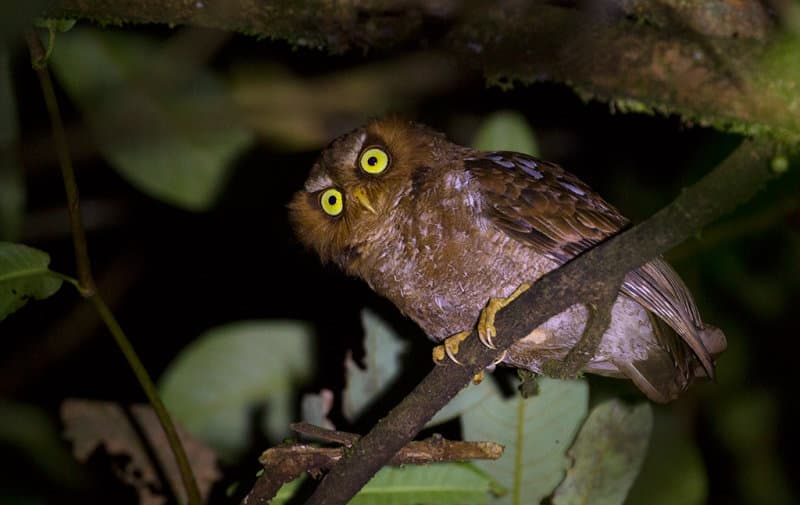
Flores scops owl
The Flores scops owl (Otus alfredi) is a small owl species found exclusively on the island of Flores in Indonesia. It is distinguished by its short, rounded ear-tufts, white forehead vermiculation, and orange-yellow beak with long, reddish rictal bristles. This vulnerable species is threatened by significant habitat loss.

Golden masked owl
The golden masked owl (Tyto aurantia) is a barn owl species native to New Britain, Papua New Guinea. It is characterized by its distinctive heart-shaped, white facial disc and is a poorly studied, largely solitary, and nocturnal predator of small mammals and insects. Habitat loss due to deforestation poses a significant threat to its vulnerable conservation status.