
Rufous fishing owl
The Rufous fishing owl is a medium-sized owl endemic to West Africa, inhabiting forest rivers and mangrove forests. This species is distinguished by its lack of ear tufts, pale cinnamon facial disc, and barred flight feathers. It is primarily nocturnal and feeds on small fish, though its habits are not extensively documented.
Key Facts
- ›Endemic to West Africa, found in Ivory Coast, Ghana, Guinea, Liberia, and Sierra Leone.
- ›Medium-sized owl, measuring 46-51 cm in length, smaller than the Pel's fishing owl.
- ›Distinctive features include lack of ear tufts, a pale cinnamon facial disc, and barred flight feathers.
- ›Primarily nocturnal, though rare diurnal activity has been observed.
- ›Feeds mainly on small fish, with catfish and freshwater crabs also noted as potential prey.
- ›Formerly classified as endangered, now listed as vulnerable due to habitat loss and fragmented populations.

Rufous-Backed Fishing-Owl, Ussher's Fishing Owl
Subtropical Or Tropical Moist Lowland Forests, Subtropical Or Tropical Mangrove Forests, Gallery Forest Along Streams, Secondary Forest, Plantations
West Africa, Ivory Coast, Ghana, Guinea, Liberia, Sierra Leone
Small Fish, Catfish, Freshwater Crabs
About Rufous fishing owl
The Rufous fishing owl (Scotopelia ussheri) is a medium-sized owl species primarily found in West Africa, where it is a localized resident along forest rivers. Also known as the rufous-backed fishing-owl or Ussher's fishing owl, this species is characterized by its lack of ear tufts, a pale cinnamon facial disc, and barred flight feathers. It inhabits subtropical or tropical moist lowland and mangrove forests, often preferring smaller, shallower rivers compared to its larger relative, the Pel's fishing owl.
Description and Behavior
Measuring between 46 to 51 cm in length, the Rufous fishing owl is distinguished by its plumage, which features a mix of rufous, creamy-buff, and white on the upperparts of its wings. While juveniles have similar markings, their initial feathers are typically paler. The owl's legs and feet are a bright yellowish-orange, and its bill is bluish-grey. Its call is a distinctive low, deep hoot that can be repeated for extended periods, and pairs may engage in duets. Though primarily believed to be nocturnal, rare instances of diurnal activity, including being photographed in a camera trap at midday, have been recorded.
Diet and Breeding
The diet of the Rufous fishing owl mainly consists of small fish, with catfish and freshwater crabs also noted as potential food sources. Breeding activity has been observed with eggs laid in Sierra Leone during September and October. Juveniles have been recorded in Liberia in July, suggesting a typical brood size of a single chick.
Distribution and Conservation
This species is endemic to West Africa, with confirmed populations in Ivory Coast, Ghana, Guinea, Liberia, and Sierra Leone. Its habitat includes forest rivers and mangrove forests, and it has also been observed in secondary forests and plantations, suggesting a degree of adaptability. Once classified as endangered, the Rufous fishing owl was downlisted to vulnerable in 2011 due to revised population estimates. However, it remains one of the rarest and least understood owl species globally, with fragmented populations continuing to decline due to habitat loss.
Source: Wikipedia ↗
Frequently Asked Questions
What is the scientific name of the Rufous fishing owl?
The scientific name of the Rufous fishing owl is Scotopelia ussheri. It was formally described in 1871 by Richard Bowdler Sharpe.
Where can the Rufous fishing owl be found?
The Rufous fishing owl is endemic to West Africa and is found in Ivory Coast, Ghana, Guinea, Liberia, and Sierra Leone. It lives along forest rivers and in mangrove forests.
What does the Rufous fishing owl eat?
The Rufous fishing owl is thought to mainly eat small fish. Catfish and freshwater crabs have also been recorded as part of its diet.
What is the conservation status of the Rufous fishing owl?
The Rufous fishing owl is currently listed as vulnerable by the IUCN. It was formerly classified as endangered but was downlisted due to new research.
What are the distinctive physical characteristics of the Rufous fishing owl?
It is a medium-sized owl with no ear tufts and an indistinct, pale cinnamon facial disc. Adults have barred flight feathers and upperparts showing a mixture of rufous, creamy-buff, and white.
What kind of sounds does the Rufous fishing owl make?
Its call is described as a low, deep, moaning or dove-like hoot. It may be repeated at regular intervals, and pairs might also duet.
Related Owl species

Christmas boobook
The Christmas boobook (Ninox natalis), also known as the Christmas Island hawk owl, is a small, rufous-brown owl endemic to Christmas Island in the Indian Ocean. It is characterized by its barred breast, dark chestnut facial mask, and a distinctive double-noted hoot. This species faces threats from habitat destruction and introduced species, leading to its vulnerable conservation status.
Mindoro boobook
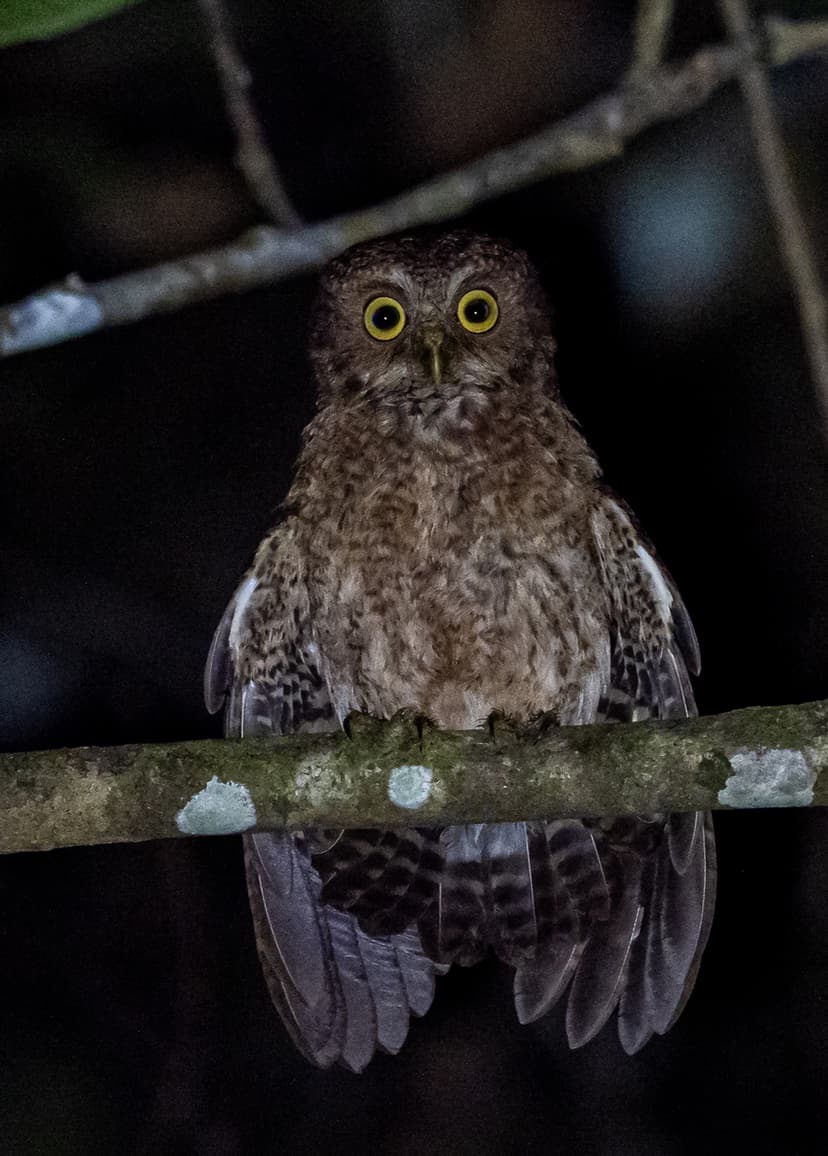
The Mindoro boobook (Ninox mindorensis) is a species of owl endemic to the Philippines, belonging to the Strigidae family. It is distinguished among Philippine hawk-owls by its darker plumage and fine barring on its head and belly. This medium-sized, earless owl inhabits tropical lowland forests and faces a conservation status of vulnerable due to significant habitat loss.

Pemba scops owl
The Pemba scops owl is a small owl species endemic to Pemba Island, off the coast of Tanzania. It is distinguished by its two color morphs, brown and rufous, and its distinctive "hoo" call. This owl is primarily nocturnal and feeds on insects, inhabiting various wooded areas including native forests and plantations.