
Rusty-barred owl
The rusty-barred owl (Strix hylophila) is a medium-sized typical owl native to Argentina, Brazil, and Paraguay. It is distinguished by its rusty brown facial discs, barred plumage, and a unique frog-like vocalization. This owl inhabits various wooded landscapes and is a nocturnal hunter of small mammals and arthropods.
Key Facts
- ›Found in Argentina, Brazil, and Paraguay.
- ›Medium-sized owl, approximately 35 cm in length.
- ›Features rusty brown facial discs with dark rings.
- ›Primarily a nocturnal hunter of small mammals, birds, and arthropods.
- ›Nests in tree cavities and lays two to three eggs.
- ›Vocalization described as a frog-like deep grunting sound.

Brazilian Owl
Montane Forest, Tropical Evergreen Forest, Temperate Forest, Secondary Forest, Pine Plantations, Wooded Landscapes
South America, Brazil, Paraguay, Argentina
Small Mammals, Birds, Arthropods, Rodents, Marsupials, Reptiles, Amphibians
About Rusty-barred owl
The rusty-barred owl (Strix hylophila) is a medium-sized owl found in the wooded landscapes of South America, specifically in Argentina, Brazil, and Paraguay. Known in Brazil as the Brazilian owl, it belongs to the genus Strix and is considered most closely related to the Chaco owl and the rufous-legged owl.
Description and Characteristics
Adult rusty-barred owls measure approximately 35 cm (14 inches) in length. Males typically weigh between 250 to 340 grams, while females are slightly heavier, ranging from 275 to 395 grams. A distinctive feature is their light rusty brown facial disc, encircled by darker brown rings, complemented by small white "eyebrows." Their plumage is characterized by barring in shades of white, brown, and orange-buff on the upperparts, with orangish buff chests and flanks, and whiter bellies, all marked by dark brown bars. Juveniles present a more uniform buff coloration with faint darker barring.
Habitat and Distribution
This owl inhabits a variety of wooded environments, including montane, tropical evergreen, and temperate forests, as well as secondary forests and pine plantations. They are found from sea level up to at least 1,000 meters (3,300 feet) in elevation. Their range extends through southeastern Brazil from Minas Gerais to Rio Grande do Sul, across southeastern Paraguay, and into the extreme northeastern Misiones Province of Argentina. The rusty-barred owl is adaptable and can be found in proximity to human habitation.
Behavior and Diet
The rusty-barred owl is a nocturnal hunter, actively foraging during the night. While its diet has not been exhaustively studied, it is known to include small mammals, birds, and arthropods. Rodents constitute a significant portion of their prey, with marsupials making up most of the remainder. It is also believed to consume reptiles and amphibians. They have been observed foraging in the forest canopy.
Reproduction
The breeding season for the rusty-barred owl generally occurs between August and October, although it has also been recorded between December and March. They nest in pre-existing cavities within trees. The female incubates a clutch of two to three eggs for a period of 28 to 29 days. The male plays an active role in provisioning the female and nestlings, and is also reported to brood the young.
Vocalization
A notable characteristic of the rusty-barred owl is its distinct vocalization. Its song is described as a "frog-like deep grunting 'grugruu-grugruugrugru'." Both sexes participate in singing, sometimes in duets. Additional calls include a "rrrrroh" sound and a long-drawn "i-ew-eh."
Conservation Status
The International Union for Conservation of Nature (IUCN) has assessed the rusty-barred owl as Least Concern. However, the species faces threats from habitat loss due to burning and logging, which is contributing to a presumed decrease in its population. Despite these challenges, the owl does occur within several protected areas within its range.
Source: Wikipedia ↗
Frequently Asked Questions
Where does the rusty-barred owl live?
The rusty-barred owl is found in southeastern Brazil, southeastern Paraguay, and the northeastern Misiones Province of Argentina. It inhabits a variety of wooded environments, including forests and pine plantations, and can be found near human settlements.
What does a rusty-barred owl look like?
Adults are about 35 cm long with light rusty brown facial discs and white 'eyebrows'. Their upperparts are barred with white, brown, and orange-buff, while their chest and belly are orangish buff with dark brown bars. They have dark brown eyes and a yellowish horn bill.
What does the rusty-barred owl eat?
As a nocturnal hunter, its diet includes small mammals, birds, and arthropods. Studies indicate that rodents make up a significant portion of its prey, with marsupials forming most of the remainder. It is also believed to consume reptiles and amphibians.
What sounds does the rusty-barred owl make?
The rusty-barred owl's song is characterized by a 'frog-like deep grunting 'grugruu-grugruugrugru'.' Both males and females sing, sometimes in duets. They also produce 'rrrrroh' sounds and long-drawn 'i-ew-eh' calls.
How does the rusty-barred owl breed?
Breeding typically occurs between August and October, though it has also been reported from December to March. The female incubates a clutch of two or three eggs in a tree cavity for 28 to 29 days. The male provides food for the female and nestlings.
What is the conservation status of the rusty-barred owl?
The IUCN has classified the rusty-barred owl as Least Concern. Despite this, its population is thought to be declining due to habitat loss from burning and logging, and it has a somewhat restricted geographic range.
Related Owl species
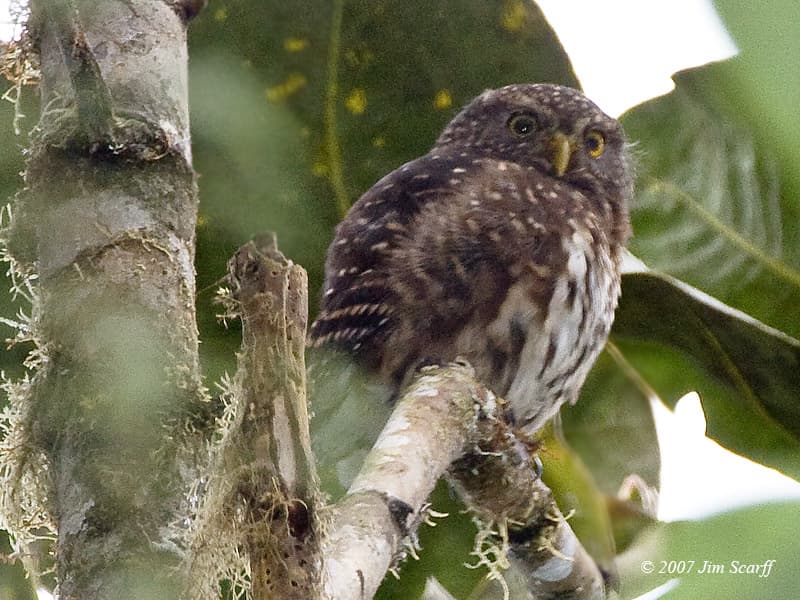
Andean pygmy owl
The Andean pygmy owl is a small owl species native to the Andes mountains of South America, found in countries like Colombia, Ecuador, Peru, and Venezuela. It is distinguished by its two color morphs, white facial markings including prominent "brows" and "moustaches," and a distinctive face-like pattern on its nape. This owl is an opportunistic predator, active both day and night, feeding on a variety of small invertebrates, birds, and mammals.
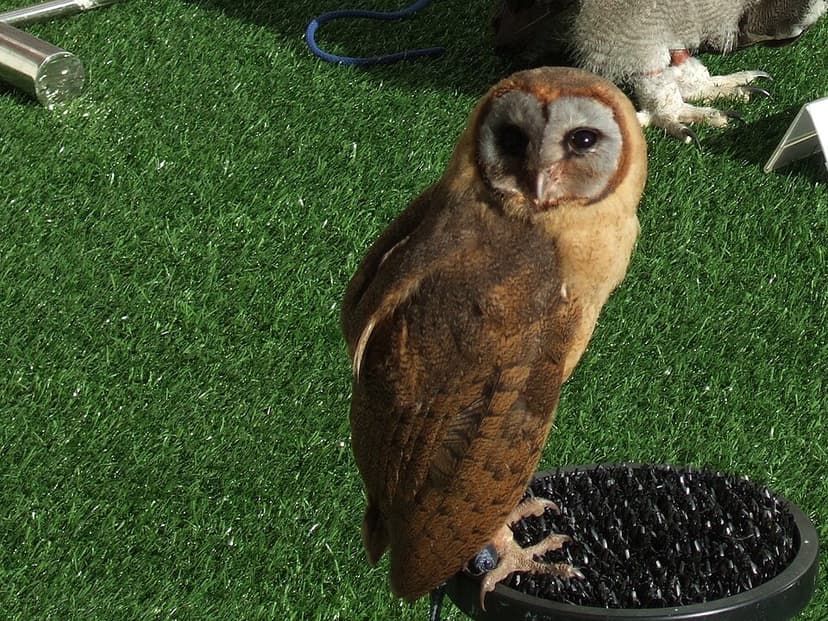
Ashy-faced owl
The ashy-faced owl (Tyto glaucops) is a species of barn owl native to Hispaniola and several islands in the Lesser Antilles. It is distinguished by its silvery-gray facial disc (in the nominate subspecies), a preference for a mix of open hunting spaces and canopy cover, and a varied diet of small vertebrates and invertebrates. This species plays a crucial role as a nocturnal predator in its island ecosystems.

Austral pygmy owl
The austral pygmy owl is a small owl species found in central and southern Chile and parts of southern Argentina. It is distinctive for its gray-brown and red color morphs and its ability to hunt both during the day and at night. This owl is known for its varied vocalizations, including contact whistles, territorial trills, and courtship calls.