
Serendib scops owl
Strigiformes·Declining (implied due to habitat loss and degradation)
The Serendib scops owl (Otus thilohoffmanni) is a recently discovered bird species native to the rainforests of Sri Lanka. It is distinguished by its lack of ear-tufts and a weakly defined facial disc, setting it apart from other scops owls in the region. This nocturnal hunter plays a role in Sri Lankan currency, appearing on the 20 rupee bank note.
Key Facts
- ›First new bird discovered in Sri Lanka since 1868.
- ›Lacks the prominent ear-tufts found on other Sri Lankan scops owls.
- ›Inhabits the rainforests of southwestern Sri Lanka.
- ›Primarily hunts insects like beetles and moths during the first two hours of darkness.
- ›Its population is very small, with only 80 individuals known to exist in 2006.
- ›Appears on the 20 Sri Lankan rupee bank note.
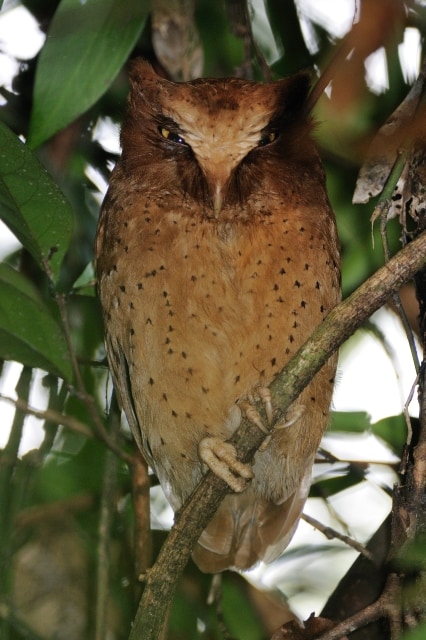
Serendib Scops Owl, පඬුවන් බස්සා
- Southern rainforests of Sri Lanka
- Rainforests in the southwestern part of Sri Lanka
- Protected areas
Sri Lanka
Insects, Beetles, Moths
About Serendib scops owl
The Serendib scops owl (Otus thilohoffmanni) is a recently identified bird species native to the island of Sri Lanka. Its discovery marked the first new bird to be found in the country since 1868, highlighting its significance in Sri Lankan ornithology. The species is recognized as a distinct endemic bird to Sri Lanka.
Discovery and Taxonomy
The Serendib scops owl was initially identified by its distinctive "poo-ooo" call in the Kitulgala rainforest by ornithologist Deepal Warakagoda. It took several years for the owl to be visually confirmed and formally described as a new species in 2004. While its existence was initially met with some academic discussion regarding its taxonomic status, subsequent research and publications have confirmed it as a valid and unique species. Apart from Kitulgala, it has also been recorded in the Sinharaja, Runakanda Reserve, and Eratna Gilimale areas.
Habitat and Behavior
This rare owl inhabits the southern rainforests of Sri Lanka, specifically in the southwestern regions, with an altitudinal range typically between 30 and 50 meters. It is a strictly nocturnal species, hunting for its food during the first few hours after sunset. Its diet primarily consists of insects, such as beetles and moths, which it catches close to the ground. The species exhibits a unique calling pattern, beginning at dusk and increasing in frequency again approximately two hours before dawn.
Physical Characteristics
Distinctive features of the Serendib scops owl include the absence of prominent ear-tufts, a characteristic present in other scops owl species found in Sri Lanka. Its facial disc is only weakly defined. The owl measures about 16.5 cm (6.5 inches) in length and has a short tail. Its general coloration is reddish-brown with paler underparts, all finely spotted with black markings. The irides are tawny yellow, with males exhibiting a more orangish hue, and its feet are a pale fleshy color. The upper portion of the tarsi is feathered, and both the claws and bill are pale ivory.
Conservation and Cultural Significance
The Serendib scops owl faces threats from habitat loss and degradation, leading to a declining population. In 2006, only an estimated 80 individuals were known to exist. Despite its elusive nature and precarious conservation status, the Serendib scops owl holds a place in Sri Lankan culture, notably appearing on the 20 Sri Lankan rupee bank note (2010 series).
Source: Wikipedia ↗
Frequently Asked Questions
When was the Serendib scops owl discovered?
The Serendib scops owl was first located by its call in the Kitulgala rainforest and was formally described as a new species in 2004, six years after it was first seen in 2001.
What makes the Serendib scops owl different from other scops owls in Sri Lanka?
Unlike the Indian scops owl and the oriental scops owl found in Sri Lanka, the Serendib scops owl does not possess ear-tufts, and its facial disc is only weakly defined.
Where does the Serendib scops owl live?
This owl inhabits the rainforests in the southwestern part of Sri Lanka, specifically in areas like Sinharaja, Kitulgala, Runakanda Reserve, and Eratna Gilimale.
What is the conservation status of the Serendib scops owl?
The Serendib scops owl is considered to be declining due to habitat loss and degradation, and its population is known to be very small.
What does the Serendib scops owl eat?
As a nocturnal hunter, the Serendib scops owl primarily feeds on insects, including beetles and moths, hunting close to the ground.
Related Owl species
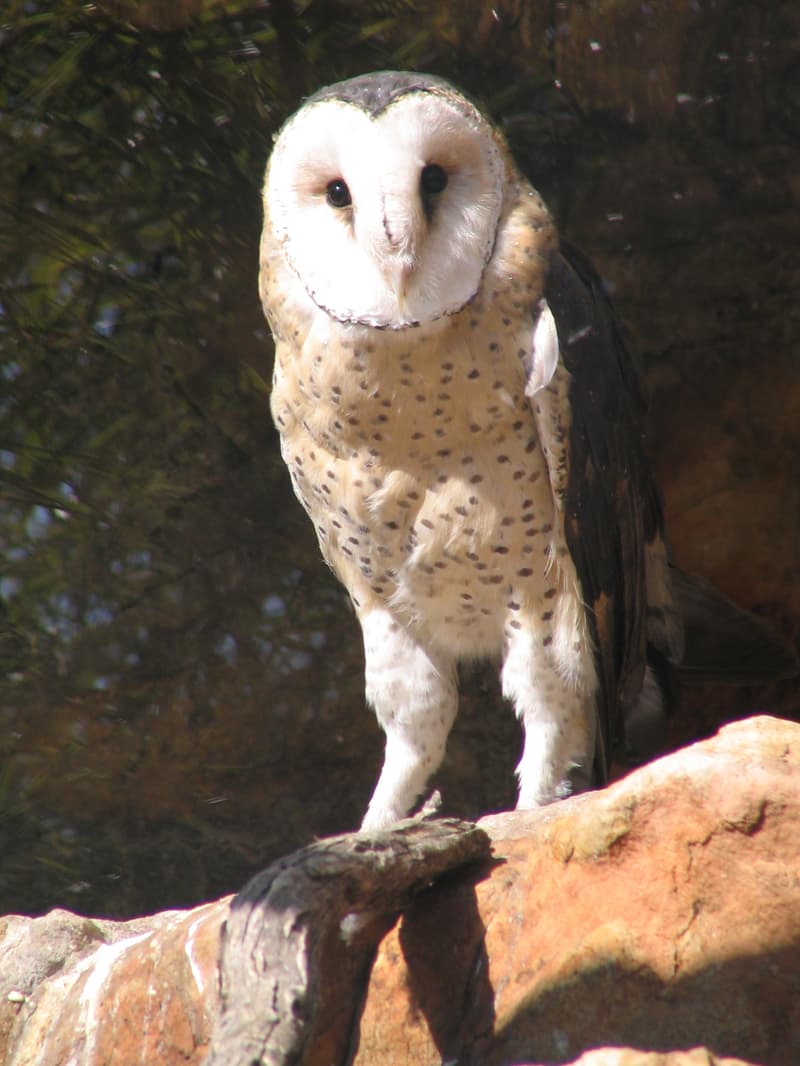
African grass owl
The African grass owl (Tyto capensis) is a medium-sized owl found in sub-Saharan Africa, known for its uniform sooty blackish-brown upperparts and heart-shaped facial disc. It primarily inhabits moist grasslands and savannas, where it hunts rodents and other small mammals at night.

African scops owl
The African scops owl (Otus senegalensis) is a small owl native to sub-Saharan Africa, characterized by its cryptic greyish-brown plumage and bright yellow eyes. It is a strictly nocturnal hunter, often overlooked during the day due to its remarkable camouflage. Its distinctive call is a monotonous "prrrp" sound.

African wood owl
The African wood owl (Strix woodfordii), also known as Woodford's owl, is a common forest owl species native to sub-Saharan Africa. It is distinguished by its rounded head, large dark eyes with white eyebrows, and a distinctive hooting call that can be heard over long distances. This owl is strictly nocturnal and primarily inhabits indigenous forests and woodlands.