
Snowy owl
Strigiformes·Declining
The snowy owl, also known as the polar owl, is a large, predominantly white owl native to the Arctic regions of North America and Eurasia. It is distinguished by its striking white plumage, which provides camouflage in its snowy habitat, and its adaptation to hunting during daylight hours, particularly in summer. Its breeding success is closely linked to lemming populations, though it can adapt to other prey when necessary.
Key Facts
- ›Largest avian predator of the High Arctic and one of the largest owls globally.
- ›Primarily white plumage, with males typically purer white than females who have dark brown flecks.
- ›Often active during the day, unlike most owl species.
- ›Breeding success is heavily dependent on the availability of lemmings.
- ›Nests on the ground on small rises in the tundra.
- ›Undergoes significant population fluctuations tied to prey availability.

Polar Owl, White Owl, Arctic Owl
Arctic Tundra
North America, Palearctic
Lemmings, Small Mammals, Water Birds, Carrion
About Snowy owl
The snowy owl (Bubo scandiacus), also known as the polar owl, white owl, or Arctic owl, is a large and striking owl species native to the Arctic regions of both North America and the Palearctic. It is distinguished by its predominantly white plumage, a rarity among owls, which serves as exceptional camouflage in its snowy environment. This species is one of the largest owls in the world and is the largest avian predator of the High Arctic.
Adaptations and Behavior
Unlike most owl species that are nocturnal, the snowy owl is often diurnal, meaning it is active during the day, particularly during the summer months. This adaptation is crucial for hunting in the continuous daylight of the Arctic summer. The snowy owl exhibits a remarkable flexibility in its hunting strategy, acting as both a specialized and a generalist predator. Its breeding success and population dynamics are closely linked to the availability of its primary prey, tundra-dwelling lemmings. However, during the non-breeding season, and sometimes even during breeding periods, snowy owls can adapt to a varied diet that includes other small mammals and water birds, as well as opportunistically consuming carrion.
Physical Description
The snowy owl's plumage is its most distinctive characteristic. Adult males are generally pure white, while females and juveniles typically display more extensive dark brown flecking and barring, especially on the wings and underparts. This plumage can make them appear like lumps of snow when at rest. They have bright yellow eyes and a relatively small head with shallow facial discs. Their toes are densely feathered, and their claws are black, adaptations that likely assist in navigating and hunting in cold, snowy conditions.
Reproduction and Lifespan
Snowy owls typically nest on the ground, selecting a small rise on the tundra. They lay a large clutch of eggs, usually between 5 and 11, with hatching and development occurring over a staggered period. Despite the short Arctic summer, young owls require a considerable time to mature and become independent by autumn. Information regarding the typical lifespan of snowy owls in the wild or captivity is not detailed in available records.
Range and Migration
These owls are nomadic birds, often not breeding at the same locations or with the same mates year after year, and may not breed at all if prey is scarce. They are largely migratory, capable of wandering far into areas near the Arctic and sometimes irrupting in large numbers to more southerly regions. This unpredictable movement makes surveying and understanding their population status historically challenging.
Conservation Status
Recent data from the 2010s and 2020s indicates a precipitous decline in the snowy owl population. Global estimates have fallen significantly, with concerns arising from complex environmental factors, often correlated with global warming, that are believed to be impacting the species' fragility. The exact causes of this decline are not yet fully understood.
Taxonomy and Evolution
Originally described by Carl Linnaeus in 1758, the snowy owl's taxonomic classification has seen some debate. Historically placed in its own genus, Nyctea, genetic studies suggest it is closely related to the true owls in the genus Bubo. While some authorities prefer to maintain the separate genus Nyctea due to osteological distinctions, others include it within Bubo. Genetic evidence indicates that the snowy owl may have diverged from related species around 4 million years ago, with the great horned owl (Bubo virginianus) being its closest living relative.
Fossil History
Fossil records indicate that snowy owls once had a much wider distribution, extending further south during the Quaternary glaciation. Fossils have been found across Europe and parts of Asia, suggesting a significant presence during ice age periods. Some Pleistocene-era fossils from France suggest that ancient snowy owls were somewhat larger and exhibited more pronounced sexual dimorphism in size than their modern counterparts.
Source: Wikipedia ↗
Frequently Asked Questions
What are the different names for the snowy owl?
The snowy owl is also commonly referred to as the polar owl, the white owl, and the Arctic owl. Its scientific name, Bubo scandiacus, reflects its classification and geographic association.
What is distinctive about the snowy owl's appearance?
The snowy owl's most striking feature is its predominantly white plumage, which is unique among owl species. Males are generally purer white, while females and juveniles tend to have more dark brown flecks and barring.
When is the snowy owl most active?
Unlike most owls that are nocturnal, the snowy owl is often active during the day, especially during the Arctic summer. This adaptation allows it to hunt effectively in its environment.
What does the snowy owl eat?
The snowy owl is a specialized and generalist hunter. Its diet is closely tied to lemmings during the breeding season, but it will opportunistically prey on other small mammals, water birds, and carrion during other times.
Where does the snowy owl build its nest?
Snowy owls typically construct their nests on the ground, choosing a small rise on the tundra. This ground-nesting habit is common for the species.
Are snowy owls migratory?
Yes, snowy owls are largely migratory birds. They are nomadic and can wander extensively, sometimes irrupting in large numbers to the south during non-breeding seasons.
What is the conservation status of the snowy owl?
Recent data suggests that the snowy owl population is declining precipitously. While exact causes are complex and not fully understood, environmental factors correlated with global warming are considered a significant concern.
Related Owl species

Burrowing owl
The burrowing owl (Athene cunicularia) is a small, long-legged owl found in open landscapes across North and South America. Unlike most owls, they are often active during the day and are known for their unique habit of living in burrows, often those excavated by other animals. Their adaptive behaviors and reliance on specific habitats make them a subject of conservation interest.
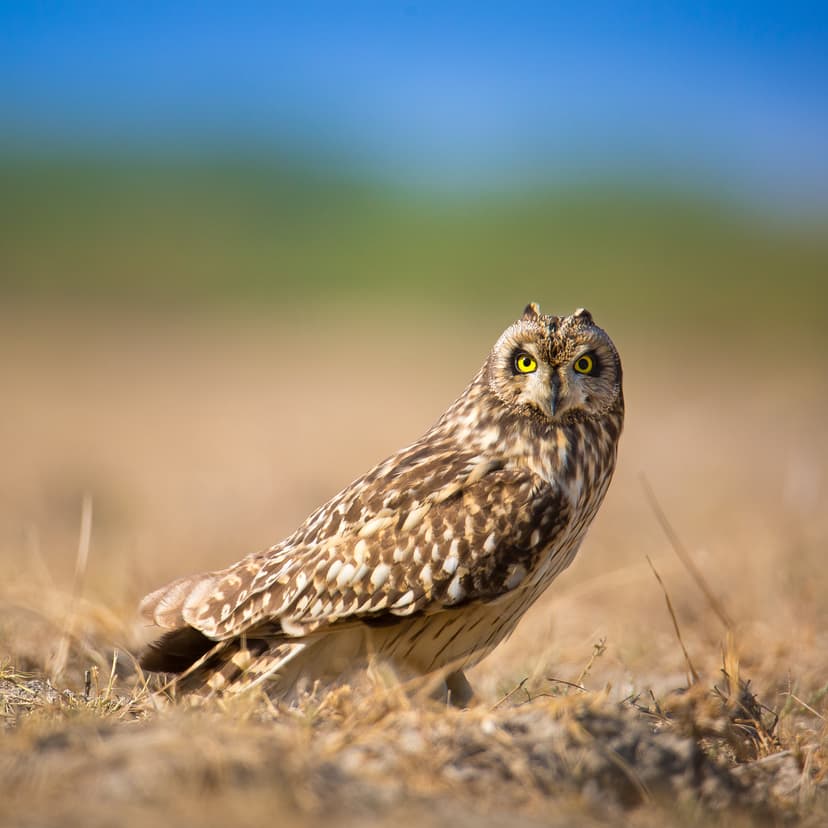
Short-eared owl
The short-eared owl (Asio flammeus) is a widely distributed grassland species known for its distinctive "ear" tufts, which are usually not visible but can be displayed when defensive. This medium-sized owl is found on open country and grasslands across most continents, feeding primarily on rodents like voles.

Boreal owl
The boreal owl, also known as Tengmalm's owl, is a small owl found in the taiga forests of North America and Eurasia. It is distinguished by its pearly-white spots on brown plumage, remarkable confiding nature when encountered, and a unique asymmetrical skull structure that aids in pinpointing prey.